

- Pulizia tecnica
- Tradotto con IA
Riprodurre superfici lucide perfette in modo riproducibile e rispettoso delle risorse
Elettropolitura a secco – più sostenibilità nella lavorazione delle superfici
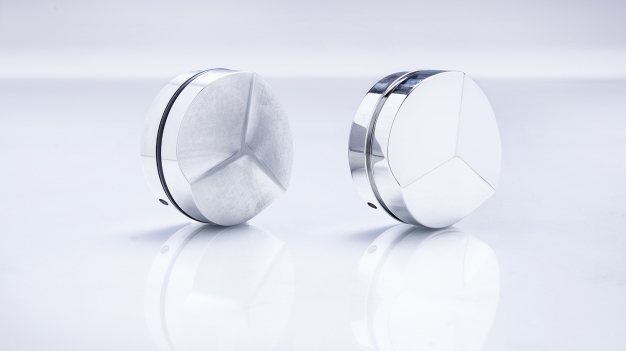
La lucidatura elettrochimica a secco è anche ideale per la finitura di prodotti lifestyle, come questo tampone. / The dry electropolishing technology is also ideal for finishing life style products, like this tamper. ©Rösler
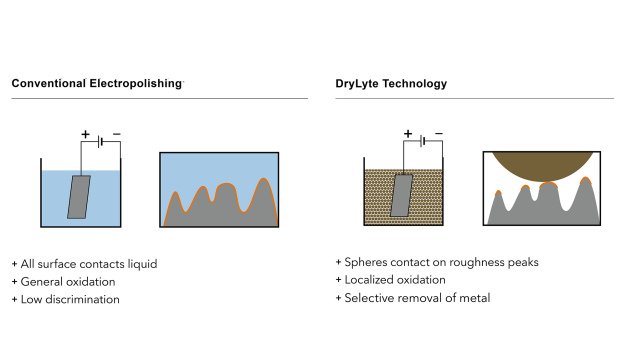
A differenza dei sistemi di elettropolishing convenzionali, nel processo di elettropolishing a secco DryLyte, il materiale viene rimosso solo dalle punte di rugosità della superficie del pezzo. Pertanto, il tasso di rimozione del materiale è molto basso. Ciò garantisce che l'integrità geometrica dei pezzi non venga compromessa. © Rösler
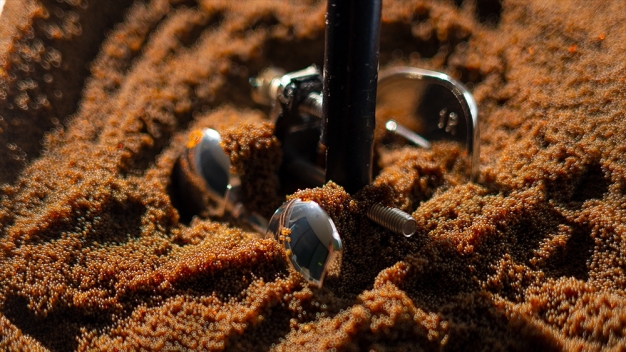
Con l'elettropolitura a secco si possono ottenere superfici lucide perfette in modo ripetibile e con un risparmio di risorse, in tempi di processo ridotti. / The dry electropolishing technology enables the reproducible and resource-saving generation of perfect high-gloss surfaces in short process times. ©GPA Innova
Rising demands on surface quality alongside higher requirements for reproducibility, traceability, and resource efficiency of processes necessitate adapted procedures for surface finishing. With the DryLyte process, Rösler Oberflächentechnik offers an innovative solution for electro-polishing demanding metallic components. Unlike traditional electrochemical polishing methods, the automated treatment is carried out with electrolytic, solid particles in a dry environment. Acid wheels or process liquids are completely eliminated. Among the advantages are high geometric accuracy and an overall improved surface finish, along with a reduced CO2 footprint and lower disposal costs. The costly and complex preparation of used process liquids is entirely eliminated, and the workpieces come out clean from the processing.
Whether optical or functional properties – surface treatment faces many challenges. On the one hand, higher requirements for surface roughness and geometric accuracy of the component must be met, but simultaneously, the process must fulfill economic and ecological criteria. Topics such as energy consumption and resource use, as well as the avoidance of potentially hazardous substances and waste, are increasingly in focus. In many cases, reproducible and fully traceable processes are also required. Procedures such as manual processing or classical electro-polishing with liquid electrolytes cannot or only partially meet these requirements. An innovative solution for the reproducible treatment of demanding and geometrically complex components made of conductive metals is the innovative DryLyte technology from GPA Innova, a partner of Rösler Oberflächentechnik.
From deburring to high-gloss polishing – sustainable and efficient
The automated process simplifies and standardizes various surface treatments, from deburring, grinding, and polishing to mirror finish polishing, as well as post-processing of additively manufactured components. Dry electro-polishing can be used either as a finishing process in combination with known lapping, blasting, and other pre-sanding procedures or alone, depending on the initial surface condition and desired result.
The DryLyte technology is based on the principle of electrochemical surface removal. However, instead of liquid electrolytes, a variety of differently sized polymer beads with an application-adapted, integrated electrolyte medium are used for metal removal. Unlike traditional electro-polishing, no hazardous fumes are generated, which would require energy-intensive extraction and special protective equipment for personnel. Since the material removed from the surface is absorbed by the electrolyte medium, no dust or metal particles, as in manual grinding and polishing processes, are released into the environment. A stable processing result is achieved throughout the lifespan of the electrolyte medium. Replacement is only necessary when the dry electrolyte becomes saturated due to metal ingress, after which disposal is similar to that of grinding media. The saturation level of the electrolyte is monitored by the machine, and the operating personnel are continuously informed about the condition and remaining usage time. This ensures that reproducible results are always achieved on the component and that the electrolyte is used optimally. This reduces labor and disposal costs. Simultaneously, due to high resource efficiency, the product’s carbon footprint is reduced.
Precise, gentle, and geometry-preserving processing
During dry electro-polishing, the fixed components move slowly through the electrolyte medium, ensuring homogeneous agitation. Depending on the component, internal processing can also be performed using special electrodes. Material removal primarily occurs from surface roughness peaks due to the process, resulting in comparatively low and very gentle material removal. The processed components exhibit a homogeneous surface without marks, patterning, or orange peel effects. Even with delicate and complex geometries, no micro-scratches or cracks occur during processing.
The targeted and "controlled" processing ensures that, for example, precision parts such as machine tools and tools for the pharmaceutical industry do not alter their geometry or edges are not rounded. Conversely, effective surface smoothing minimizes the formation of cracks and craters, resulting in improved corrosion and fatigue resistance and thus longer component lifespan. Compared to conventionally electro-polished workpieces, dry-polished parts corrode 4 to 15 times more slowly (corrosion tests were conducted in a saline solution with 30 g/L NaCl). For components such as gears used in mechanical systems, the treatment also improves sliding properties through rapid load-sharing and achieves an optimal distribution of lubricants on the surface. Wear and noise emissions are also significantly improved through better surface quality.
Another advantage of the DryLyte technology is the relatively short process times. Depending on the application, initial roughness, and desired result, times range from a few minutes up to 1.5 hours. Surfaces can not only be smoothed but also polished to a high gloss in a single manufacturing step. Very rough surfaces, such as those of additively manufactured components, are typically prepared by an abrasive lapping process.
Adaptable to many applications
The unrivaled and patented process was originally developed for the treatment of model castings and crowns made of cobalt-chromium and titanium in the dental industry. Today, GPA Innova’s dry electro-polishing is also used for the treatment of stainless steel, steel, hard metals, nickel, aluminum, and copper alloys, as well as other conductive metals in various industries where high surface quality requirements are imposed, such as aerospace, pharmaceuticals, mechanical engineering, and the consumer and luxury goods industries. Furthermore, due to its proven biocompatibility, it is also used in medical technology for manufacturing implants and instruments.
The process design and parameter setting are tailored to the components and application in Rösler’s Customer Experience Center. Different systems are available for automated processing, ensuring that all parts are processed with defined or validated parameters.
Rösler Oberflächentechnik GmbH
96190 Untermerzbach
Germania