




- Translated with AI
X-ray holography in flight
A new method of X-ray holography produces images of particles in the gas phase
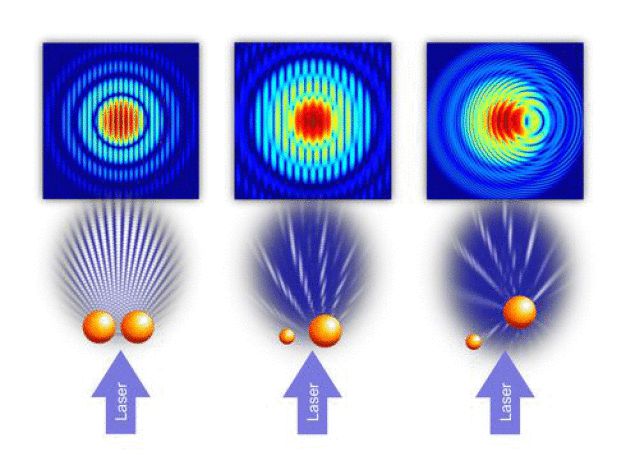
(Image on the left) X-ray radiation is scattered by two spheres and forms a characteristic interference pattern known as a hologram. (Image in the middle) Changes in the size or distance of the spheres are directly reflected in the hologram and can also be recalculated from it. (Image on the right) If the two spheres are not in the same plane, the interference fringes change into curved lines, from which the three-dimensional arrangement can be reconstructed. In "In-Flight Holography," the smaller sphere is used as a holographic reference, and the larger one is replaced by the sample under investigation. From the hologram, not only the distance but also the structure of the sample can be recovered through the characteristic interference. (© Tais Gorkhover & Anatoli Ulmer)
Scientists in the research group of Prof. Thomas Möller at the Institute of Optics and Atomic Physics of TU Berlin, together with an international team, have succeeded in developing a new type of holography, called "In-Flight Holography." With this special form of X-ray holography, they were able to produce high-resolution images of nanoviruses for the first time, which previously did not need to be fixed to a surface — meaning they were "in flight."
Holography, in the broadest sense, is based on interference — that is, superposition — of light beams. A hologram is created when light scattered by an object is superimposed with a reference beam. This superposition leads to unique interference patterns, from which, with the help of special algorithms, information about the structure of the object can be calculated. For example, in optical holography, the three-dimensional structure of an object can be determined.
In the X-ray range, holography is a powerful tool and allows, without much computational effort, unique insights into the structure of tiny particles such as viruses and other nanoparticles. "A disadvantage: Until now, samples only a few nanometers in size had to be fixed to a surface. This can be problematic for biological and sensitive samples, such as viruses, because any form of fixation automatically alters the sample. The resulting image therefore does not reflect the original state," explains Anatoli Ulmer, co-author of the study and doctoral student at Prof. Möller's chair at TU Berlin.
"What is special about our method is, on the one hand, that we investigate nanoparticles without needing to alter them beforehand. Additionally, the method allows for a clear and simple reconstruction of the sample and is less susceptible to background noise and other disturbances compared to non-holographic approaches," says Anatoli Ulmer.
In this study, the researchers demonstrated that X-ray holography can also be successfully applied to non-fixed nanoclusters in the gas phase. The experiment was led by Dr. Tais Gorkhover, Prof. Dr. Christoph Bostedt, and Anatoli Ulmer at the Linac Coherent Light Source (LCLS) X-ray laser in California and was selected for the cover of the March issue of Nature Photonics.
A reference object was added to the virus sample to create the conditions for a holographic recording. The reference consisted of so-called nanoclusters: spherical nanoballs made of xenon.
Both the nanoviruses and the nanoclusters were injected together into the focus of the X-ray laser. The sample was irradiated with a laser pulse in the order of 100 femtoseconds (1 femtosecond = 10-15 seconds). The X-ray radiation was scattered by both the nanoclusters and the viruses. The resulting interference patterns of the scattered light were recorded with a special camera and contain information about the structure of the virus.
"Without holography, the scattering images would have to be analyzed in thousands of steps using complex algorithms. The structure then results from averaging hundreds of possible solutions. In contrast, our holograms can be unambiguously interpreted in just two steps," adds Dr. Tais Gorkhover, the first author of the study, the lead scientist of the team assembled for the experiment, and a former employee of TU Berlin, currently conducting research at Stanford University in the USA.
In the long term, this holographic method could open new avenues for studying nanoparticles that play a major role in air pollution, combustion mechanisms, and catalysis.
*Publication: Femtosecond X-ray Fourier holography imaging of free-flying nanoparticles; Nature Photonics, Volume 12, pages 150–153 (2018), DOI: 10.1038/s41566-018-0110-y
Technische Universität Berlin
10587 Berlin
Germany