- Translated with AI
Watch metals freeze in real time
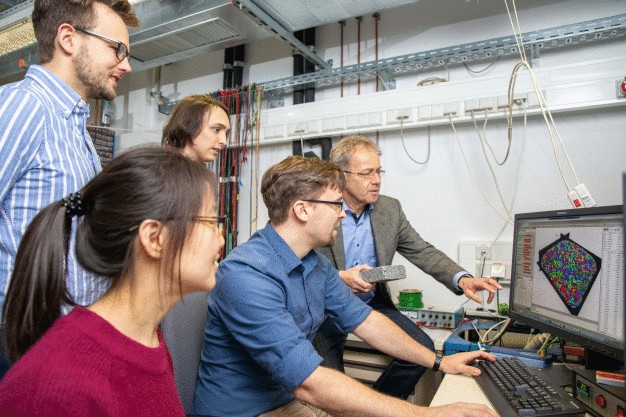
The team of Prof. Dr. John Banhart (1st from right) holds the world record in 3D X-ray tomography. The staff can currently capture 50 tomograms per second. (© TU Berlin/PR/Felix Noak)
Materials scientists aim to better understand dendritic growth using 3D X-ray tomography and plan to increase the speed of acquiring X-ray tomograms by a factor of twenty.
When observing metal as it solidifies, it looks as if countless small trees are growing. These structures are called dendrites, derived from the Greek word déndron for tree. That’s why science also refers to this as dendritic growth. This solidification process is highly complex and still not fully understood. However, to observe it, X-rays are required because only they can penetrate metal. For deciphering the solidification process, a suitable method called 3D X-ray tomography is now available, as dendritic growth is a three-dimensional process that occurs extremely rapidly.
3D X-ray tomography is extremely fast. Currently, the team of Prof. Dr. John Banhart can record 50 tomograms per second. This is a world record. "But for dendritic growth, it’s still not fast enough," says the head of the TU department for Structure and Properties of Materials. "We want to achieve 1,000 tomograms per second and thus apply tomography to the solidification process of metals for the first time, to better understand it." The term 'tomography' was recently coined by Banhart’s team. They want to express the enormous speed they are now able to achieve and linguistically distinguish it from the slower precursor – 3D tomography.
The German Research Foundation (DFG) classified this research as "particularly innovative" and approved a "Reinhart Koselleck Project." With this DFG funding line, researchers recognized for their scientific achievements are given the opportunity to pursue high-risk projects. The Reinhart Koselleck Project is funded by Prof. Dr. John Banhart through the DFG over five years with a total of 750,000 euros.
In 3D tomography, three-dimensional X-ray tomograms are recorded in fractions of a second and processed into a 3D film. John Banhart and his research group already have extensive experience applying this technique to the study of metal foams. This material is used, for example, in damping elements in mechanical engineering and lightweight construction. There are also initial approaches to encasing motors in electric vehicles in metal foam to protect them from penetrating objects that could cause a short circuit and thus an explosion.
Like almost all foams, metal foam tends to be unstable. The beautiful foam head on beer disappears faster than one would like, and in the bathtub, you can literally watch the bubbles burst. "Dreams are foams," as the saying goes colloquially. This instability of foam also challenges materials scientists like Prof. Dr. John Banhart. "Metal foams are made from metal powder and a blowing agent. The blowing agent is also a powder made of metal and hydrogen. Both are mixed, compacted, and heated, which releases hydrogen from the blowing agent, causing the mixture to foam. During solidification, the bubbles burst and grow together into larger bubbles. This is an undesirable process because it deteriorates the mechanical properties of the material," explains John Banhart. Using 3D tomography, his team has succeeded in describing why the bubbles burst: the cause is local pressure increases around the blowing agent particles. "Therefore, we are researching a new blowing agent that distributes more evenly in the metal and produces the foam more gently," says Banhart.
Another application of tomography involves processes where metal is melted in a very short time using a laser beam. This includes laser welding and cutting, as well as additive manufacturing, also known as 3D printing, where material is deposited layer by layer to form a component. John Banhart’s team aims to use 3D X-ray tomography to investigate what happens during the brief melting and re-solidification phases.
A second focus will be to mathematically process the enormous amounts of data generated—several terabytes per minute—in a way that also yields insights. "We are facing a tremendous challenge," says John Banhart. The third research focus is the development of functional and portable experimental setups that can be used to make recordings at the synchrotron of the Paul Scherrer Institute in Switzerland. John Banhart explains, "We need intense X-ray light, and this can only be provided by synchrotrons."
Technische Universität Berlin
10587 Berlin
Germany