



- Science
- Translated with AI
Virtual labs – Working with expensive equipment and dangerous experiments also for students
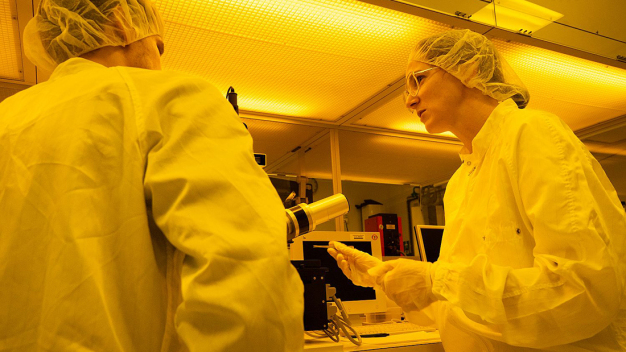
Christina Schindler and Cornelius Weiß at the real ellipsometer in the cleanroom. (Photo: Mark Siaulys Pfeiffer)
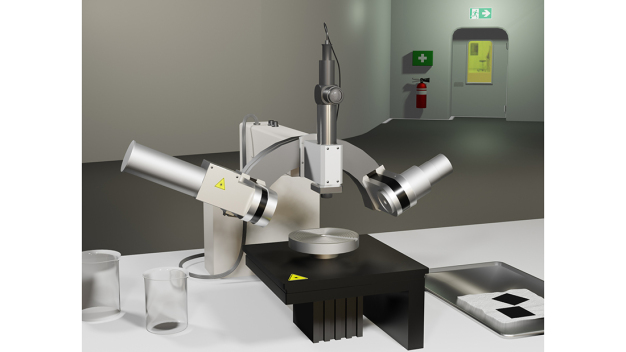
Like in reality: A complete digital twin already exists of the ellipsometer, which is located in the laboratory cleanroom. (Graphic: Corneliu Weiß)
Hybrid labs can expand the limited resources of physical laboratories, which require space and financial means, by adding a virtual and digital component. The virtual HM laboratory for the study of micro- and nanotechnology allows students to perform dangerous experiments as well as handle expensive equipment.
Virtual labs offer students many opportunities
The 1:1 mapping of laboratories into the virtual space opens up many possibilities: Students can better prepare for their on-site presence and familiarize themselves with the laboratory environment in advance. They can clarify open questions beforehand. Errors that could be dangerous from a safety perspective remain harmless in a virtual lab, for example, without health consequences. And the familiarization with the subject matter takes place playfully. Entire experiments or individual parts of experiments can be tested and learned as if in a video game. "I personally see the great advantage of VR (Virtual Reality) in conveying complex subject-specific content and scientific phenomena, which are otherwise difficult to grasp or visualize, in an illustrative and playful manner," says Weiß about didactics.
It is planned to eventually program a complete digital twin of Munich University of Applied Sciences — but it will take several more years. Currently, only a digital twin of the so-called cleanroom is in progress, a laboratory where the concentration of airborne particles, microbes, or germs is kept very low and which can only be entered with protective clothing. In a 360° tour, the cleanroom can be explored, and digital twins of individual devices, such as the ellipsometer or profilometer, are already available for use.
International collaboration
Exciting are also the possibilities of international cooperation: In a double degree program for the Master’s in Micro- and Nanotechnology at HM with the Institut National de la Recherche Scientifique (INRS) in Quebec, Canada, academic achievements are mutually recognized, and two degrees are awarded simultaneously. In the future, students will have reciprocal access to the virtual laboratories of each institution, allowing them to use various equipment and prepare for stays abroad.
Hochschule München
80335 München
Germany