

- Universities
- Translated with AI
TU students fly to Sweden for tests of their spaceflight experiment
The experiment is scheduled to launch in early 2025 with a high-altitude research rocket.
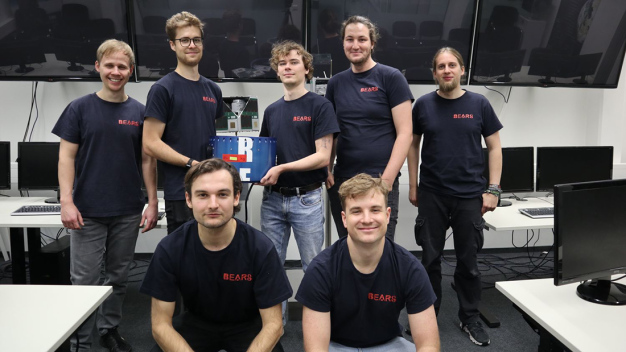
A part of the now larger team of WOBBLE2. Top row from left to right: Jonas Engler (Computer Science), Robin Nitschke (Aerospace Engineering), Felix Oesterle (Transport Engineering), Matteo Grube (Aerospace Engineering), Benedict Grefen (Research Associate in Aerospace Engineering). Bottom row from left to right: Aurel Gröbel (Civil Engineering and Transportation Engineering) and Franz Schneider (Aerospace Engineering). The five people in the middle (Robin, Felix, Matteo, Aurel, and Franz) are flying to Kiruna together with Nima Mirrafati (Transportation Engineering, not in the picture).
As part of the European program REXUS (Rocket Experiments for University Students), six students from TU Berlin will fly to the Esrange Space Center near the Swedish city of Kiruna for training and testing from February 5 to 9, 2024. A team from the spaceflight club "BEARS e.V." (Berlin Experimental Astronautics Research Student Team) at TU Berlin successfully applied for REXUS. This student space program is supported by the German Aerospace Center (DLR) and the Swedish Space Agency SNSA. After training in Kiruna, the team must develop a flight-ready version of their experiment within a year. The focus is on innovative fuel tanks for rockets, produced with the help of 3D printing. A total of nine teams will launch their experiments in early 2025 in northern Sweden with two sounding rockets heading towards space, conducting experiments in weightlessness for about three minutes.
"The space industry is very innovative on one hand, but also very conservative on the other. Because everything costs so much money, there's a tendency to avoid changing functioning solutions," says Matteo Grube, a master's student in aerospace engineering. Affordable student projects could trigger innovations that are relevant for the overall development of spaceflight. For example, the project that the TU Berlin team applied with in the REXUS program: 3D-printed fuel tanks that simplify manufacturing and enable new designs.
Fuel in weightlessness must be contained
Liquid fuel in a rocket's tank behaves completely differently when entering weightlessness than when pulled towards Earth by gravity. The free floating of the liquid could cause problems with the orientation control of rockets and satellites, as well as prevent the fuel from flowing optimally from the tank outlet to the rocket engine. "So far, welded sheets or hollow profiles have provided a solution," explains Grube. These structures are called "Propellant Management Devices" (PMDs). "We now want to test various new designs for PMDs that can only be manufactured using additive manufacturing processes." Just over ten years ago, 3D printing was established for metals as well. Here, a laser beam selectively melts metal powder to create any three-dimensional shape.
Six different shapes for fuel tanks are being tested
Since the first meetings in summer 2023, the student team, now grown to ten members, is working on possible shapes for the PMDs, of which six different designs will be tested in the REXUS high-altitude research rocket. "We are in contact with industry and various universities to find suitable facilities for laser melting metals," says Grube. Additionally, the testing environment for the fuel tank models must be developed. Six cameras will monitor the tanks, which are simply filled with water containing a fluorescent substance for the experiments. To film the behavior of the water, the outer shell of the tanks must be made of Plexiglas.
Rigorous testing schedule until the launch in March 2025 in Sweden
"We are very happy that so many students from the team will be able to fly to the Esrange Space Center rocket base, where the REXUS rocket will take off in just over a year," says Benedict Grefen from the TU Berlin Department of Aerospace Engineering, who supervises the student team. "We are very grateful to the Society of Friends of TU Berlin for enabling two additional students to make this trip, in addition to the four places allocated in the REXUS program." There, the team will get to know the launch facilities and the high-altitude research rocket and receive safety instructions. But most importantly, the students will present their experimental concept to various experts and receive valuable feedback.
"Afterwards, there will be a tight schedule leading up to the rocket launches in March or April 2025. The students will undergo further reviews, some at DLR in Oberpfaffenhofen and at the Center for Applied Space Technology and Microgravity (ZARM) in Bremen, as well as one or two reviews here at our facility," explains Benedict Grefen. "The experiment will be thoroughly tested to ensure it functions reliably during flight."
"WOBBLE2" team is multidisciplinary
Matteo Grube looks forward to this stress calmly, in addition to his studies. He was elected leader of the team, which has given itself the acronym "WOBBLE2," standing for "Weightless Observation of Fluid Behaviour with Berlin Liquid Guidance Experiment." The number 2 indicates that the idea with the new tank designs nearly succeeded in another competition — at that time, an experiment was sought that German astronaut Matthias Maurer later took into space. Grube is confident that his team will master the upcoming tasks well because of its broad expertise. "Alongside aerospace engineers, we also have people from computer science, mechanical engineering, and civil engineering on board," says Matteo Grube. "Even an Erasmus student from Norway is part of the team."
Technische Universität Berlin
10587 Berlin
Germany