



- Science
- Translated with AI
TU Kaiserslautern receives seven million euros for the construction of a quantum computer
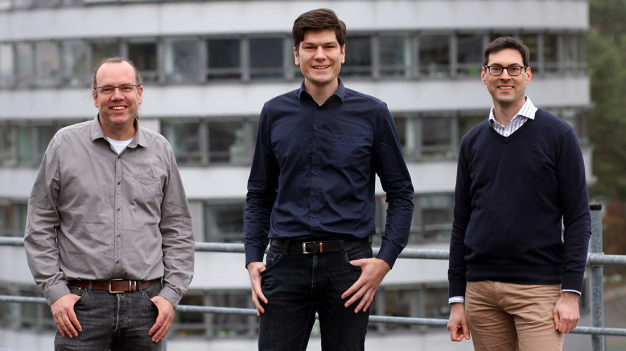
Professor Herwig Ott (l. to r.), Dr. Thomas Niederprüm, and Professor Artur Widera are working with their partners on the new quantum computer. Photo: Koziel/TUK
Quantum computers offer significant advantages over classical, digital computers in processing speed. This is particularly important when solving optimization problems, which involve calculating complex issues such as logistics processes. To harness this potential, the Federal Ministry of Education and Research is now funding a project to develop a practical quantum computer with around 25 million euros. The total project volume amounts to 29 million euros. More than seven million euros of this go to the Department of Physics at the Technical University of Kaiserslautern (TUK).
Many practical computational problems push even today's high-performance computers to their limits. This is evident, for example, repeatedly in optimization problems such as route planning with many stops, optimizing interconnected work and production processes, calculating the ideal climb for an aircraft, or planning resource-efficient logistics processes in supply chains and transshipment points.
In the race to build a usable quantum computer, researchers at TU Kaiserslautern have now achieved a major success. They managed to secure a prominent large-scale project for building such a computer at TU Kaiserslautern. Over the next five years, they will work together with colleagues from the University of Hamburg and the Fraunhofer Institute for Techno- and Economic Mathematics (ITWM), as well as industry partners, to develop a functional quantum processor based on so-called Rydberg atoms. The goal is to optimize industrially relevant problems. The quantum computer will be located in the newly constructed research building "Laboratory for Advanced Spin Engineering" (LASE) on the university campus.
Quantum computers can outperform traditional computers many times over because they operate in a completely different way. Instead of classical bits, which can take the value 0 or 1, they use so-called quantum bits, which can be 0 and 1 simultaneously. "This gives them immense potential to tackle problems that are unsolvable for classical computers. In particular, they promise to solve important problems in logistics and process optimization," says Professor Dr. Herwig Ott, group leader in the Department of Physics at TUK, who secured the project together with his physics colleagues Professor Dr. Artur Widera and Dr. Thomas Niederprüm.
Professor Widera adds: "We are proud to have secured this forward-looking project for the city, region, and the state of Rhineland-Palatinate, which will bring international visibility to Kaiserslautern. It is a great success that we can now bring the expertise in quantum technology and quantum physics, which we have built up over the past ten years through our special research areas, into this highly exciting project." Dr. Thomas Niederprüm further explains: "With the quantum computer, we want to test how shipping routes for goods logistics or supply chains can be improved and made more sustainable overall, so that energy is saved and climate protection is supported."
Future application areas include the calculation of new active substances for medications or the optimization of insurance algorithms. "In the long term, we also expect a positive impact on the regional industry, as the quantum computer can be operated entirely externally and optimization problems arise in many areas," concludes Professor Ott.
University President Professor Dr. Arnd Poetzsch-Heffter emphasizes the importance of the project: "With the construction of a quantum computer, we are among the few research locations worldwide developing this new technology. This is an excellent achievement and of enormous strategic importance for the entire site. I congratulate all involved wholeheartedly." Professor Dr. Werner R. Thiel, Vice President for Research and Technology at TUK, also expresses his pleasure: "Congratulations to the colleagues. They laid the groundwork in recent years through various projects, special research areas, and the profile area OPTIMAS funded by the state. This is now paying off."
The research consortium "RYMAX" includes researchers from TU Kaiserslautern, the University of Hamburg, the Fraunhofer Institute for Techno- and Economic Mathematics (ITWM), and industry partners from the fields of laser technology, optical technologies, electronics, software development, and logistics.
Technische Universität Kaiserslautern
67663 Kaiserslautern
Germany