



- Translated with AI
TU Berlin sends five new picosatellites on their journey
The satellites are used for precise positioning in space at 27,000 km/h
(© TU Berlin/ Nikolas Korn)
(© Roscosmos/ EXOLAUNCH)
(© TU Berlin/ILR)
On July 5, 2019, all eyes in the space flight control center at TU Berlin were focused on five small objects in space: At 3:40 PM local time, scientists attempted to establish contact with the pico-satellites they had developed and built. The satellites BEESAT-9 and -10 to -13 are now five of a total of 21 satellites from TU Berlin that have been built, tested, and tested in orbit.
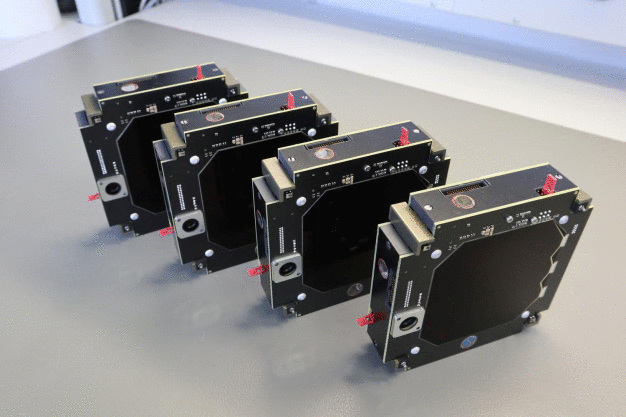
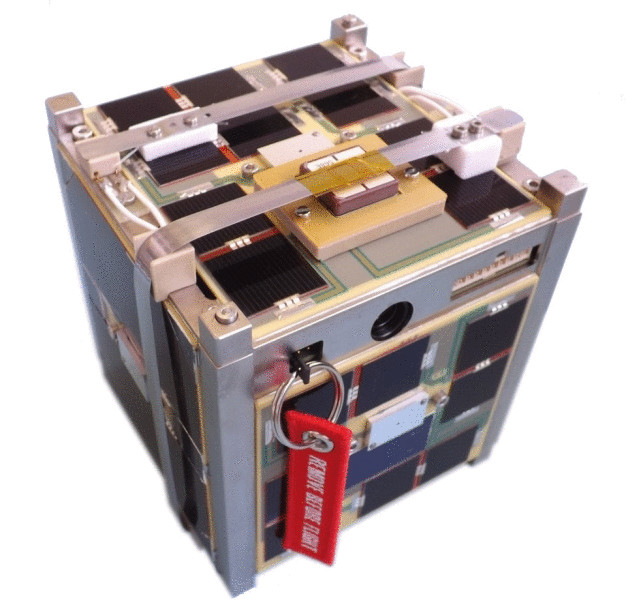
The goal of the BEESAT-9 mission of the Department of Aerospace Engineering was to perform precise position and orbit determination using the integrated GPS receiver "GNSS200". "In addition to the GPS receiver, the so-called pico-fluid dynamic actuator, based on a rotating liquid metal, represents an innovation because it can specifically stabilize the satellite's orientation or set it into rotation," explains the project leader of the mission, Dipl.-Ing. Sascha Weiß. The four satellites of the BEESAT-10 to -13 mission form a so-called swarm mission, where communication between the satellites and navigation relative to each other are studied. With a mass of one kilogram (BEESAT-9) and 0.375 kilograms (BEESAT-10 to -13), the satellites are considered "pico satellites". (BEESAT stands for Berlin Experimental and Educational Satellite.)
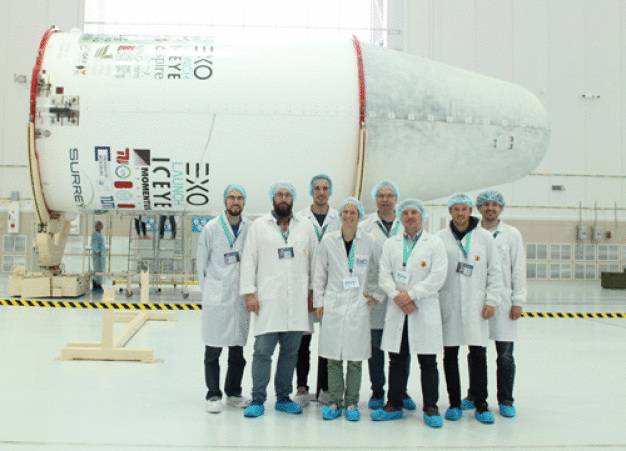
The pico satellites developed and built at the Faculty of V Transportation and Mechanical Systems at TU Berlin under the leadership of Prof. Dr.-Ing. Klaus Brieß were launched on July 5, 2019, at 7:41 AM from the Vostochny spaceport in Russia. The launch was organized by the Berlin-based company EXOLAUNCH, which is also responsible for the deployment containers and their control. EXOLAUNCH was founded in 2010 by researchers from TU Berlin and has been working closely with TU ever since. A Soyuz-Fregat carrier rocket carried the satellites to an altitude of 530 kilometers and was separated from the rocket at 12:06 PM.
Satellite Projects at TU Berlin
With these satellite projects, the latest technologies in spaceflight are tested and engineering insights gained. In addition, students are trained in a modern and practical way for careers as aerospace engineers. The launch of the BEESAT-9 to -13 missions continues the long tradition of satellite construction at TU Berlin. As early as 1991, the first student-built satellite, TUBSAT-A, was successfully launched. Further satellite launches are planned for this year and the next.
In addition to the BEESAT missions, TUBIN, a satellite weighing 20 kilograms, is planned to be launched into orbit in 2020, where it will use an infrared camera to detect fires and flames on Earth. Furthermore, in the second half of 2020, the SALSAT satellite will be launched, which aims to study radio communication across the entire planet.
Further Information
Project website BEESAT-9: http://www.tu-berlin.de/?204943
Project website BEESAT-5-8: http://www.tu-berlin.de/?183539
Press release "Engineering from Berlin-Charlottenburg in Space" (February 1, 2018): https://www.tu-berlin.de/?192509
Film "Space Mission in Nano Format": https://youtu.be/JCMQfDMIgxc
In the series "A Look into the Lab," the TU Berlin Mission Control Center is introduced: https://www.tu-berlin.de/?190830
Technische Universität Berlin
10587 Berlin
Germany