



- Translated with AI
The "dark" side of spin physics
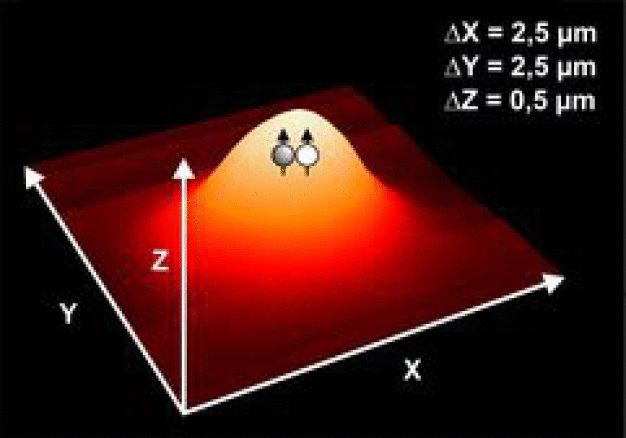
Raster scanning electron microscope image of a microlens precisely fixed over a quantum dot. The spin state of the dark exciton in the quantum dot contains the quantum information, i.e., the qubit. (© Dr. Tobias Heindel)
Researchers from the Institute of Solid State Physics at TU Berlin, in cooperation with the Technion Research Institute in Haifa, Israel, have succeeded in creating novel quantum information carriers that could be used in quantum information processing.
Quantum computers are a hot topic and are being researched worldwide. Leading international teams are now also using so-called "dark excitons" as information carriers. These special "quasiparticles," which consist of bound electron-hole pairs in a solid crystal, are promising candidates for quantum information carriers – the so-called quantum bits or qubits. "A qubit based on a dark exciton is capable of storing information in its spin state. This can be thought of similarly to a classical bit in a computer. However, unlike a classical bit, a qubit can, in principle, take on infinitely many intermediate states," explains Dr. Tobias Heindel, a member of Prof. Dr. Stephan Reitzenstein's research group, head of the Department of Optoelectronics and Quantum Devices at TU Berlin.
However, there is a problem with using dark excitons: as their name suggests, they are not able to emit light on their own and are therefore difficult to detect. But it is precisely their darkness that makes these excitons interesting for their application as quantum memories: once a dark exciton is generated, it can store information for about a microsecond – a thousand times longer than in typical bright exciton states.
Now, the team from TU Berlin, together with the Israeli research team, has not only succeeded in reading out the spin state and thus the information of a dark exciton but also in precisely localizing it within a nanostructure.
The nanostructure in which the researchers were able to isolate dark excitons is a semiconductor quantum dot sitting at the focus of a microscopically small lens. To generate the dark exciton and subsequently read out its spin state, the researchers used a trick developed by the Israeli partners in 2010: they extract the quantum information stored in the spin state of the quantum dot via another intentionally introduced electron, which switches the exciton – simplified – from dark to bright. This allows the exciton to emit a detectable photon. The clever part: the polarization of this photon contains the information about the spin state of the original dark exciton.
The major advantage over previous experiments lies in the nanostructure developed at TU Berlin. A special microscopic lens is precisely placed over the previously selected quantum dot using a unique method, which is only mastered in the Reitzenstein group worldwide. "The lens collects the emitted photons and directs them toward the detector. This significantly increases the frequency with which the spin state of the dark exciton can be read out compared to without the lens, which will later be crucial for the transmission rate of quantum information. Through this demonstration, we have shown that dark excitons can be used as long-lived qubits, enabling future applications in quantum information processing," says Heindel.
The experimental work on this novel quantum information carrier was carried out by Dr. Tobias Heindel and his colleagues partly in the Reitzenstein group at TU Berlin and in the research group of Prof. Dr. David Gershoni at the Technion Research Institute (Israel Institute of Technology) in Haifa, Israel. This research was funded by the German-Israeli Foundation for Scientific Research and Development.
The article was published in the open-access journal APL Photonics of the American Institute of Physics* and highlighted as a significant breakthrough in the field.
* T. Heindel et al., Accessing the dark exciton spin in deterministic quantum dot microlenses, APL Photonics 2, 121303 (2017).
Technische Universität Berlin
10587 Berlin
Germany