


- Trade fair
- Translated with AI
The Cleanzone demonstrates how energy efficiency can be embraced
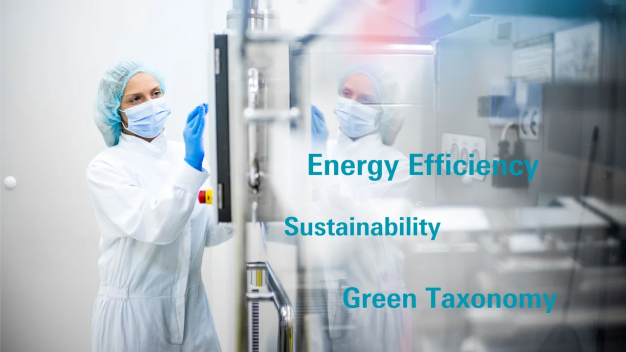
The industry's focus today is more strongly on energy efficiency. Source: Messe Frankfurt Exhibition GmbH
The energy efficiency of cleanrooms has developed into a top topic over the past twenty years. There are many successful levers to achieve this. Which ones they are and how to operate them will be explained to visitors of the Cleanroom Trade Fair Cleanzone on September 25 and 26, 2024, in Frankfurt am Main.
Wars and crises around the world make the future energy supply seem uncertain, or costs are rising. Or both. Additionally, there is a need to reduce the carbon footprint and the emissions of other greenhouse gases. This is reflected in the "European Green Deal": climate neutrality by 2050. The EU taxonomy regulation sets the technical framework for this. According to it, the degree of ecological sustainability of an investment should become measurable, combined with disclosure obligations for the "non-financial" ecological and sustainable qualities of companies.
All of this forces us to save energy. But especially in the cleanroom?
Ideas for energy efficiency with multiplier effects
It is true: A cleanroom must primarily be clean. Energy efficiency takes a subordinate role in this. Until the 2000s, energy costs were hardly considered; the primary focus was on achieving the necessary purity for the process. However, conditioning and cleaning air require a lot of energy, and these costs have been rising and continue to do so. As a result, over the last twenty years, energy has transformed from a readily available commodity into a cost-determining factor.
Today, the focus is more strongly on energy efficiency, also because its numerical significance is becoming more prominent in awareness. For example, a staggering 60 percent of the total energy costs at Fraunhofer Society can be attributed to cleanrooms. The good news: ideas for energy savings should have a large multiplier effect, and Fraunhofer Society is already working on unlocking this potential.
Similarly, major activities are underway at the Association of German Engineers (VDI). A working group is currently developing a new guideline on energy efficiency. Its task is to revise the existing guideline VDI 2083 Part 4.2 "Cleanroom Technology – Energy Efficiency," which has been in place since 2011 and is therefore somewhat outdated.
Representatives from all interested circles are involved, mainly planners, installers, and operators of cleanroom facilities, researchers and educators, manufacturers of control and regulation technology, as well as suppliers of cleanroom components. "We hope to be able to approve the draft soon," says Thomas Wollstein, a scientific employee in this VDI working group. He can already share some insights into the contents of the new guideline: the focus will be on two points: "Cleanroom and Ventilation Concept" and "Energy-Efficient Operation." Additionally, specific topics such as "Energy Demand of Cleanrooms," "Energy-Related Parameters and Particularities of Cleanrooms," "Process for Evaluating and Improving Energy Efficiency," "User Requirements, Planning Preconditions," "Commissioning," and "Energy-Related Operational Optimization (eBO)" will be addressed.
New contents of VDI 2083 often resemble the corresponding norm parts of DIN EN ISO 14644. This is only logical, as VDI working groups are usually involved in global committees, giving their guidelines international significance. The industry’s focus today is increasingly on energy efficiency.
Once you are aware of the topic "Energy Efficiency in the Cleanroom," you will quickly find a range of approaches. For example, consider not operating a cleanroom at the highest air exchange rate 24/7 but only during production times. There are also various – and differently "energy-hungry" – ways to achieve specific air conditions and cleanliness levels.
Heating, ventilation technology, and ventilation systems are often the first focus. And considering that the most cost-effective cleanroom is the one you don't need at all, it is always worth considering in new constructions: isn’t a cleanroom sufficient? Isn’t a lower cleanroom class enough?
For existing cleanrooms, a strategic approach can help optimize energy use. For example, operators can follow a four-point scheme and ask themselves the following questions:
1. Can I replace existing filters with better ones?
2. Does my cleanroom already have heat recovery options?
3. How much can I possibly reduce the number of air changes per hour?
4. How can I improve the efficiency of motors or drives?
The key is to genuinely ask these questions openly. Traditional rules of thumb, such as 20 air changes per hour and 30 percent outside air requirement being minimum standards, should be "put in the mothbox." An important lever is air management. In particular, outside air drawn into the cleanroom through end-stage filtration should never be blown back outside. Instead, already conditioned air should stay in the cleanroom and be circulated within. For this, practical solutions like Filter-Fan-Units (FFUs) are used. They repeatedly clean the air and bring in oxygen-rich outside air. Overall, recirculation concepts are fundamental for good energy efficiency in cleanrooms.
An additional lever involves tolerances. Some cleanroom operators initially set them without considering energy efficiency optimization. However, if the product being manufactured can tolerate 20 to 80 percent humidity, there is no need to set tighter limits. And if the temperature can be set from 21 °C ± 1 °C to 21 °C ± 3 °C, this results in further energy savings.
If outside and inside temperatures match, it even opens the possibility of free cooling, saving (at least temporarily) the entire energy-intensive cooling equipment.
How a strategic approach to increasing energy efficiency in the cleanroom looks like and which products are suitable for this at the state of the art will be demonstrated at the Cleanroom Trade Fair Cleanzone on September 25 and 26, 2024, in Frankfurt am Main.

Cleanzone
Messe Frankfurt Exhibition GmbH
Ludwig-Erhard-Anlage 1
60327 Frankfurt am Main
Germany
Phone: +49 69 75756290
Fax: +49 69 757596290
email: anja.diete@messefrankfurt.com
Internet: https://cleanzone.messefrankfurt.com