


- 3D printing
- Translated with AI
Sustainable medical technology for people and the environment
Recycling, Point-of-Care Diagnostics, 3D Printing
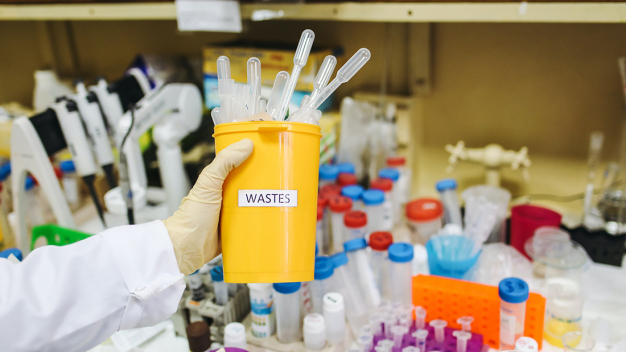
Sterile disposable products account for a large share of waste generation in hospitals and medical practices. Sustainable medical technology means resource-conserving management with circular products. © Pexels/Polina Tankilevitch
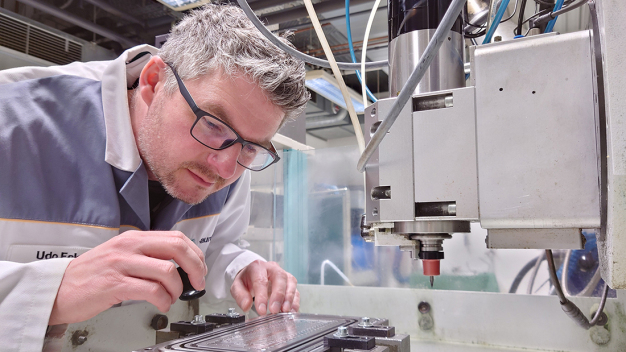
With the WIR! alliance "DIANA – Technologies for future-proof Point-of-Care Diagnostics based on microstructured manufacturing processes and sustainable materials," Fraunhofer IWU, together with Fraunhofer IZI and SensLab GmbH, will develop the region between Leipzig and Chemnitz into a key area for medical diagnostics. © Fraunhofer IWU

Waste containers goodbye: raw materials used in medical technology can be returned to the material cycle — even if they are no longer suitable for use in medical devices. For example, a container for treating wastewater from showers, bathtubs, and sinks in private households is conceivable. © Pixabay
Sterile disposable products account for a large share of waste generation in hospitals and medical practices. High hygiene standards impose certain limits on the principle of "Reuse, Reduce, Recycle." Nevertheless, the goal of sustainable medical technology should be to operate more resource-efficiently and to transition products into a circular economy — ensuring that single-use products go to recycling rather than incineration. Sustainable medical technology also cares for the individual person. Artificial replacements (prostheses) or support structures (orthoses) for joints and body parts maintain or improve quality of life when they are optimally adapted to the ergonomics and needs of patients. Diagnostics that are quick and straightforward to use on-site at the patient's location (Point-of-Care), even in underserved areas, can be life-saving. Fraunhofer IWU is convinced: the contribution of manufacturing makes all the difference.
How single-use waste from clinics and medical practices becomes new medical products…
Hospitals, clinics, and medical practices are cornerstones of the healthcare system. Inpatient and outpatient treatment involves many single-use products, which, according to the Federal Statistical Office, already accumulated to about seven to eight tons of waste per day before the COVID-19 pandemic. Hospitals have thus been among the largest waste producers in Germany. During the pandemic, waste generation in the medical sector increased significantly again. A trend that cannot be reconciled with the goals of closed material cycles and climate neutrality before the turn of the century.
Disposing of or burning plastic single-use products is the exact opposite of resource efficiency. Researchers at IWU are convinced: there is another way. The project's goal is to develop a mid-term strategy for dealing with waste from the field of medical technology and to embed it among stakeholders in the healthcare sector. The focus is particularly on waste from clinics. A successful strategy must therefore answer key questions about the composition of the waste, the involved parties within the process chain, regulations, material flows, and the processing of recyclates. Taking these priorities into account, the project aims to produce a realistic scenario at its conclusion, illustrating how medical waste can be collected, separated, processed, and recycled into high-quality materials.
The mechanically produced recyclates are processed using three manufacturing methods (3D printing, injection molding, SMC) to develop a product that can be reintroduced into the cycle of medical single-use products or alternatively be usable for a less regulated industry.
…or into containers for private wastewater treatment
Goodbye, piles of trash: When manufacturers, hospitals, doctors, and recycling companies work together, material cycles can be closed, and recyclates used sustainably — without creating additional workload in hospitals and medical practices. Another innovative approach to recycling medical single-use products can help reintroduce raw materials used in medical technology into the material cycle — even recyclates that are no longer suitable for use in medical devices. For example, a container for treating wastewater from showers, bathtubs, and sinks in private households is conceivable. Further research is needed for this. A project with societal benefits that anyone can participate in: Goodbye, piles of trash!
DIANA
The WIR! Alliance DIANA will soon close a supply gap in the region between Chemnitz and Leipzig and establish a network for manufacturing and applying innovative Point-of-Care diagnostics. These will enable simple, cost-effective, and reliable measurement of health status on-site with the patient. Additional applications may include sports and care. DIANA stands for DIagnostics and Sustainability and unites around 80 partners, including SMEs, research institutions, and supporters from education and society.
Point-of-Care (PoC) diagnostics aim for decentralized on-site analysis that can be used outside laboratory infrastructure and can save time, especially in cases of immediate decisions or life-saving measures. Developing and translating highly integrated PoC test systems requires interdisciplinary collaboration between diagnostics and manufacturing technology. Fraunhofer IWU will contribute its extensive expertise in manufacturing technology and microfabrication technologies. The alliance is led by Fraunhofer Institutes IWU and IZI, as well as SensLab GmbH; the VEMASinnovativ network is also an important partner in the strategic development of DIANA.
ATeM
The Germany-Poland Center of Excellence ATeM (Additive Technology for Medicine and Health) researches new technologies for the use of additive manufacturing in medical technology. The Fraunhofer Institutes for Material and Beam Technology IWS and for Machine Tools and Forming Technology IWU cooperate in ATeM with the Faculty of Mechanical Engineering, the Center for Advanced Manufacturing Technologies (CAMT) at Wroclaw University of Science and Technology, as well as university clinics in Dresden and Leipzig.
3D printing methods enable customized, patient-specific solutions in medical technology, as well as the integration of new, improved properties and functions into components. This is often not only significantly more cost-effective than conventional methods but also broadens the spectrum of therapies and treatment approaches.
Fraunhofer-Institut für Werkzeugmaschinen und Umformtechnik IWU
01187 Dresden
Germany