



- Standards
- Translated with AI
Stainless steel resistant to rust in contact with other materials
Contact corrosion is often misjudged – new fact sheet 829 provides clarity: the Stainless Steel Information Center publishes a fully revised fact sheet
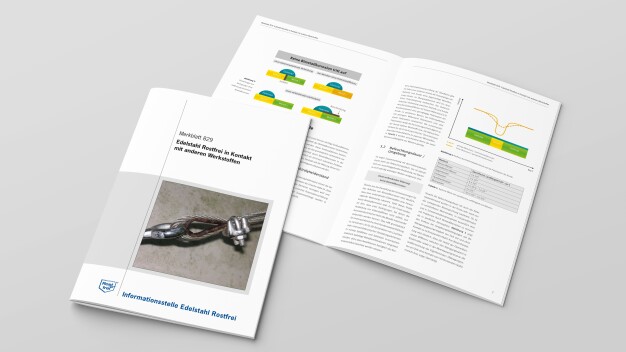
Mockup: The new ISER fact sheet 829 "Stainless Steel Corrosion-Resistant in Contact with Other Materials".
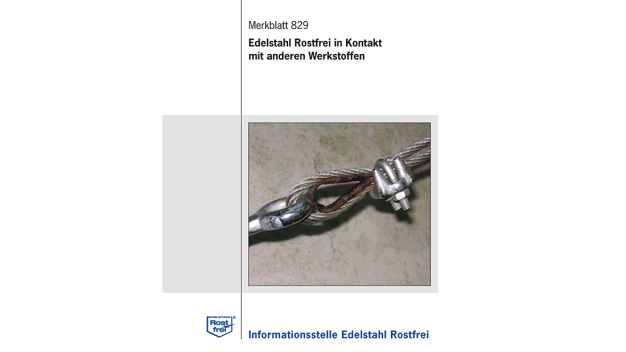
Cover page of the information sheet 829: "Stainless Steel Corrosion-Resistant in Contact with Other Materials"
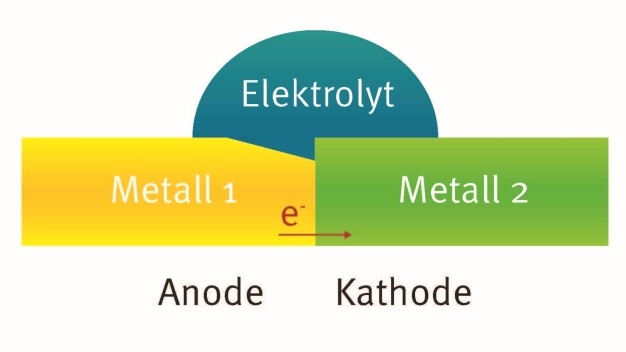
Schematic representation: Conditions for the occurrence of bimetallic corrosion ©ISER
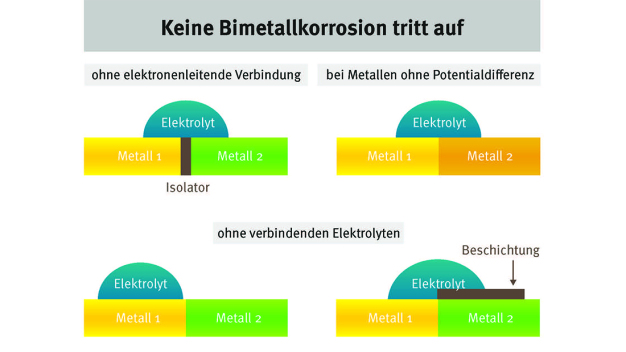
Schematic representation: No risk of bimetallic corrosion under these four conditions ©ISER
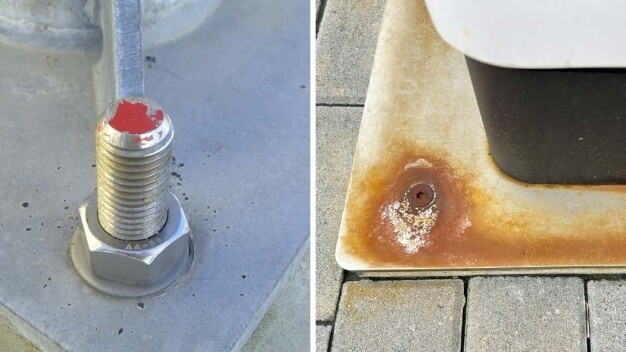
Identical material combination: stainless steel and galvanized steel. Left: No bimetallic corrosion; right: Bimetallic corrosion. © left: BAM, right: Eberhard Wied
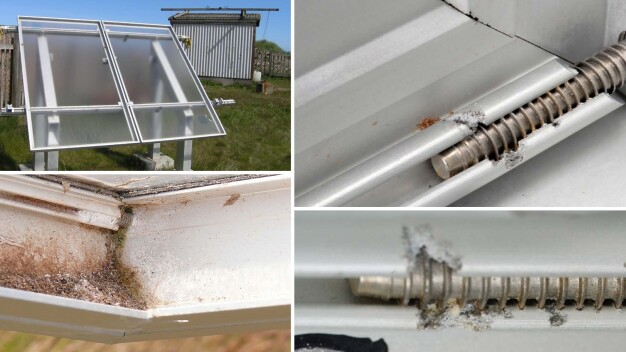
Bimetal corrosion after three years of storage in Helgoland: Pronounced corrosion attack on the aluminum frame in the area of the screw connection with stainless steel fasteners. © BAM
Is stainless steel corrosion-resistant safely compatible with aluminum, galvanized steel, or copper? This question has been occupying planners, designers, and processors for decades. The answer is more complex than often assumed: general statements about the compatibility of different materials are not possible.
With the 5th, fully revised edition 2026 of the information sheet 829 "Corrosion-Resistant Stainless Steel in Contact with Other Materials," the Stainless Steel Information Center (ISER) provides a current and practical orientation aid for all those planning, executing, or evaluating constructions in mixed materials. This information sheet replaces the previous brochure, which regularly topped the ISER's bestseller list.
The Phenomenon of Bimetallic Corrosion
In many technical applications, different metallic materials are combined to optimally utilize their respective properties. However, such material pairings often also occur accidentally — for example, through fastening elements, connecting devices, or subsequent repairs. Under certain conditions, galvanic elements can form, leading to accelerated corrosion of the less noble material.
Whether bimetallic corrosion — formerly often referred to as contact corrosion — actually occurs depends not only on the material combination but also on environmental conditions and the structural design.
The information sheet explains the electrochemical fundamentals of bimetallic corrosion in an understandable way and shows which factors are crucial for a well-founded assessment. Topics include the influence of electrolyte resistance, duration of moistening, environmental conditions, the kinetics of electrode reactions, and the surface ratio between cathode and anode. Current examples illustrate why identical material combinations can lead to corrosion depending on the application conditions or remain resistant.
Examples from Practice
The information sheet addresses typical questions from water and wastewater technology, construction, applications under atmospheric conditions, and vehicle construction. Additionally, proven measures to prevent bimetallic corrosion are described, and frequently asked questions from practice are answered.
The document has been comprehensively updated and expanded in content by BAM - Federal Institute for Materials Research and Testing, Berlin, in collaboration with ISER. New graphics, current examples, revised explanations, and a clearly structured presentation enable a well-founded assessment of potential corrosion risks and help prevent damage cases during planning.
5th fully revised edition 2026, 22 pages DIN A4, 18 illustrations, 5 tables, order number: MB 829
The information sheet 829 can be downloaded free of charge; the printed version will also be sent free of charge in single copies.
Publisher: Stainless Steel Information Center
Sohnstraße 65, 40237 Düsseldorf
Email: info@edelstahl-rostfrei.de
Warenzeichenverband Edelstahl Rostfrei e.V.
40237 Düsseldorf
Germany