



- Translated with AI
Spin phenomena
New research building is being constructed on the campus
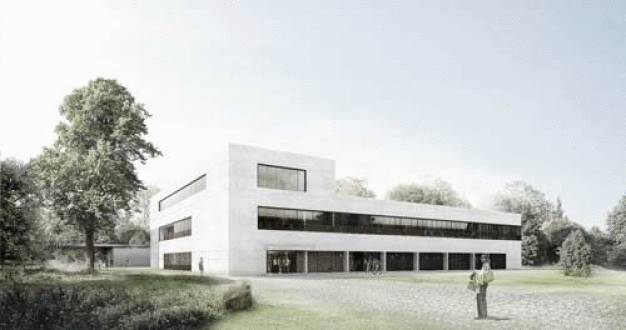
Model of the building (Source: LBB Branch Kaiserslautern / P+B R. Becker Architekten GmbH Berlin)
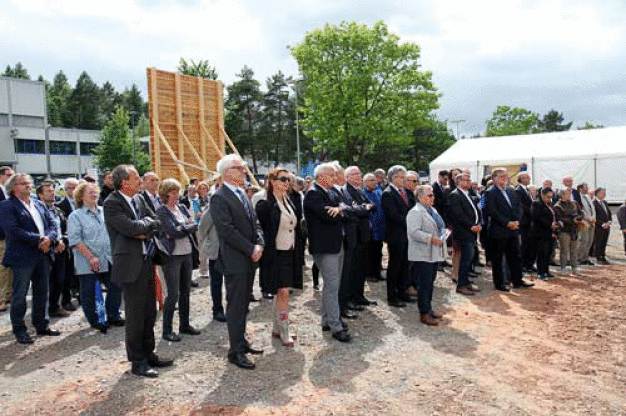
Groundbreaking (Photo: Thomas Koziel)
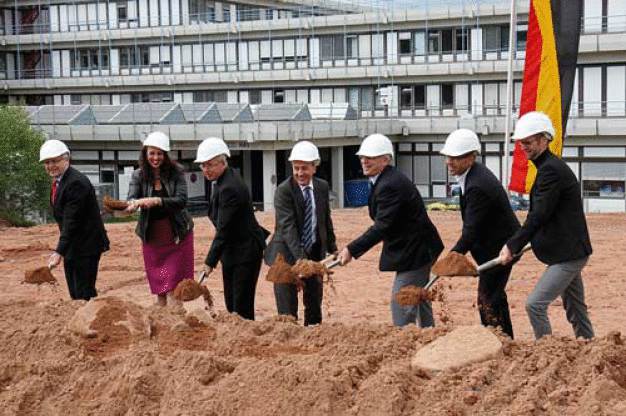
Groundbreaking ceremony (Photo: Thomas Koziel)
On the campus of the Technical University (TU) Kaiserslautern, a new research building is being constructed by 2020. In the Laboratory for Advanced Spin Engineering, or LASE, researchers from physics, chemistry, and engineering sciences will delve into the fundamentals of spin phenomena. These phenomena make many technologies possible, such as the storage of large data. The groundbreaking ceremony took place on Tuesday afternoon, June 6th.
If we can stream music and videos from the internet despite enormous data volumes today or our cars can brake safely thanks to anti-lock braking systems, we owe this to spin research. In physics terminology, a spin describes the intrinsic angular momentum of a quantum particle, such as an electron or proton, and forms the basis for all magnetic phenomena. Technologically, such phenomena are mainly interesting today for fast storage of large data amounts and the development of modern sensors.
At TU Kaiserslautern, research teams from various disciplines have long been working on different spin phenomena. Scientists are involved in four out of seven special research areas focusing on this topic. "This underscores the significant importance of this research field for our location," says physics professor Martin Aeschlimann, LASE spokesperson. "What was missing until now was a common umbrella for all these research projects, and that is exactly what our new research building LASE will provide." Around 100 scientists from chemistry, physics, and engineering sciences will move into laboratories and offices from 2020 to better explore known applications of spin and develop new techniques.
Young scientists will also have their place at LASE. Female and male students can participate in research projects during their studies, and doctoral candidates will have the opportunity to work with state-of-the-art equipment and in interdisciplinary teams.
"The future research building LASE demonstrates that we are excellently positioned at TU Kaiserslautern in the field of spin research. The new building will develop a visible radiance far beyond our campus and the region," says university president Professor Dr. Helmut J. Schmidt.
The building will have a usable area of over 3,300 square meters and will be equipped with the latest research equipment. For example, high-resolution helium microscopes will allow better insight into nanostructures of modern magnetic sensors and storage elements. Other research methods, such as ultrashort X-ray laser pulses, will also shape daily work. It is also planned that the Nano Structuring Center (NSC) of TU Kaiserslautern will be housed in the new building, including the establishment of a highly modern cleanroom.
The Landesbetrieb Liegenschafts- und Baubetreuung (LBB) is responsible for planning and executing the construction. Special technical requirements must be considered during construction, including the stability of room temperature, earthquake safety, prevention of light intrusion, and the purity of laboratory air.
LBB managing director Holger Basten thanked the involved engineering firms and the members of the interdisciplinary State Research Center for Optics and Material Sciences, OPTIMAS, at TU Kaiserslautern for their constructive cooperation: "The upcoming implementation with complex scheduling and construction site logistics will be demanding for all involved. Currently, we will carry out 54 European-wide tenders, sector by sector, so that local companies also have real chances in the bidding process."
The Rhineland-Palatinate Minister for Science, Professor Dr. Konrad Wolf, also expressed his satisfaction: "The fact that state funding has a catalytic effect on research initiatives is demonstrated by numerous successes achieved by TU Kaiserslautern and its researchers at the interface of physics, chemistry, and materials science. The new research building is evidence of this, as are the special research areas of the German Research Foundation and numerous other third-party funding acquisitions."
The federal government and the state of Rhineland-Palatinate are providing around 40 million euros for the construction. Additionally, there are funds of 6.8 million euros for eight new large-scale devices.
As part of the Rhineland-Palatinate research initiative, TU Kaiserslautern aims to further sharpen its profile, for example through research centers, including OPTIMAS, and through new research focus areas. These include developing and applying new materials (Advanced Materials Engineering, AME) and more efficient use of raw materials in the focus area of nanostructured catalysts (NanoKat). All three institutions are involved in LASE and will work together to advance spin research in the future.
Questions answered by:
Dr. Sandra Wolff
Nano Structuring Center (NSC)
Email: wolff[at]physik.uni-kl.de
Tel.: 0631 205 4091
Technische Universität Kaiserslautern
67663 Kaiserslautern
Germany