



- Cleaning | procedures, devices, agents, media (Wipers, Swaps,...)
- Translated with AI
Simple system integration and process feedback
Compact generator for industrial ultrasonic cleaning
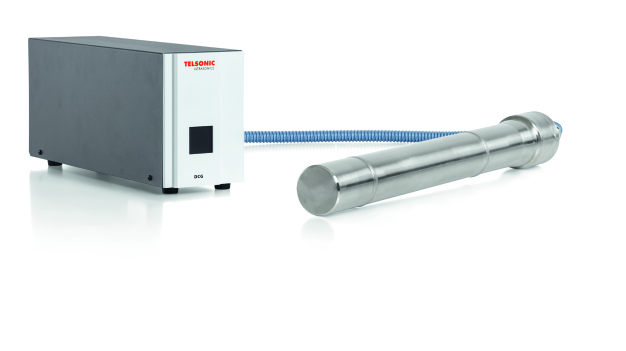
Compact generator for industrial ultrasonic cleaning: easy system integration and process feedback. (Author: Telsonic)
Cleaning with ultrasound offers an effective final cleaning method in many industries, but also for intermediate cleaning before further processing of various workpieces or parts, especially since no or minimal additives are necessary. Telsonic has now introduced the DCG cleaning generator with frequencies of 25 or 40 kHz to the market, which not only generates powerful ultrasonic energy for industrial cleaning applications but can also be easily integrated into automation networks (Image 1). It provides the higher-level control with valuable process feedback, for example for power monitoring, pulsed and degassing operation, up to error messages that facilitate service. This increases process transparency and improves system availability. The cleaning generator is very compact, with a height of approximately 164 mm, a width of 106 mm, and a length of nearly 400 mm, designed for use in harsh industrial environments. It can be used both as a standalone and as a built-in device in control cabinets and is process-compatible with the predecessor model. During replacement, the tube resonator can remain in the cleaning chamber.
How does ultrasonic cleaning work
An ultrasonic cleaning system consists of the generator, a converter, and a resonator. The generator and the converter (with piezo-ceramic) generate the ultrasound. The resonator (pipe oscillator), which varies in length from 340 to 1180 mm depending on the size of the cleaning chamber, distributes the ultrasound into the cleaning medium. Here, the introduced sound creates overpressure and underpressure, leading to cavitation. Cavitation refers to bubbles in the liquid that implode during pressure phases, producing the cleaning effect on the workpieces. Like millions of tiny brushes, they remove contaminants deep into the pores, even on complex geometries. The cleaning effectiveness depends on the temperature of the medium, the prevailing pressure in the liquid, the concentration of additives in the bath, and the settings of the ultrasound system (frequency, amplitude, power). Process transparency through feedback from the cleaning generator is therefore essential for an effective process.
Telsonic AG
9552 Bronschhofen
Switzerland