




- Science
- Translated with AI
Set up faster and produce resource-efficiently
Artificial Intelligence for ultra-precise manufacturing machines
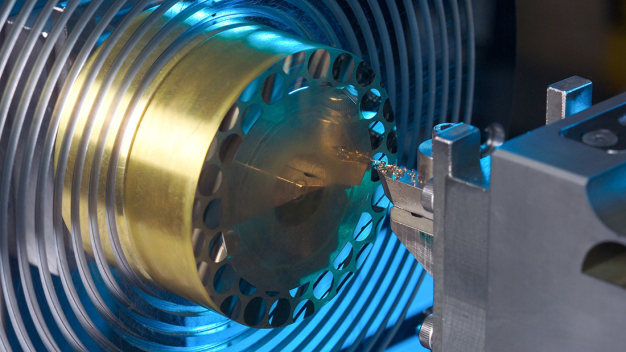
Ultra-precision turning of a microlens structure © Fraunhofer IPT
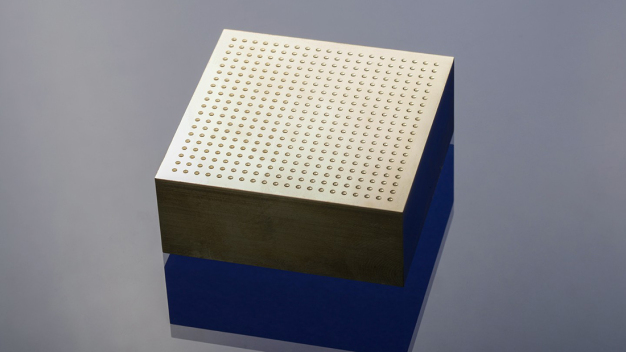
Example of a drilled microlens array © Fraunhofer IPT
Medical Technology, Photonics, Photovoltaics: In numerous application fields, microstructured component surfaces contribute to the functionality of high-tech products. Setting up the machines for these ultra-precise manufacturing processes often requires years of experience and specialized expertise. At the same time, the demands on the quality and durability of the workpieces and an efficient and resource-conserving production process are increasing. Together with the partner Innolite GmbH, the Fraunhofer Institute for Production Technology IPT from Aachen is working on the BMBF-funded project UP_Ramp-up to accelerate machine setup processes using artificial intelligence and thereby make manufacturing more efficient.
Producing products whose functional surfaces consist of freeform surfaces with integrated microstructures is a challenging task: As the complexity of geometric structures increases, ultra-precise manufacturing methods such as diamond tool cutting are reaching their limits more and more often. To date, manufacturing machines are manually and iteratively adjusted until the production process is optimized enough to achieve the desired surface quality. The efficiency of this ramp-up process traditionally depends on the experience and competence of the operator. The goal of the UP_Ramp-up project is therefore to fully automate the ramp-up process using artificial intelligence (AI). This significantly reduces material consumption and manufacturing costs. The experts aim to reduce the planning and manufacturing time for producing replication tools with microstructures for microlens arrays by a factor of four.
The big unknowns: Parameters for control and regulation technology
The quality of material processing directly depends on the highly precise movement control of the machine axes: When the individual parameters of the machine components are coordinated, movements can be executed very precisely. High-precision molds can be maintained, and very low surface roughness can be achieved. While the mechanical relationships in complex ultra-precision machines are now well understood, the influences of control and regulation components have not yet been sufficiently analyzed. Here, Fraunhofer IPT and Innolite rely on artificial intelligence that uses modern methods from so-called reinforcement learning. This means that the trained algorithms can make decisions on their own. The goal is to train the AI application before the setup process without a component and then integrate it into the manufacturing process so that it autonomously adjusts optimal parameters.
Training artificial intelligence and accurately predicting manufacturing processes
For training the AI models, the scientists use data generated automatically through so-called air cuts in the manufacturing process without a component. Human expert knowledge and manufacturing data from real processes complement the dataset. Additional process data are processed using pattern recognition methods. The artificial intelligence has access to all parameters recorded by the machine during production. Data collection and the subsequent provision of a parameter set optimized for the manufacturing process are fully automated, significantly speeding up the entire regulation parameterization. Using the modeling calculated by the AI, precise predictions are possible so that the first component is already produced within tolerance limits.
The project partners are also developing a generalized model that can be used for other applications of parameter optimization. Small and medium-sized enterprises particularly benefit from an integrated AI solution that can improve their machine regulation. This can drastically reduce the duration of the setup process.
Application example: Microlens arrays
Using a machine manufactured by Innolite for producing replication tools for microlens arrays, in which microstructures are embedded in freeform surfaces, the project partners demonstrate how well the AI application works in industrial practice. Microlens arrays are increasingly important as components of highly modern optical systems. Their applications range from optical sensors to medical laser systems and lighting systems such as LED headlights. Manufacturing data such as CAM data, tolerances, and analytical target contours are available but can also be generated depending on the desired component. The project partners then examine the quality of the workpiece using suitable measurement technology. This allows experts to assess the influences of control and regulation components and the efficiency of the process.
The UP_Ramp-up Project
The Federal Ministry of Education and Research funds the UP_Ramp-up – AI-supported process for optimizing the parameter space of manufacturing processes for individual production of complex optical structures under the guideline KI4KMU to promote projects on the topic of Research, development, and use of methods of artificial intelligence in SMEs. The project is supported under funding number 01IS21046B from October 2021 to March 2024 and is managed by the project sponsor DLR.
Fraunhofer-Institut für Produktionstechnologie IPT
52074 Aachen
Germany