




- R+D & Community of Interest
- Translated with AI
Service robots worldwide on a growth trajectory
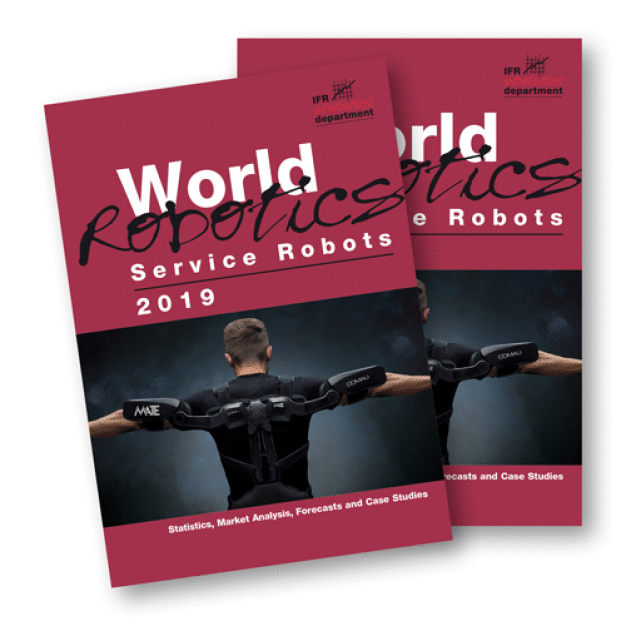
The "World Robotics 2019 – Service Robots" provides the latest market figures and comprehensive background information on applications with service robots. (Source: World Robotics 2019)
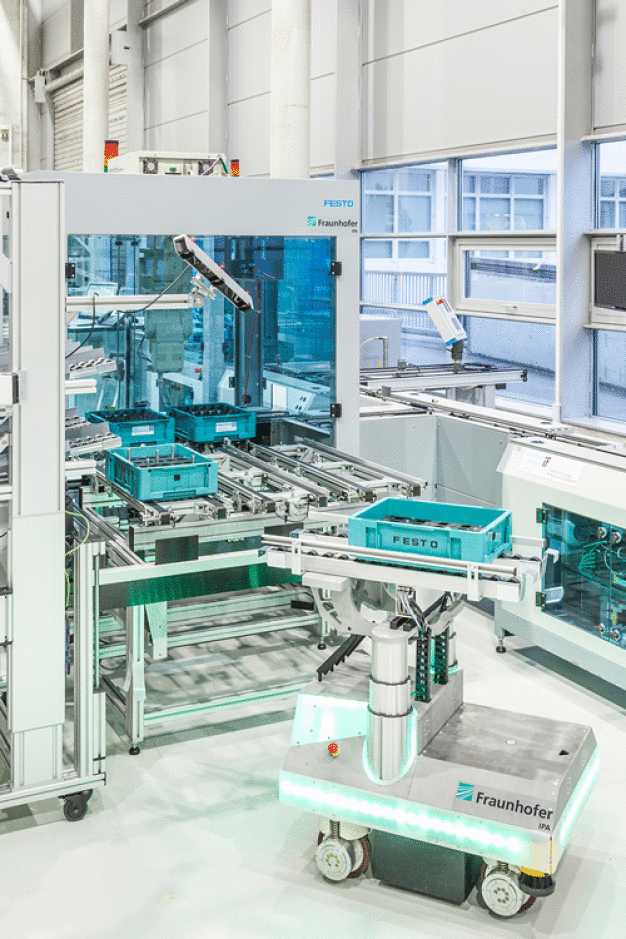
Mobile systems like this autonomous transport vehicle from Fraunhofer IPA significantly contribute to the growth of service robotics. (Source: Fraunhofer IPA / University of Stuttgart IFF, Photo: Rainer Bez)
Commercial and privately used service robots recorded double-digit growth rates in revenues and units in 2018. Detailed market analyses are presented in the new yearbook »World Robotics 2019 – Service Robots«, a cooperative project of the »International Federation of Robotics« (IFR) and Fraunhofer IPA.
In 2018, 61 percent more commercially used service robots were sold than in the previous year. This amounts to a total of 271,000 units sold. These had a value of $9.2 billion, an increase of 32 percent. Two industries primarily drive these figures: Mobile robots such as autonomous guided vehicles (AGVs) and inspection robots account for 41 and 39 percent of sales success, respectively.
Logistics is the strongest market
As in previous years, demand for AGVs remains significant. Most of these, namely 103,000 units, are used outside the manufacturing sector, primarily in e-commerce. But also in large hospitals, AGVs improve intralogistic processes. Production still accounts for 7,700 AGVs. Overall, the revenue from AGVs has increased by 53 percent to $3.7 billion. The units sold increased by 60 percent. North American companies benefit most from this boom, as they supplied a large share of all systems sold in 2018.
Other high-revenue industries include inspection robots and medical robots. Although their units sold remain significantly below those of the industries mentioned, they are high-priced. For example, 5,100 units sold contributed nearly one-third of the total revenue of commercial service robotics. Further growth markets include robots for agriculture, especially for field and crop processing, and to a lesser extent, milking robots and exoskeletons. The latter are »wearable robots« that provide strength support and thus promote ergonomic work. They are also widely used in rehabilitation. Looking across all industries, forecasts suggest that in 2022, a total of 1 million commercially used service robots could be sold for the first time.
Relief at home is welcomed
Privately used service robots are also in high demand. They recorded a 15 percent increase in revenue in 2018, reaching a total value of $3.7 billion. A total of 16.3 million systems were sold, an increase of 59 percent. The drivers of this success are automatic helpers in households: around 11 million devices vacuum or clean floors. Growth potentials are also seen in play and entertainment robots as well as assistance systems that support people in need in everyday life. Asian and American manufacturers benefit from the boom in private service robots; the European market still has much growth potential with only a 4 percent share.
Comprehensive market knowledge
For the yearbook, the IFR surveys several hundred service robotics companies worldwide at the beginning of each year about their sales figures and forecasts for the current year as well as for the next three years. The basis for this is a database with around 750 companies maintained jointly by the IFR and Fraunhofer IPA. This ensures a current and comprehensive market overview at all times. The surveys generate extensive statistical material for the yearbook.
The detailed analyses of individual applications, technologies, and research trends have been created by Fraunhofer IPA since the late 1990s. Since then, the institute has also been involved in service robotics itself, advancing it through numerous innovative hardware and software developments and the implementation of new service robotics applications. This overview and detailed knowledge are provided by IPA researchers to companies and organizations for strategic decisions. At the same time, it forms the basis for advancing developments according to market needs. »We see service robotics as a key technology to respond to societal challenges,« explains Dr. Werner Kraus, head of the Robotics and Assistance Systems department. »Whether it’s demographic change, digitalization, or personalized production: service robots will increasingly support humans in various industries and contribute to value creation,« Kraus is convinced.
An important role here is played by more efficient software development and utilization. Service robotics increasingly benefits from open-source
software such as the free »Robot Operating System« (ROS), which enables faster system development and saves resources at the same time. Numerous lectures at the ROS-Industrial Conference from December 10–12, 2019 at Fraunhofer IPA will showcase the latest developments in ROS, the status of ROS2, and how companies can profitably use open-source technologies.
The annual ROS-Industrial Conference with high-caliber speakers from industry and research is already the eighth major event on open-source software in robotics organized by Fraunhofer IPA. The institute provides insights into research trends, developments, and applications around the free operating system Robot Operating System (ROS) for service and industrial robotics each year.
What? ROS-Industrial Conference
When? December 10–12, 2019
Where? Fraunhofer IPA, Nobelstraße 12, 70569 Stuttgart
Registrations are now open. Until November 15, 2019, there is an early bird discount.
Members of the ROS-Industrial consortia and partners of the EU project ROSIN also receive discounted tickets.

Fraunhofer-Institut für Produktionstechnik und Automatisierung IPA
Nobelstraße 12
70569 Stuttgart
Germany
Phone: +49 711 970 1667
email: joerg-dieter.walz@ipa.fraunhofer.de
Internet: http://www.ipa.fraunhofer.de