


- Robot
- Translated with AI
Robot-assisted and simultaneously flexible pipetting
World novelty: Stericlean robot with electronic pipette
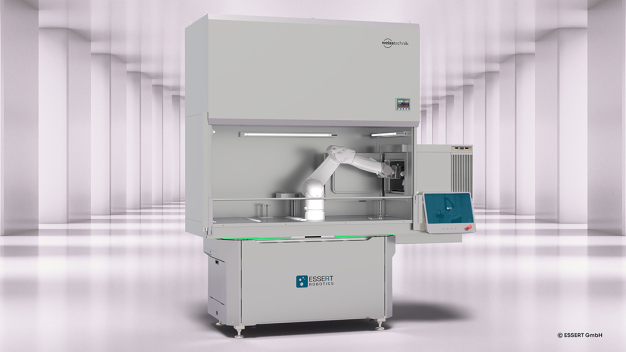
In the pioneering pipetting cell, a Stäubli TX2-60L in Stericlean version is used. (Copyright: ESSERT Robotics)
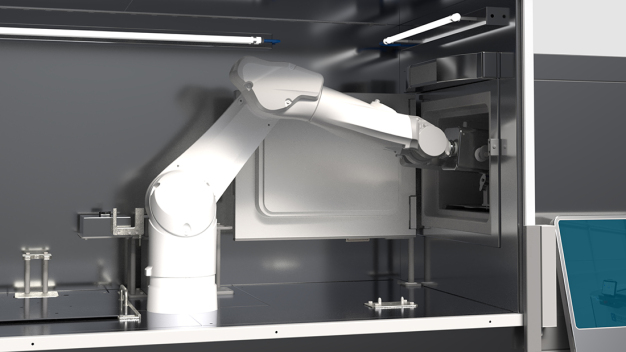
Stäubli Stericlean robots can operate permanently in aseptic production environments. This opens up new territory for robotics. (Copyright: Stäubli Tec-Systems GmbH Robotics)
stäubli de (Copyright: Stäubli Tec-Systems GmbH Robotics)
As a repetitive task that must be carried out under strict hygiene requirements, pipetting in pharmaceutical research is perfectly suited for robot-assisted automation. It becomes challenging when flexibility is also desired because source and target vessels vary in size. ESSERT Robotics has addressed this issue and developed the first fully automated and simultaneously flexible robotic solution for pipetting and aliquoting. A Stäubli Stericlean robot plays a central role in this.
In research and the manufacturing of pharmaceutical products, pipetting and aliquoting of substances play a crucial role. This repetitive activity must adhere to strict time and safety regulations and must be performed under sterile conditions.
For this reason, fully automated solutions have been established in pharmaceutical research, developed based on existing laboratory equipment.
However, automation has so far been limited where tasks were not purely repetitive. For example, when pipetting from both small and large vessels (or into them), human operators are still required.
Pioneering: Robots with electronic pipettes
ESSERT Robotics, a specialist in flexible automation solutions from Bruchsal, has now developed a groundbreaking robotic cell specifically for this task spectrum. The solution consists of a six-axis robot from Stäubli equipped with an electronic pipette, handling tasks within the workspace of a microbiological safety cabinet.
This is by no means a "normal" industrial automation robot, but a Stericlean robot from Stäubli. This series – here a compact TX2-60L Stericlean – was specifically designed for operation in aseptic production areas of Class A.
Designed for use in aseptic environments
The fully enclosed design of the robot, the use of stainless steel for highly stressed parts, and a special surface treatment create the conditions for the TX2 Stericlean robots to operate permanently in aseptic production areas. They are GMP-compliant and meet ANSI/RIA R15.06 standards. Additionally, they support the high AAP requirements. With these features, they ensure comprehensive protection of the products they handle, package, or pipette.
This means: sterile processes can be automated, where the use of standard robots would be completely impossible – for example, during pipetting. Another highlight: the patented JCS drive technology from Stäubli ensures that the high precision requirements for pipetting are consistently met.
Pipetting on a microbiological safety cabinet
With this robot as a core component, ESSERT has developed an automation system for laboratory technology with unprecedented flexibility. Handling and pipetting take place on a Class II microbiological safety cabinet from Weiss Pharmatechnik, specifically designed for this application. It complies with the requirements of DIN EN 12469 ("Biotechnology - Performance criteria for microbiological safety cabinets") and offers ISO 5 clean air according to ISO 14644-1 or EU-GMP Annex 1 (Aseptic conditions).
Additionally, contamination zones below the work surface are maintained under negative pressure with an inflow of 0.5 m/s, preventing particles from escaping the work area. The required air is drawn from the surrounding room and recirculated above the cabinet via a HEPA filter.
Flexible pipetting – with vessels from a few milliliters up to two or three liters
This describes the environment where the innovative – because flexible – fully automated pipetting takes place. The central innovation is that the Stäubli robot can access multiple source and target containers of different sizes – ranging from a few milliliters to 2 or 3 liters. Such flexible automation is desirable, for example, when small batches need to be pipetted without delay to optimize laboratory workflows. It also minimizes the risk of external contamination entering the process.
(Almost) everything is possible: sampling from deep-frozen media, automatic decapping…
Depending on the application, the Stäubli TX2-60L can also divide the material to be pipetted into multiple target containers, i.e., aliquoting. If needed, an electric gripper can also retrieve vessels with frozen media from a fully integrated ultra-low temperature freezer.
After a defined thawing period, the robot draws the medium with a pipette and samples the designated containers. Depending on the application, an automated decapper ensures higher throughput. Optionally, samples can be fully automatically labeled. The robot's high working speed guarantees high throughput and maximum productivity.
Complies with strict GMP requirements
ESSERT's OS operating system utilizes proven audit trail and PM quality functions, ensuring full compliance with GMP requirements. Precise positioning of the pipette on the robot arm and multiple checks guarantee very high process quality. The entire solution is made of stainless steel and meets all requirements for a hygienic process. Its compact design also saves valuable laboratory space.
Conclusion: New efficiency in laboratory automation
With the fully automated pipetting system developed by ESSERT Robotics, users can perform a wide range of routine laboratory activities requiring some flexibility, completely independent of personnel and at any desired time. The system is operational exactly when needed, enabling downstream processes to be served just-in-time.
Manual errors, inefficient personnel deployment, contamination risks for personnel and media, as well as downtime due to missing or unusable samples, are thus a thing of the past – and robotics has gained another (flexible) application area in the sterile sector of the pharmaceutical industry.
Stäubli Tec-Systems GmbH Robotics
95448 Bayreuth
Germany