




- Electronics (wafers, semiconductors, microchips,...)
- Translated with AI
Researchers pave the way for mass production of fuel cells
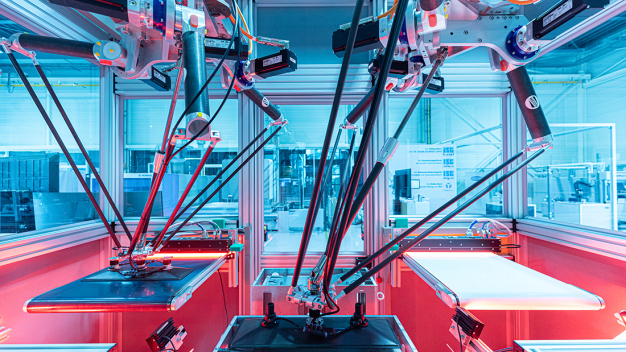
Completely automated and in seconds, two Delta robots assemble a fuel cell. © Fraunhofer IPA / Photo: Rainer Bez
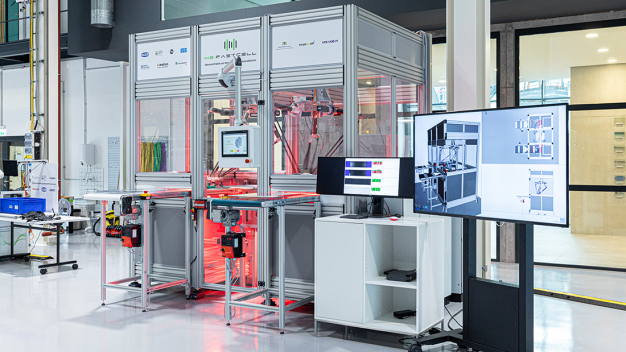
The completed robot cell is located on an experimental site at the Schwarzwald Campus in Freudenstadt and is intended primarily to serve small and medium-sized enterprises as a test stand to evaluate their products. © Fraunhofer IPA / Photo: Rainer Bez
A research team from Fraunhofer IPA and the Schwarzwald Campus has built a robotic cell that assembles fuel cells in seconds and completely automatically. This is a significant prerequisite for the prices of fuel cell systems to fall and for them to replace combustion engines in heavy-duty transport.
A conveyor belt transports bipolar plates into the field of view of a robot. Its image processing software recognizes the component used in fuel cells. With its suction gripper, the robot picks up the bipolar plate and briefly holds it in front of another camera. This scans the bipolar plate from below, captures the exact dimensions, and recognizes the texture of the fine structures on the underside – an important quality feature. Then, the robot places the bipolar plate on a stack. The entire process takes two seconds.
To recognize, grasp, and place membrane-electrode assemblies with a one-second delay, a second robot is used. The bipolar plate and membrane-electrode assemblies – these two layers make up a fuel cell. Hydrogen and oxygen are fed through the bipolar plate. The two chemical elements react within the membrane-electrode assembly. Because only a voltage of a maximum of one volt is generated, approximately 400 fuel cells need to be stacked to form a so-called fuel cell stack for a fuel cell motor, for example, to drive a truck.
Robot duo stacks fuel cells in seconds
Until now, fuel cell stacks are manufactured in a craft-like manner, involving a lot of manual labor and thus time-consuming. "If fuel cells are to replace combustion engines in heavy-duty transport, they must be produced in industrial mass production, largely automated, and cost-effective," says Erwin Groß from the Department of Corporate Strategy and Development at the Fraunhofer Institute for Production Technology and Automation IPA.
This has now been achieved by a research team from Fraunhofer IPA and the Center for Digitalization, Leadership, and Sustainability Schwarzwald (Schwarzwald Campus) in the project "H2FastCell." The robot duo places a bipolar plate or membrane-electrode assembly onto the fuel cell stack every second. A stack made up of 400 individual fuel cells can thus be completed in about 13 minutes. Manual production would take many times longer.
An additional criterion for the industrial mass production of fuel cell stacks is precision. Because even deviations – in the micrometer range – can reduce the performance of the fuel cell system. Therefore, the two robots stack two fuel cell stacks in parallel. When their cameras detect tiny deviations in shape and size during quality control, they assign the bipolar plate or membrane-electrode assembly to the respective matching stack. "With this best-fit approach, we reduce the scrap that manufacturers have previously complained about," says Friedrich-Wilhelm Speckmann from the Center for Digitized Battery Cell Production at Fraunhofer IPA. He co-led the H2FastCell research project with Erwin Groß.
Digital twin documents high-speed assembly in real time
Speed and precision place special demands on the hardware of the two robots and the entire cell setup. The suction cups developed specifically for the research project are made of carbon fiber-reinforced plastic to keep the mass that needs to be accelerated and decelerated as low as possible. To prevent vibrations caused by the rapid movements from affecting the robots or the enclosure, a heavy base plate stabilizes the robot cell. Any vibration impairs imaging and complicates precise grasping and placing. For this reason, the cameras are mounted separately and not connected to the enclosure.
A digital twin, i.e., a virtual replica of the production, documents the high-speed assembly of the fuel cell stacks in real time. This data can be used to simulate how the finished stacks will behave later. Additionally, the data enables simulations used in quality control of the bipolar plates and membrane-electrode assemblies.
Robotic cell to serve as a testing platform for companies
The completed robotic cell is located on a test field at the Schwarzwald Campus in Freudenstadt and will primarily serve small and medium-sized enterprises as a testing platform to evaluate their products. "With this, we have laid the foundation for our future research center for biointelligent hydrogen circular economy in the Black Forest," says Stefan Bogenrieder, Managing Director of the Schwarzwald Campus. "We aim to make hydrogen technology usable for mobile and stationary energy applications together with companies in Baden-Württemberg."
The H2FastCell research project, which has now concluded, involved, besides Fraunhofer IPA and the Schwarzwald Campus, five companies from Baden-Württemberg: the software developer ISG Industrial Control Technology GmbH from Stuttgart, the vacuum technology manufacturer J. Schmalz GmbH from Glatten in the Northern Black Forest, the sensor producer i-mation GmbH from Rottweil, the machinery and plant manufacturer teamtechnik Maschinen und Anlagen GmbH from Freiberg am Neckar, and the automation technician Weiss GmbH from Buchen in the Odenwald. The Ministry of Economic Affairs, Labor, and Tourism of Baden-Württemberg funded H2FastCell with around 2.3 million euros.

Fraunhofer-Institut für Produktionstechnik und Automatisierung IPA
Nobelstraße 12
70569 Stuttgart
Germany
Phone: +49 711 970 1667
email: joerg-dieter.walz@ipa.fraunhofer.de
Internet: http://www.ipa.fraunhofer.de



