




- Translated with AI
Reproducible deburring and cleaning in a process using ultrasound
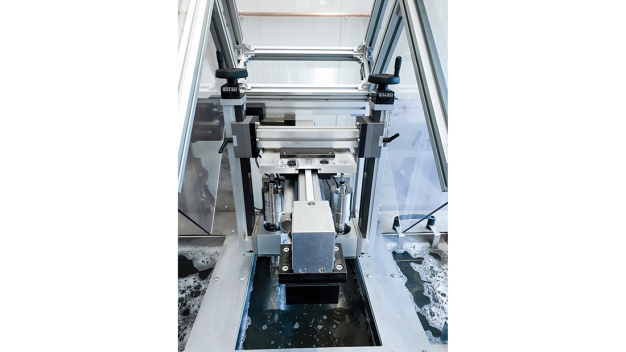
To meet the deburring specifications as burr-free and sharp-edged, the company designed a combined system for deburring and cleaning using ultrasound.
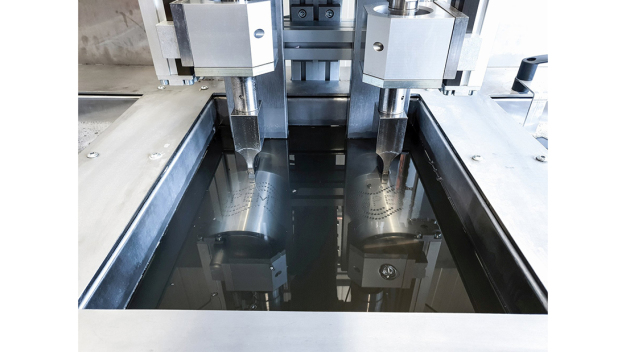
Two approximately 60 mm long measuring torch electrodes move in close proximity over the workpieces rotating in the immersion bath during the deburring process.
Process-safe deburring and cleaning are a must in the manufacturing of precision and quality components. For these essential manufacturing steps, a parts manufacturer and special machine builder jointly developed a multi-bath ultrasonic system with Weber Ultrasonics, in which workpieces can be pre-cleaned, deburred, and fine-cleaned in a single process.
Specifically, the requirement was for burr-free and sharp-edged parts, for which a process-safe deburring method was sought that could be integrated into their production. The workpieces to be deburred are machined, cylindrical components approximately 150 mm long made from a special stainless steel, featuring numerous fine holes. These parts are used in a granulate dosing system for hygiene products with skin contact.
Ultrasound – also as a deburring solution
The project managers at the company, whose core competencies include not only machining but also the construction of special machines, became aware of ultrasound deburring through publications. This contactless process for removing external and internal burrs is based on the physical effects of cavitation and agitation. It can be adapted to various deburring tasks by adjusting power, amplitude, and duration of the ultrasound, as well as the distance and position of the specifically designed sonotrode relative to the workpiece.
After extensive testing in Weber Ultrasonics' technical center demonstrated that the deburring specifications could be reliably met, the companies jointly designed a combined deburring and cleaning system. The multi-bath system implemented by the special machine builder features a total of four tanks. In the first tank, two parts are pre-cleaned with an ultrasound frequency of 25 kHz. Alongside residues from processing media and loose chips, some burrs are already removed. For the deburring process, the parts mounted on the holder are transported into the second tank and lowered into the bath. Then, two sonotrodes approximately 60 mm long, moving along an X-axis, approach the rotating parts in close proximity within the tank. The combination of 20 kHz frequency and high amplitude creates an intense sound field at the surface of the parts, specifically removing the burr roots. Simultaneously, the burrs are moved, broken off, and transported away by the agitation. In the third tank, a fine cleaning is performed at 40 kHz, followed by a dip spray rinse process in the fourth tank.
The ultrasound system is operated by Sonic Digital HS generators, each with a maximum power of 1,000 watts. The system component, designed to be integrated and compatible with DIN rail mounting, generates and controls the digital frequency via a 32-bit microcontroller. Power can be adjusted from 10 to 100 percent in 1% steps. This allows for optimal adaptation to specific deburring and cleaning programs for each part. In this case, high amplitude – economically achieved with 300 watts – is used. To ensure high operational and process safety, features such as frequency monitoring, fan control, temperature management, and dry-run protection are included as standard. Optional Profibus or Profinet interfaces enable integration of the generators into higher-level control processes and/or remote maintenance.
A process for deburring metal and plastic parts
Optimal deburring results are achieved not only with these stainless steel components but also in removing internal and external flash burrs on aluminum and zinc die-cast parts, as well as brass parts. Ultrasound can also be used to process thin-walled workpieces. Furthermore, ultrasound deburring is suitable for injection-molded parts made of polypropylene (PP), polyamides (PA), and polycarbonates (PC) – including fiber-reinforced variants. It can target burrs that form at the parting lines of injection molds as well as so-called “floating skins.”
Weber Ultrasonics AG
76307 Karlsbad-Ittersbach
Germany