


- Translated with AI
Price for cruelty-free research
TU scientists recognized by the association Ärzte gegen Tierversuche
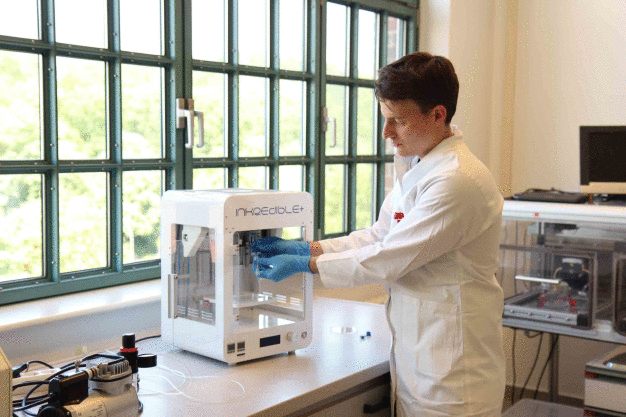
Clean bioprinting: 3D printing of organ models – without any animal components, this is the goal of the research project in the working group of Prof. Dr. Jens Kurreck. (© TU Berlin / Jens Kurreck)
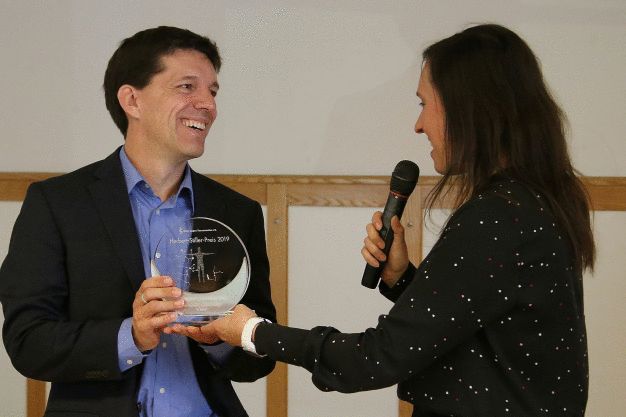
From the hand of Dr. Tamara Zietek, Doctors Against Animal Testing, Prof. Dr. Jens Kurreck, Professor of Applied Biochemistry at TU Berlin, receives the Herbert Stiller Promotion Award. (© Photo-Digital-Studio Marcus Müller)
Medical research is constantly seeking methods that do without animal testing. Cell cultures and especially 3D tissue cultures from bioprinters hold great potential. However, the often overlooked fact is that the so-called bio-ink used for printing organ models, or the culture media used, contain numerous animal components such as fetal calf serum (FCS) or gelatin. The association Doctors Against Animal Testing has now awarded a project by Dr. Johanna Berg and Prof. Dr. Jens Kurreck, head of the Department of Applied Biochemistry at TU Berlin, with the Herbert Stiller Promotion Prize. The project is developing a method for "Clean Bioprinting." The goal is to print human organ models completely without the use of animal products.
According to an estimate by the European Biomedical Research Association from 2017, between one and two million calves are slaughtered each year to produce around 800,000 liters of fetal calf serum, which is used worldwide in research. "FCS still remains the gold standard for use in nutrient media for tissue cultures, but also for bio-ink in organ printing, as it supplies cells with all essential hormones, growth factors, proteins, amino acids, minerals, and trace elements they need to survive," says Johanna Berg. In addition to FCS, bio-inks often contain Matrigel, a type of support gel derived from mice that have been previously infected with a specific tumor. Matrigel serves as a growth substrate for cultured cells.
A focus of Jens Kurreck and his team's research is on establishing and studying lung and liver organ models for medical research—with the aim of replacing animal testing. They rely on the use of nutrient media and bio-ink. "Therefore, it seemed only logical for us to develop a complete process that does not require substances derived from slaughtered animals," explains the biochemist. Although chemically defined nutrient media without animal components already exist, they are, first, not applicable in such a broad manner—each cell culture must be individually adapted to them. Additionally, these media currently do not perform as well as FCS. Chemically defined media contain a mixture of non-animal biopolymers in precisely measured compositions. "A disadvantage of existing media: cell cultures need to specifically adapt to each medium, which usually takes several weeks. Moreover, they lack some properties necessary for 3D printing of organ models," explains Jens Kurreck.
The scientists aim to use the Herbert Stiller Promotion Prize of 20,000 euros from the association Doctors Against Animal Testing to develop a bio-ink for lung and liver organ models that replaces both FCS and Matrigel and gelatin. "We start from known basic substances and will experiment over the next two years with the addition and amounts of various biopolymers, growth factors, proteins, etc.," says Johanna Berg. "It is not only important to us that the bio-ink keeps the cells alive; it must also meet various scientific and technical criteria during handling, the printing process, and later within the organ model."
Besides animal welfare, a chemically defined medium would have other advantages over FCS: "Interestingly, the exact composition of FCS is still unknown. It varies greatly depending on its source. It is therefore not standardized. This means that for comparability, experiments should always be conducted with the same batch, which is often not possible. Additionally, FCS always carries the risk of being contaminated with animal pathogens, so it can never be used for therapeutic procedures in humans," explains Johanna Berg. These are problems that do not occur when using animal-free sera.
Technische Universität Berlin
10587 Berlin
Germany