



- Universities
- Translated with AI
Precision at the quantum level
A founding team aims to bring a novel photodetector to market readiness.
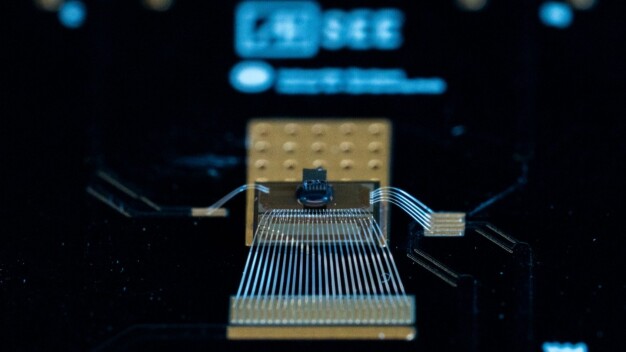
The start-up Germanium Quantum Detectors is developing a photodetector based on germanium, which is more cost-effective and flexible to use than conventional products. (Image: Nico Scheller)
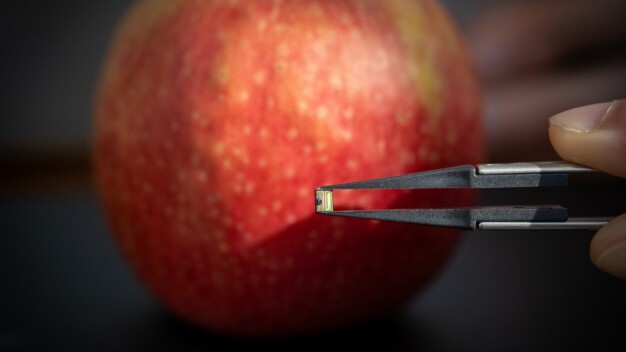
Due to its compact size, a wide variety of application possibilities are available. The founders want to produce their innovative germanium-on-silicon photodetectors for manufacturers in the autonomous driving sector and the medical technology industry as well. (Image: Nico Scheller)
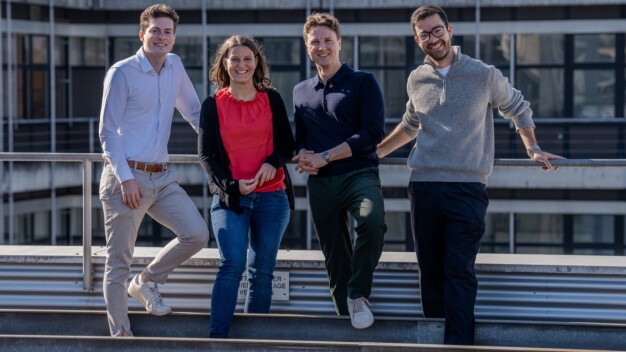
The founding team from left to right: Maurice Wanitzek, Claudia Bett, Dr. Maximilian Scheu, and Jakob Finkbeiner. (Photo: Nico Scheller)
Highly sensitive light sensors are needed, among other applications, in quantum communication, medical technology, and autonomous driving. Researchers at the Institute for Semiconductor Technology (IHT) at the University of Stuttgart have developed a photodetector based on germanium, which is more cost-effective and flexible than conventional products. To bring this technology to market, four early-career scientists are now founding the startup "Germanium Quantum Detectors."
"LabOne" is displayed on an inconspicuous gray metal cube with edges only eight centimeters long. Inside the prototype's housing is cutting-edge technology set to establish new market standards: a microchip on which four so-called "Single-Photon Avalanche Diodes" (SPADs) are connected in series. With this highly sensitive light sensor, individual photons—the smallest units of light—and the precise timing of their arrival can be measured. Silicon photodetectors are already used in many areas today, including in 3D cameras for modern driver assistance systems. The special feature of this new development, which is fully compatible with standard semiconductor manufacturing, is the use of small amounts of germanium. This material absorbs infrared light, which offers significant advantages in autonomous driving: Germanium-based photodetectors can detect obstacles more quickly and accurately over greater distances and in poor visibility conditions—an enormous safety benefit.
Germanium-based photodetectors are more compact and easier to manufacture
Why aren't such detectors already widely in use? A look into a laboratory at the Institute for Semiconductor Technology (IHT) at the University of Stuttgart provides the answer: there is a cooling unit about the size of a minibar, into which the prototype would probably fit about thirty times. Typical detectors for individual photons need to be cooled to nearly -270 degrees Celsius to prevent signal distortions. The novel germanium-on-silicon photodetector achieves the same quality level already at -10 to -20 degrees. This not only offers a much better cost-benefit ratio but also, due to its small size, provides a wide range of application possibilities.
The path from laboratory to practical application
Maurice Wanitzek, who significantly developed the technology at IHT, now aims to bring it into practical use together with three co-founders. "During my doctorate, many industry partners told me they found the product interesting and would like to buy it. As an engineer, I naturally dream of my development having real benefits and not ending up in a drawer. That’s how the idea to start a company arose." Wanitzek approached the Technology Transfer Initiative (TTI GmbH) of the University of Stuttgart to assess the chances of success. "The result encouraged me, and TTI also helped me significantly with the next steps." A coach introduced him to the EXIST research transfer program and assisted with preparing the application. Additionally, Wanitzek participated in workshops at the university's transfer center (TRACES) for aspiring founders: "This exchange was very helpful. And having to present our ideas in ten minutes made preparing the pitch for the EXIST application much easier," he says.
"We support founders with tailored consulting and funding offers to turn their bold ideas into reality," says Professor Alexander Brem, Vice Rector for Transfer and International Affairs at the University of Stuttgart. "The team of Germanium Quantum Detectors demonstrates how to advance innovations in a future-oriented field and that it pays off to take the step into entrepreneurship."
An EXIST grant of around 1.2 million euros over two years provides the four-person startup team with momentum to further develop their technology toward market readiness. The founders—Maurice Wanitzek, an expert in microelectronics; circuit designer Jakob Finkbeiner; Claudia Bett, a physicist specializing in optics and system integration; and Dr. Maximilian Scheu, a business economist specializing in entrepreneurship—have their office at IHT. They also work closely with the Stuttgart Institute for Microelectronics IMS-CHIPS. In its highly specialized cleanroom, the photodetectors will continue to be produced. The founders also continue to utilize the workshop offerings of TRACES, most recently on corporate law.
Building something new with a lot of creative freedom
"We divided the tasks within the team according to our areas of expertise and are learning an incredible amount from each other," says Claudia Bett. Despite an offer from industry, she decided to join the startup: "I prefer to work independently rather than be dictated to. Building something new together offers a lot of creative freedom." The first customers have already been secured: researchers developing applications in quantum cryptography a few buildings away. Because the elementary information units (qubits) are transmitted via photons, they require highly sensitive light sensors.
In the next phase, the four founders aim to produce for manufacturers in autonomous driving, and in the medium term, also for the medical technology sector: their photodetectors can, for example, be used in infrared spectroscopy. Currently, the team is in discussions with numerous companies. Wanitzek states that the biggest challenge is to find enough customers with similar requirements for the product to enable economical production: "We hope to be in the profit zone in five years—and that our example will motivate others to start their own businesses."
Universität Stuttgart
70569 Stuttgart
Germany