



- Electronics (wafers, semiconductors, microchips,...)
- Translated with AI
Planning expertise for the battery cell factory of the future
Opening of the FFB PreFab in Münster
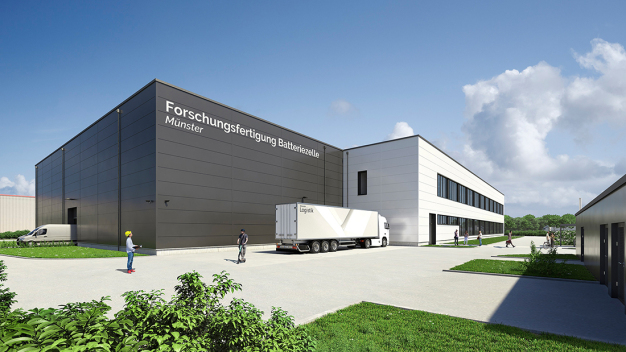
On April 30th, the first building of the Fraunhofer Institute for Manufacturing Technology and Advanced Materials (IFAM) Battery Cell Research Facility (FFB) was opened in Münster. © Network
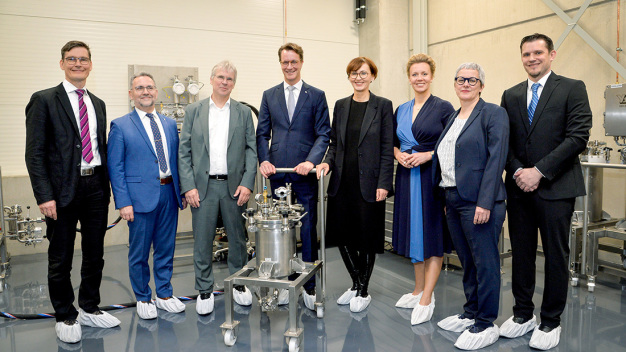
V. l. n. r.: Prof. Dr. Achim Kampker and Prof. Dr. Jens Tübke, Institute Directors of the Fraunhofer FFB, Prof. Dr.-Ing. Holger Hanselka, President of the Fraunhofer-Gesellschaft, Hendrik Wüst, Prime Minister of North Rhine-Westphalia, Bettina Stark-Watzinger, Federal Minister of Education and Research, Ina Brandes, Minister for Culture and Science of North Rhine-Westphalia, Silke Krebs, State Secretary in the Ministry of Economy, Industry, Climate Protection and Energy of North Rhine-Westphalia, Prof. Dr. Simon Lux, Institute Director of the Fraunhofer FFB. © Susanne Kurz/Fraunhofer Facility for Battery Cell Research FFB
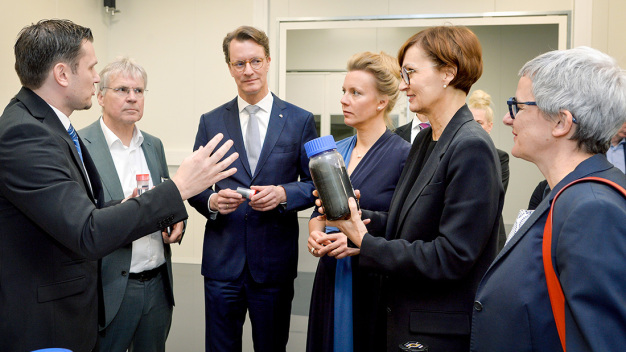
V. l. n. r.: Prof. Dr. Simon Lux, Institute Director of the Fraunhofer FFB, Prof. Dr.-Ing. Holger Hanselka, President of the Fraunhofer-Gesellschaft, Hendrik Wüst, Prime Minister of North Rhine-Westphalia, Ina Brandes, Minister for Culture and Science of North Rhine-Westphalia, Bettina Stark-Watzinger, Federal Minister of Education and Research, Silke Krebs, State Secretary in the Ministry of Economics, Industry, Climate Protection and Energy of North Rhine-Westphalia. © Susanne Kurz/Fraunhofer Facility for Battery Cell Research FFB
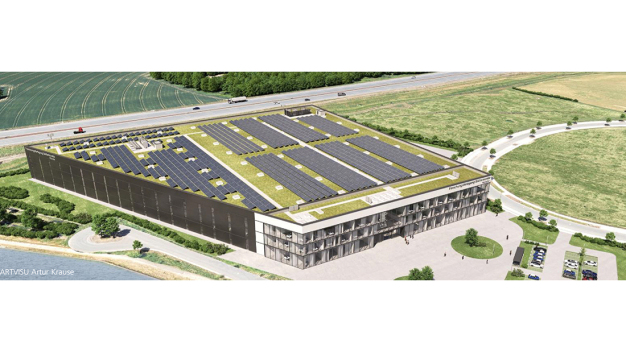
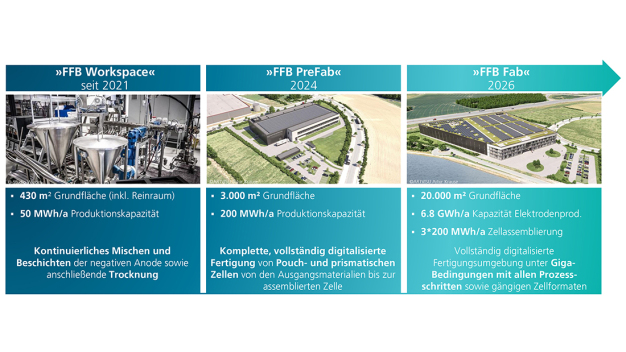
Infrastructure of Fraunhofer FFB – Laboratories and Construction Phases
On April 30th, the first building of the Fraunhofer Institute for Battery Cell Research Manufacturing FFB was opened in Münster. The new research factory aims to test and optimize battery cell production on an industrial scale. Researchers from Fraunhofer IPA are significantly involved in the planning and implementation.
"Manufacturing battery cells on an industrial scale is already a major challenge: the facilities are very complex and impose high demands on the production environment, such as purity and dryness," explains Marc-André Berchtold. The IPA engineer is leading the factory planning in the project "Research Manufacturing of Battery Cells Germany," or FoFeBat for short. "In the research factory, whose first construction phase, the 'FFB PreFab,' has now been opened, the focus is not only on production but also on working with new cell formats, processes, and technologies."
To ensure this is possible in the long term, adaptable factory and production structures have been designed in the project. "Technology is constantly evolving. In a few years, new systems and new battery cell formats will come onto the market. Therefore, the research factory must be designed in a way that it can be adapted to these developments," says Berchtold.
The Secret of Flexibility
But how does one design a flexible battery cell factory? "The basic requirement is a detailed analysis of the process steps and requirements," responds the IPA expert: "Rigid production lines in non-adjustable clean and dry rooms, as is currently state of the art, are unsuitable for this purpose."
The solution is a modular setup of the production structures: because each manufacturing step requires a very specific environment, the rooms housing the production equipment must be equipped accordingly. At the same time, it is essential to ensure that the rooms are properly dimensioned and can be repurposed to enable long-term use. Furthermore, connections—such as for water, compressed air, or electricity—must be planned so that new manufacturing technologies can be integrated smoothly into operations. This modular principle has already been implemented in the FFB PreFab.
The Key to Success: Practical Experience and Digitalization
In addition to factory planning, teams at IPA support the development of the research battery cell manufacturing facility in selecting the production equipment: To realize the specific requirements of a research factory, discussions were held with manufacturers from Europe, Asia, and America. A focus was on the specifications of the mechanical and electrical interfaces between the systems. Engineers from IPA accompany the tendering and awarding process.
Researchers at IPA are also involved in selecting digital tools and IT infrastructure specifically suitable for research manufacturing. Digital networking is crucial for the success of the battery factory: Only with data that is collected and analyzed centrally can researchers and manufacturers optimize processes, identify potential sources of error, and improve quality.
The expertise that the specialists in Stuttgart have gained in planning and implementing the research factory is intended to benefit users who are planning new battery cell factories, optimizing existing ones, or digitizing their processes in the future.
About the Project
- Open battery cell factory for research and development purposes
- As part of the "FoFeBat" project, the Federal Ministry of Education and Research and the state of North Rhine-Westphalia are promoting the construction of the Fraunhofer FFB with a total of around 820 million euros. The federal government is funding the Fraunhofer FFB with up to 500 million euros for research facilities and projects, while North Rhine-Westphalia is investing around 320 million euros in land and new buildings.
- More than 170 battery experts (including partners)
- Production capacity: theoretically up to 7 GWh/year (electrode)

Fraunhofer-Institut für Produktionstechnik und Automatisierung IPA
Nobelstraße 12
70569 Stuttgart
Germany
Phone: +49 711 970 1667
email: joerg-dieter.walz@ipa.fraunhofer.de
Internet: http://www.ipa.fraunhofer.de