

- Robot
- Translated with AI
Physical AI for Retail and Logistics: Teradyne Robotics and Sereact Collaborate
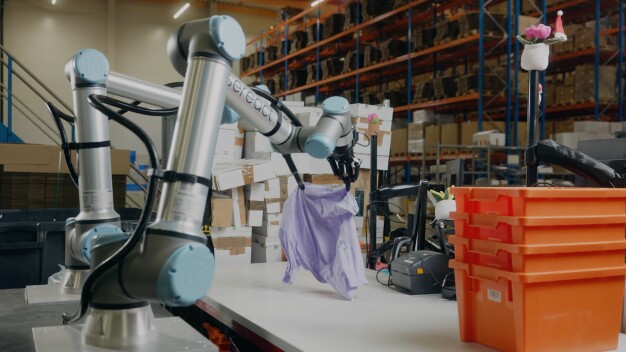
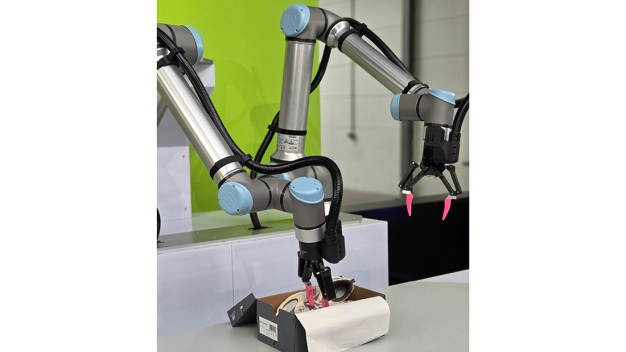
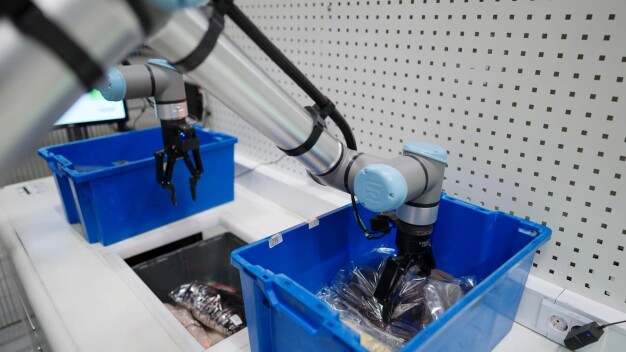
The partnership combines Sereact’s Physical AI platform with collaborative industrial robots from Universal Robots (UR). The goal is to provide intelligent and flexible automation solutions for processes that have previously been difficult to automate, such as processing returned fashion items.
Teradyne Robotics – the company behind Universal Robots and Mobile Industrial Robots – and Sereact, a pioneer in Physical AI for robotics, today announced an official partnership. Together, the companies aim to accelerate the use of industrial AI solutions in retail, logistics and manufacturing.
As part of the partnership, Sereact’s Cortex Physical AI platform controls robot arms from Universal Robots. This gives retail and logistics companies a field-tested solution for automating unstructured tasks such as returns processing and single-item picking. Together, the companies have already delivered hundreds of UR robots in dual-arm systems to customer sites across Europe, where they are in productive operation.
“Physical AI only delivers value when it proves itself in real-world operations. That is precisely where Universal Robots’ robots have always operated. Our robots are made for the age of AI: They are open, connected and have already proven themselves in more than 100,000 industrial applications. That is why Sereact chose our robots,” says Jacob Pascual Pape, Chief Commercial Officer of Teradyne Robotics.
“Our joint solution can handle mixed goods, unknown items and variable packaging. The technology has long moved beyond the demo or pilot stage and is already being used successfully at real customer sites. Our technologies complement each other perfectly. Through our partnership, we will now rapidly expand these AI-powered solutions to additional applications, industries and markets,” Pape continues.
To meet rapidly growing demand, Sereact opened a US headquarters in Boston, Massachusetts, this summer. The aim is to make the joint solution available in North America in the future as well.
One AI model, numerous applications
Sereact and Teradyne Robotics’ solutions offer potential for numerous key applications in logistics and manufacturing. These include returns processing, supplying goods to stores, single-item picking and sorting, order induction, machine tending, container-content consolidation, kitting, packing and general material handling.
“Whether it is returns processing, supplying goods or kitting: With Cortex, all these applications run on the same model. A single ‘brain’ controls all the robots, without requiring retraining for every new item or task. And what one robot learns benefits all the others,” explains Dr. Ralf Gulde, CEO and co-founder of Sereact.
He explains: “Through our partnership with Teradyne Robotics and its global network of distributors and integrators, we can make this intelligence accessible to customers around the world. This makes it easier for retail and logistics companies to implement AI-powered automation in their operations and accelerates its adoption.”
Live at NVIDIA GTC Berlin
This week, the companies are showcasing their partnership with a joint demonstration at NVIDIA GTC Berlin 2026. At the NVIDIA booth, Sereact’s vision-language-action (VLA) model controls two UR12e-1300 robots from Universal Robots. The demonstration features an application for returns processing that is already being used in real logistics centers.
The implementation is being carried out in cooperation with CEVA Logistics for Zalando. The European technology platform for fashion and lifestyle connects 62 million active customers with more than 7,000 brands in 29 markets. At Zalando’s logistics centers in Greven, Germany, and Świebodzin, Poland, the robots are already autonomously processing returned fashion items. This is the first phase of a broader initiative to expand the automation of returns processing across Europe.
“Returns processing is one of the most demanding tasks in logistics. Returned products almost never arrive in an order suitable for robots. Items differ in shape, orientation and packaging, and the composition of the goods is constantly changing. Cortex, which operates on the Universal Robots platform, was developed precisely for challenges like these,” explains Dr. Gulde.
He adds: “By quickly preparing returned goods for resale, the solution also helps retailers comply with EU regulations that prohibit the destruction or landfilling of returned goods.”
NVIDIA technologies as the technological foundation
NVIDIA technologies play a central role in Sereact and Universal Robots’ joint demonstration at GTC Berlin. Cortex is trained with NVIDIA Isaac Sim, an open simulation framework, using NVIDIA Cosmos’ open world models. The model is then further trained using reinforcement learning in the NVIDIA Isaac Lab framework and tested on Teradyne Robotics hardware before being deployed in production.
During operation, Cortex runs directly at the robot cell on NVIDIA Jetson Thor. There, the platform enables AI inference at the speed required for the production process. NVIDIA DGX Spark is used to develop, validate and update the models at the site level.
Teradyne Robotics also relies on NVIDIA computing technology across its Universal Robots and Mobile Industrial Robots (MiR) product portfolios. In addition, Teradyne Robotics provides simulation-ready OpenUSD robot models (SimReady Assets) for Universal Robots and MiR products in the SimReady Central Library on Hugging Face. This makes it easier for developers to find and reuse robot models for simulations without having to laboriously prepare the corresponding digital models.
Universal Robots A/S
5260 Odense S
Denmark