

- Universities
- Translated with AI
Part-time, interdisciplinary master's program aims to prepare professionals in quantum technologies
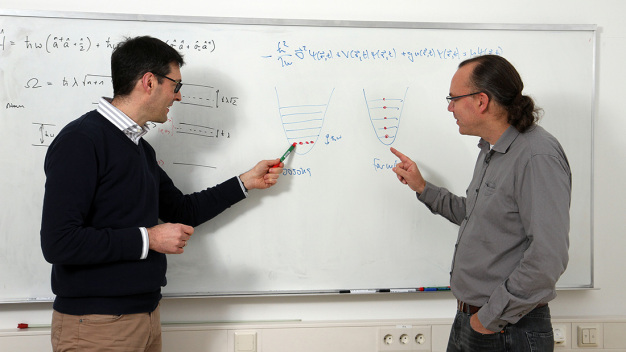
Professor Dr. Artur Widera (left) and Professor Dr. Herwig Ott research and teach about quantum technologies. (Photo: Koziel/TUK)
Quantum technologies are increasingly pushing into industrial applications at a faster and faster pace. Development in some areas is progressing so quickly that the demand for skilled professionals cannot be met by graduates from universities. To enable working professionals to qualify at an academic level in quantum technologies, the Technical University of Kaiserslautern (TUK) will develop a part-time, interdisciplinary distance learning program. The Federal Ministry of Education and Research (BMBF) is providing around two million euros over three years for the conception and development within the framework of funding programs for quantum technologies.
Quantum technologies are changing the way sensors, computers, storage media, or communication can function. "They sometimes utilize surprising properties that can now be very well controlled technically," says Professor of Physics Dr. Artur Widera from TU Kaiserslautern, who is leading the project. "The applications are diverse." They range, for example, from quantum computers for optimizing fuel consumption, to quantum sensors for more precise measurements on living systems, to quantum communication for exchanging information over more secure channels.
However, realizing such applications requires a great deal of expertise. Companies that want to invest in these new technologies sometimes struggle to meet their needs: already employed professionals often lack sufficient experience and knowledge in this area.
The new master's program called QuanTUK aims to address this need in the future. It is scheduled to start in three years at the Distance and Independent Studies Center (DISC) of TU Kaiserslautern. It will be situated at the intersection of physics, mathematics, computer science, electrical engineering, and information technology. "We rely on interdisciplinarity here to bring students closer to the subject from many perspectives," continues Widera.
Working groups from the aforementioned departments cooperate closely with the Fraunhofer Institute for Techno-Economics and Mathematics ITWM and the German Research Center for Artificial Intelligence (DFKI) in developing the new continuing education offering. The project is also supported by an industry advisory board to optimally tailor the programs to the needs of the economy.
“The challenges of quantum technologies are cross-disciplinary problems involving all participating fields. Our existing interdisciplinary collaborations were an important starting point for this project,” says Widera. “TU Kaiserslautern has the ideal conditions nationwide for this project: excellence in interdisciplinary quantum research and teaching, closely connected research institutes such as Fraunhofer ITWM and DFKI with strong industry contacts, and many years of experience in part-time study programs at DISC.”
In particular, the increased collaboration between companies through this educational offering and the associated joint research projects for theses present a great opportunity for scientists to bring new research projects into application.
Dr. Stefan Löhke, Vice President for Studies and Teaching at TUK, emphasizes the importance of the new program: “With our new offering, we are addressing the needs of companies and thus contributing to preparing professionals for future tasks. The development of the program benefits from our good interdisciplinary cooperation between departments and other institutions. I am very pleased that this is paying off in this way.”
Dr. Nadine Bondorf, Director of DISC, adds: “We are pleased to contribute to this highly attractive quantum technology program with our 30 years of experience in distance learning. We are building on the very good collaboration with the involved departments, with whom we already run successful continuing education programs.”
In recent years, TUK has developed into a center for research in quantum physics, from fundamental research, which is addressed by special research areas, to application-oriented projects carried out at the university and in collaboration with partners from industry at the Fraunhofer ITWM. The project is embedded in the research center “Optics and Materials Science (OPTIMAS),” a profile area of the state’s research initiative at TUK.
The BMBF is funding the project within the framework of the funding program “Quantum Technologies – From Fundamentals to Market” (Funding code: 13N15995).
Questions answered by:
Professor Dr. Artur Widera
Research Group for Individual Quantum Systems
Email: widera[at]physik.uni-kl.de
Phone: 0631 205-4130
Dr. Nadine Bondorf
Director of DISC
Phone: 0631 205-4921
Email: n.bondorf[at]disc.uni-kl.de
Technische Universität Kaiserslautern
67663 Kaiserslautern
Germany