- EDP, Hardware, Software
- Translated with AI
Optical Bonding
Perfect advertisements through advanced bonding technology
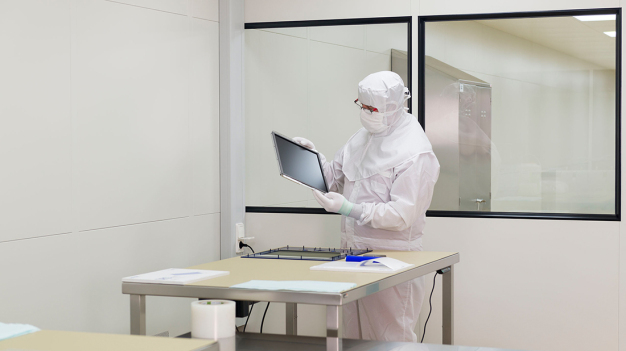
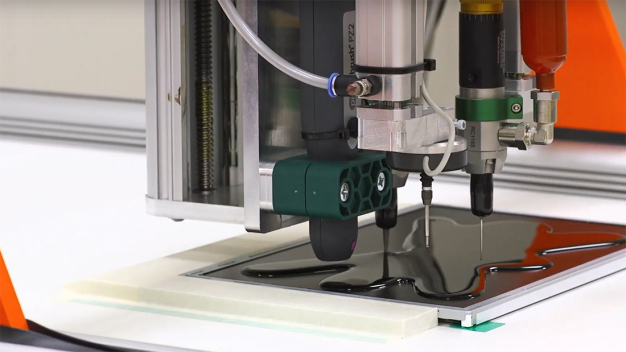
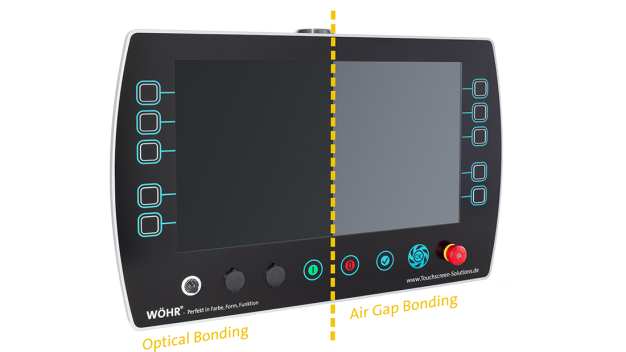
This innovative technology uses highly transparent optical adhesives, such as in liquid form LOCA (Liquid Optical Clear Adhesive), OCA (Optically Clear Adhesive), and OCF (Optical Clear Film), to seamlessly bond various components like glass, touch sensors, and displays, resulting in significantly improved optical perception and enhanced mechanical properties.
The process can be carried out in various variants, including:
Optical Bonding I
The highly transparent bonding of transparent substrates such as glass to glass, touch to glass, or functional layers to glass (e.g., PDLC, prisms). There are several technologies, often categorized into Drybonding (OCA) and Wetbonding (LOCA).
– Optical Clear Adhesives (OCA) process
– Liquid Optical Clear Bonding (LOCA) process
– Optical Clear Foil process (OCF, EVA, PVB, SGP) process
Optical Bonding II
The highly transparent bonding of transparent substrates and display technologies (TFT, O-LED, E-Paper), e.g., display onto cover glass, or display onto touch laminate.
– Optical Clear Adhesives (OCA) process
– Liquid Optical Clear Bonding (LOCA) process
Advantages that can be achieved with Optical Bonding
Reduced reflection: Bonding individual layers reduces light refraction and increases contrast. This leads to better readability, even under challenging lighting conditions, often accompanied by a reduction in display backlight power consumption.
Longer lifespan: Removing the insulating air gap between glass sheets improves thermal management by allowing heat to be efficiently dissipated outside. This results in a lower operating temperature.
Prevention of condensation: Since there is no air gap between the glass/ touchscreen or display, moisture ingress is prevented. The result is complete prevention of condensation formation (no droplet formation).
Increased robustness: A bonded display is more stable and resistant to mechanical stresses. This makes the entire device more durable and less sensitive to external influences.
Dust-free execution: Cleanroom manufacturing prevents particle inclusions, eliminating optical disturbances. Dust or contamination ingress can also be avoided throughout the entire lifecycle.
Improved optics: The user experiences optimal display quality with an enhanced appearance of the device.
The advanced bonding technology represents a significant development in display technology, offering numerous benefits for both manufacturers and end users. It improves the robustness, optics, and functionality of displays while protecting them from external influences. It is particularly suitable for applications in demanding fields such as medical technology, digital signage, automation, mobility, and many more. Whether in aircraft cockpits, medical devices, or outdoor displays – Optical Bonding optimizes performance and increases the operational capability of displays in various environments. Additionally, the improved readability helps reduce brightness settings, lowering energy consumption. The increased longevity of display assemblies also minimizes material waste, leading to a longer device lifespan. An increased user satisfaction with an optically bonded display can significantly enhance acceptance and enthusiasm for your product.
Richard Wöhr GmbH
75339 Höfen/Enz
Germany