



- Science
- Translated with AI
Opening of the Fraunhofer laboratories on the campus of the Roche Biotechnology Center in Penzberg
Immunology, Infection, and Pandemic Research
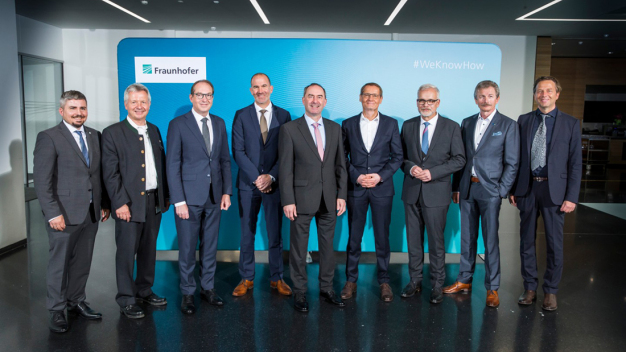
Inauguration of the Fraunhofer Laboratory at Roche Diagnostics GmbH in Penzberg (from left to right): Stefan Korpan, Ullrich Opitz, Alexander Dobrindt, Raoul Klingner, Hubert Aiwanger, Klaus Haberda, Thomas Gudermann, Gerd Geisslinger, Michael Hölscher. © Bernhard Huber Photography
On May 6, 2022, the laboratories of the Fraunhofer site for Immunology, Infection, and Pandemic Research in Penzberg/Munich were officially opened. The goal of the on-site research is to identify and characterize pandemic pathogens, develop new diagnostics and therapies, and better understand the role of the immune system in infectious diseases. Until the completion of their own building, the researchers will carry out their work in rented spaces at Roche in Penzberg. Among the guests and speakers at the ceremonial opening were: Hubert Aiwanger, Bavarian State Minister for Economy, Regional Development, and Energy; Alexander Dobrindt, Chairman of the CSU in the Bundestag; Stefan Korpan, First Mayor of Penzberg; Prof. Raoul Klingner, Director of Research at the Fraunhofer Society; Prof. Thomas Gudermann, Dean of the Medical Faculty of LMU, Board Member of the Walther-Straub Institute for Pharmacology and Toxicology at LMU Medical Faculty; Claus Haberda, Managing Director and Head of Finance at Roche Diagnostics GmbH; Prof. Gerd Geisslinger, Institute Director of the Fraunhofer Institute for Translational Medicine and Pharmacology ITMP; as well as Prof. Michael Hoelscher, Site Director Penzberg/Munich, Fraunhofer ITMP, and Director of the Department of Infectious and Tropical Medicine at LMU Klinikum Munich.
Precision medicine for the benefit of all patients – this goal has been committed to by the partners Roche, LMU Klinikum Munich, Ludwig-Maximilians-University (LMU), and the Fraunhofer Society, and they are establishing an institute site of the Fraunhofer Institute for Translational Medicine and Pharmacology ITMP in Penzberg. The institute's task will be to identify and characterize pandemic pathogens, develop new diagnostics and therapies, and better understand the role of the immune system in infectious diseases. The new Fraunhofer site is part of a network for immunomodulated diseases, which will in the future ensure the targeted bundling of relevant forces within the German research landscape.
In this context, a strategic partnership is forming between Roche, LMU, LMU Klinikum Munich, and the Fraunhofer Society at the Penzberg/Munich location to establish an institute site of the Fraunhofer Institute for Translational Medicine and Pharmacology ITMP, which will characterize the role of the immune system in infectious diseases and immune reactions.
For the permanent accommodation of the new research capacities, a new building has been initiated in the immediate vicinity of the Roche factory premises. Temporarily, the research work will begin in rented spaces at Roche's Life Sciences Competence Center in Penzberg.
Hubert Aiwanger, Bavarian State Minister for Economy, Regional Development, and Energy, said: "Prevention, precaution, and early detection of future pandemics are essential. With financial support of 40 million euros from the Free State, Bavaria aims to make an important contribution to immunology and infection research in the future. The new Fraunhofer Institute is a unique lighthouse project. I am convinced that the close integration of university research and industry will lead to significant advances in diagnostics, therapeutics, and vaccine development. Ultimately, we will all benefit from the new therapies and medicines funded by the government."
Alexander Dobrindt, Chairman of the CSU in the Bundestag, stated: "I am very pleased that we have succeeded in establishing this unique cooperation for a science campus in Penzberg with the Fraunhofer Society and the German Bundestag. The Fraunhofer Institute in Penzberg is a great gain and an extraordinary opportunity for our health region. My heartfelt thanks for the excellent networking of university research and applied top medicine go to all cooperation partners, the Roche Group, and the city of Penzberg for hosting this successful project."
"With the Fraunhofer site for Immunology, Infection, and Pandemic Research in Penzberg/Munich, we are creating a gravitational center for research on infectious agents as well as a hub of national immunology research in Germany. I am confident that this cooperative enterprise will also develop international influence," said Prof. Reimund Neugebauer, President of the Fraunhofer Society, on the occasion of the ceremonial laboratory opening. "We have already achieved a lot. When – as in this case – the framework conditions are right and all actors act together and decisively, such an important project can only succeed."
Prof. Thomas Gudermann, Dean of the Medical Faculty of LMU, Board Member of the Walther-Straub Institute for Pharmacology and Toxicology at LMU Medical Faculty, explained: "In the field of research, cooperation between academic research and industry is becoming increasingly important. The Fraunhofer project targets this interface." Prof. Michael Hoelscher, Site Director Penzberg/Munich, Fraunhofer ITMP, and Director of the Department of Infectious and Tropical Medicine at LMU Klinikum Munich, added: "The research location Munich/Penzberg has even more to offer: the next steps will be networking with other important research institutions in Munich, especially with our sister university TUM and the Helmholtz Center Munich."
"The scientific concept of the Fraunhofer Society with its four components: medicines, diagnostics, data, and medical systems, is the basis for personalized patient care," emphasizes Claus Haberda, Managing Director and Head of Finance at Roche Diagnostics GmbH. "In the strategic partnership with Fraunhofer and LMU Munich, Roche contributes its complementary expertise in medicines, diagnostics, and data, and together we can improve healthcare for patients."
About Roche in Germany
Roche employs around 17,500 people in Germany in the fields of pharmaceuticals and diagnostics. The company is represented at three major sites in Grenzach-Wyhlen (Roche Pharma AG), Mannheim (Roche Diagnostics GmbH, Roche Diagnostics Deutschland GmbH, Roche Diabetes Care GmbH, and Roche Diabetes Care Deutschland GmbH), and Penzberg (Biotechnology Competence Center, Roche Diagnostics GmbH). The focus areas span the entire value chain of the two business sectors, Pharma and Diagnostics: from research and development to production, logistics, and marketing and sales, with each site also handling global tasks alongside its German operations. Roche is clearly committed to its German locations and has invested approximately 2.5 billion euros in them over the past five years.
About Ludwig-Maximilians-University Munich (LMU)
LMU is one of Europe's leading universities with a tradition of over 500 years. It offers a broad spectrum of all fields of knowledge – the ideal basis for excellent research and demanding teaching. Its disciplines range from humanities and cultural sciences to law, economics, social sciences, medicine, and natural sciences. 18 percent of the 50,000 students come from abroad – from a total of 130 nations. The expertise and creativity of the scientists form the foundation of the university's outstanding research record. The success of LMU in all three phases of the Excellence Strategy and its ongoing funding as an "Excellence University" demonstrate the university's research strength."
About LMU Klinikum
LMU Klinikum is one of the largest university hospitals in Germany and Europe. Annually, 500,000 patients trust in the competence, care, and commitment of our 11,000 staff members across approximately 50 specialized clinics, institutes, and departments.
Outstanding facilities at LMU Klinikum include the oncology center CCC-M and Bavaria's largest transplantation center TxM.
LMU Klinikum is the only hospital involved in all German centers for health research.
The Medical Faculty and LMU Klinikum make a significant contribution to the Excellence Strategy of Ludwig-Maximilians-University Munich.
Fraunhofer-Gesellschaft zur Förderung der angewandten Forschung e.V.
80686 München
Germany