


- Translated with AI
One, two, three - many
Special detector measures the exact number of photons in a weak light pulse
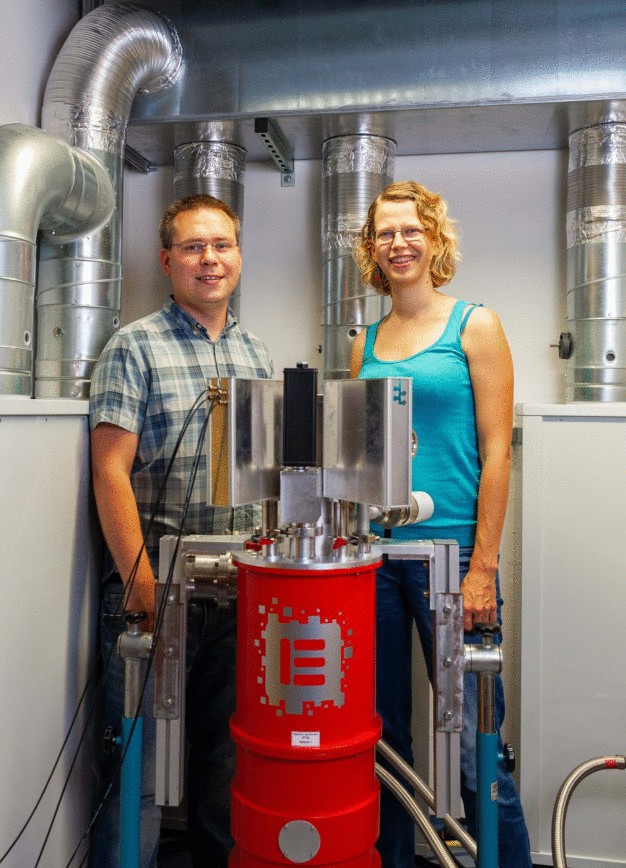
Elisabeth Schlottmann and Marco Schmidt, both research assistants of Prof. Reitzenstein at TU Berlin, present the complex structure of the special photon detector. (© TU Berlin/PR/Felix Noak)
For most people, light is just light. Not so for the physicists in the working group of Stephan Reitzenstein, from the Institute of Solid State Physics at TU Berlin. "We are very interested in exactly which processes cause light (i.e., photons) to be emitted. The so-called photon statistics, which tells us how many photons are contained in a particular light pulse, provides us among other things with information about whether it is laser light (so-called coherent light) or normal, thermal light (so-called incoherent light). For strong light sources, the decision between the coherent light of a laser and the thermal light, for example from a candle, is very straightforward. It becomes more complicated with weak light pulses, such as those emitted by nanophotonic light sources. With the research work now published together with the Physikalisch-Technische Bundesanstalt (PTB), it has been possible for the first time to develop a measurement method that can determine the exact number of photons even at extremely low intensities.
Normal photodiode detectors lack the necessary sensitivity to detect individual photons, let alone determine the exact number of photons in light pulses. They cannot, for example, distinguish between one million or one million plus one photons. Surprisingly, it becomes somewhat easier again with single-photon sources, which can be characterized with so-called click detectors. These are known to emit only one photon at a time. "The interesting intermediate range, in which micro lasers emit weak light pulses of around 1 to 40 photons, has so far remained open," outlined Elisabeth Schlottmann, a researcher in the Reitzenstein group, who is working on this research topic. These special micro lasers were developed together with colleagues in the group of Prof. Sven Höfling at the University of Würzburg.
"Thanks to our very good and long-standing cooperation with PTB Berlin, we were able to jointly set up and use a suitable detector, a so-called Transition Edge Sensor, in our laboratories," said the scientist. The detector system, developed by the NIST (National Institute of Standards and Technology) in the USA and PTB, operates just above absolute zero at a temperature of only 100 millikelvin – which corresponds to about minus 273 degrees Celsius. This makes it actually possible to measure precisely whether one, two, or multiple photons arrive simultaneously in a light pulse. "You can't just buy such a detector. There are only a handful of these detector systems worldwide," added Stephan Reitzenstein.
"With this detector, we obtain significantly deeper information about a light pulse than is normally possible. For example, we were able to prove that two micro lasers, which appeared to have the same properties with the previously established measurement methods, show different photon distributions in each pulse. The number of photons per pulse follows a certain probability distribution," explained Elisabeth Schlottmann. To determine the exact form of the probability distribution, the researcher performed many millions of measurements with individual pulses and each time determined the exact photon count per pulse. From the results, she created a kind of histogram that allows predictions of the probability that a particular micro laser emits a specific number of photons in a given pulse.
"The detector also distinguishes whether the photons are chaotic – i.e., thermal – light or exhibit a coherent distribution as expected from laser light. This allows us to sharply differentiate light pulses between laser light and thermal light even in the quantum regime of individual photons. Interestingly, laser light and thermal light can produce the same power but look completely different in the photon histogram," said Elisabeth Schlottmann.
"Such measurements for micro lasers have not existed until now. This is also an interesting result for all theorists who have made predictions about how the photon distribution should look in micro lasers. We can now investigate for the first time whether the predicted distribution matches reality or if the theorists need to rethink," said Stephan Reitzenstein, who achieved these results as part of his ERC Consolidator Grant "EXQUISITE".
Exploring the Photon-Number Distribution of Bimodal Microlasers with a Transition Edge Sensor
E. Schlottmann, M. von Helversen, H. A. M. Leymann, T. Lettau, F. Krüger, M. Schmidt, C. Schneider, M. Kamp, S. Höfling, J. Beyer, J. Wiersig, and S. Reitzenstein
Phys. Rev. Applied 9, 064030 (2018).
DOI:10.1103/PhysRevApplied.9.064030
Photon-Number-Resolved Measurement of an Exciton-Polariton Condensate
M. Klaas, E. Schlottmann, H. Flayac, F. P. Laussy, F. Gericke, M. Schmidt, M. v. Helversen, J. Beyer, S. Brodbeck, H. Suchomel, S. Höfling, S. Reitzenstein, and C. Schneider
Phys. Rev. Lett. 121, 047401 – Published 25 July 2018
https://journals.aps.org/prl/abstract/10.1103/PhysRevLett.121.047401
DOI: 10.1103/PhysRevLett.121.047401
Technische Universität Berlin
10587 Berlin
Germany