


- Translated with AI
On the trail of textile stimuli perception
Hohenstein researchers develop new methods for analyzing and assessing the interaction between textiles and human skin.
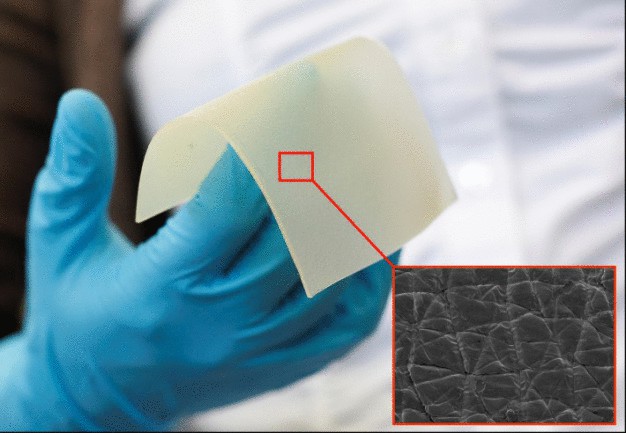
Artificial skin ("HUMskin") for the investigation of skin-textile interaction. It exhibits numerous physiological properties of human skin as well as the surface profile of the epidermis. (© Hohenstein Group)
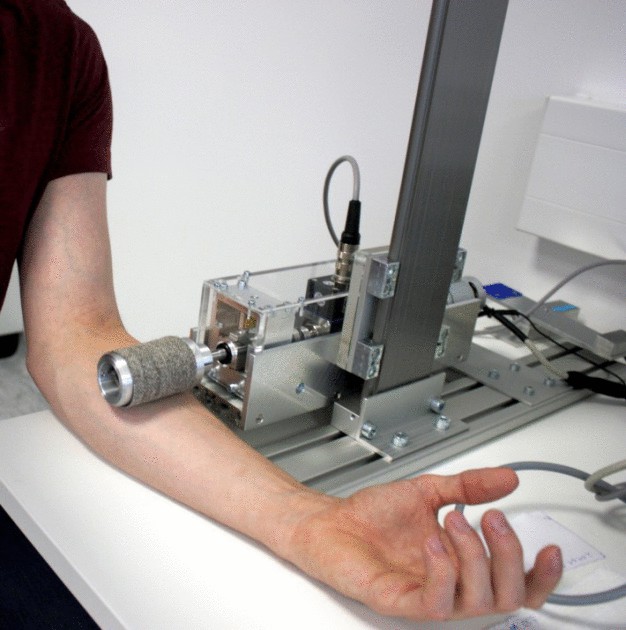
With the help of the developed applicator SOFIA2.0, a standardized application of textiles to various body parts with varying pressure and speed is possible. (© Hohenstein Group)
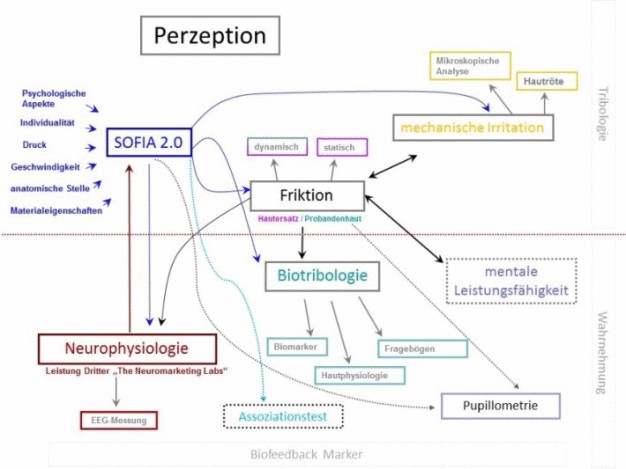
Parameters and measurement methods that are relevant for the perception of textile stimuli. (© Hohenstein Group)
The IGF project 137 EN of the Research Association Research Consortium Textile e.V., Reinhardtstraße 12-14, 10177 Berlin, was funded through the AiF within the framework of the program for the promotion of industrial joint research and development (IGF) by the Federal Ministry for Economic Affairs and Energy based on a resolution of the Bundestag.
As part of the European community project "Touché" (a subproject of the CORNET project AiF-No. 137 EN), researchers from the Hohenstein Institute have so far investigated open aspects of the interaction between human skin and textiles. The goal of the now successfully completed project was to analyze the perception of textile stimuli as realistically as possible and to develop suitable test methods for assessing both haptic and tactile stimuli. For the textile and clothing industry, the question of the processes involved in the perception of textiles is of central importance because conclusions can be drawn regarding technical construction parameters along the textile chain. Such optimized clothing could thus be specifically designed for the wearer.
During the Touché project, researchers from the WKI for Hygiene, Environment, and Medicine at the Hohenstein Institutes focused on the so-called "fabric feel," i.e., the tactile perception of textiles, which is significant on the body surface during passive wearing of clothing. At the same time, project partners from the University and University of Ghent examined whether and how the active touching of textiles, i.e., the haptic "textile grip," can be measured instrumentally. Furthermore, the cross-disciplinary research approach made it possible to investigate precisely those textile parameters that influence human perception.
For studying the interactions between textile and human, the Hohenstein researchers used a specially developed artificial skin called "HUMskin," which exhibits numerous physiological properties and surface profiles of the outermost skin layer. With this, the wearing events on the body surface, such as static and dynamic friction on the skin, could be realistically simulated under laboratory conditions. Together with the 3D data at the microscopic level, these so-called tribological data provided a fundamental understanding of the material.
Using the textile applicator "SOFIA 2.0," the Hohenstein scientists were also able to standardize textile patterns on various body sites of test subjects with different pressures and varying speeds during the project, to measure the resulting friction compared to the artificial "HUMskin" skin. To capture and evaluate the spontaneous and unconscious reactions of test subjects to textile stimuli as neutrally as possible, neurophysiological and various biological markers were used. For example, the researchers recorded neurological reactions to different textile stimuli using EEG (electroencephalography) and analyzed them. They also examined immunological markers such as Immunoglobulin A (IgA; antibodies) or hormonal marker molecules like cortisol, and conducted measurements of heart rate and electrodermal activity (EDA). Some of these unconscious biological markers, such as EDA and heart rate, proved to be potentially relevant methods for future analysis to gain insights into textile perception.
Based on all the collected results, the scientists were able to create a data set. By combining the various data obtained from microscopy, biotribology, and biomarkers, the perception of textiles on the skin could be realistically analyzed and evaluated. Furthermore, the complex analyses enabled the researchers to identify parameters and disturbance factors relevant to the interaction between skin and textile.
Hohenstein Laboratories GmbH & Co. KG
74357 Hohenstein
Germany