
- Translated with AI
Novel multifunctional supply modules for laboratories
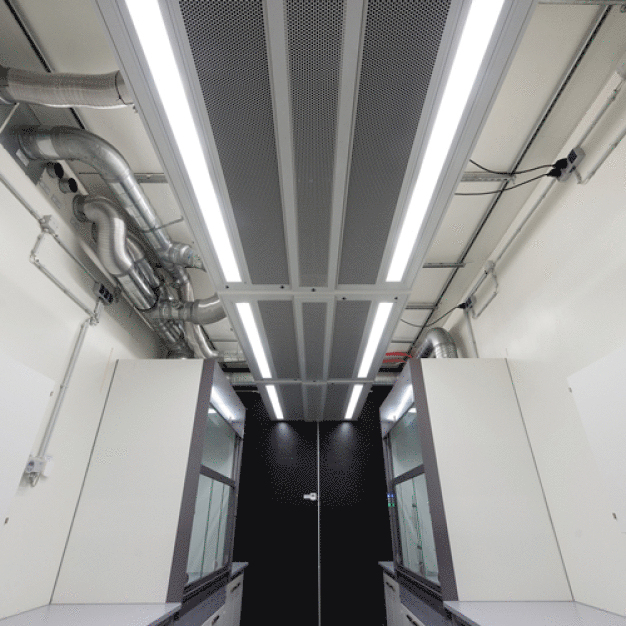
The compact design reduces the installation density at the laboratory ceiling to a minimum compared to individual components. (Image rights: Jörg Stanzick)
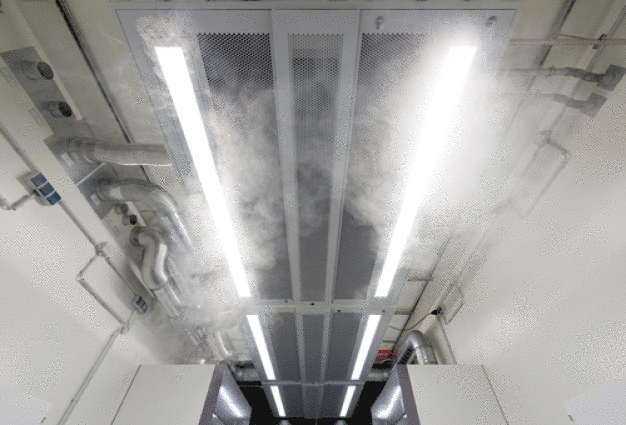
Fresh air flows out from the central outlet at the bottom of the module along the acoustic elements and gradually sinks down – visualized here with smoke. (Image rights: Jörg Stanzick)
![Adjustable outlets on the longitudinal sides enable safe thinning ventilation even at very low air volume flows of only 25 cubic meters per hour per square meter of laboratory floor area [m³/hm²]. (Image rights: Jörg Stanzick)](/uploads/images/_scale/carpuspartner_pressebild_laborlftung_03_bildrecht_jrg_stanzick_web_626x626.jpg "Adjustable outlets on the longitudinal sides enable safe thinning ventilation even at very low air volume flows of only 25 cubic meters per hour per square meter of laboratory floor area [m³/hm²]. (Image rights: Jörg Stanzick)")
Adjustable outlets on the longitudinal sides enable safe thinning ventilation even at very low air volume flows of only 25 cubic meters per hour per square meter of laboratory floor area [m³/hm²]. (Image rights: Jörg Stanzick)
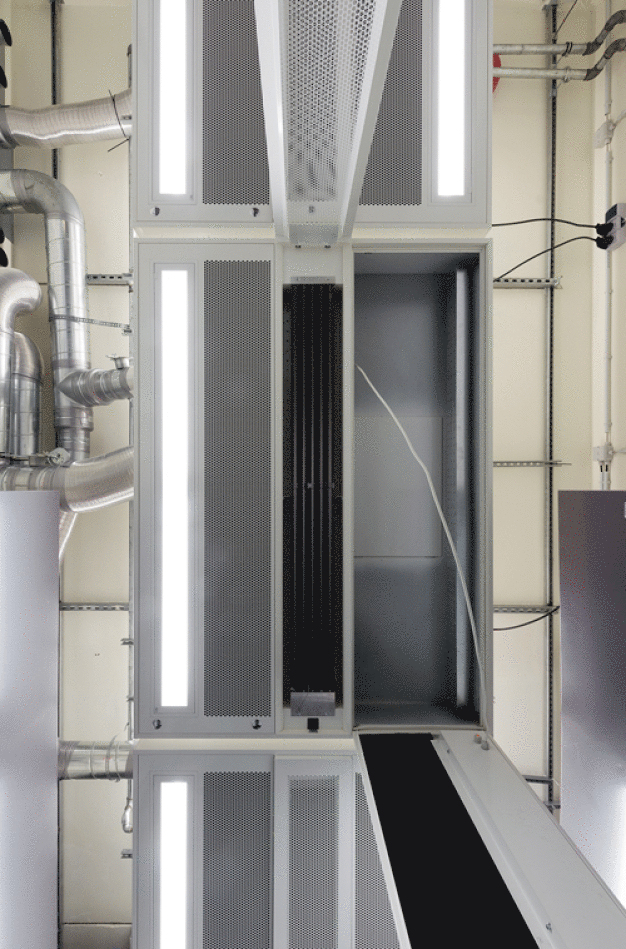
For maintenance work or for cleaning and disinfecting, the modules can be easily opened flat without tools. In the center, the optional heat exchanger is visible. (Image rights: Jörg Stanzick)
Caverion and Carpus+Partner realize for laboratories for the first time ventilation, cooling, and heating as well as lighting and acoustic insulation in a single component. This ensures a comfortable indoor climate, safer workplaces, and simplifies installation efforts.
The ventilation systems in laboratories are crucial for safety and comfort. Until now, numerous individual components had to be carefully coordinated for the relevant functions, and complications between the installing trades were hardly avoidable. The new multifunctional laboratory ventilation modules from Caverion Germany now combine ventilation and supply air, cooling and heating, as well as lighting and acoustic insulation in a compact component for the first time. They were developed in a collaborative project initiated by the architecture and engineering firm Carpus+Partner.
The versatile modules were created through an interdisciplinary engineering process that considers technical building equipment (TGA) even more holistically than before. The result addresses the increasing demands for cutting-edge technology in laboratories as well as the need for safety and comfort at workplaces. The high degree of prefabrication also supports the trend toward time- and cost-efficient construction.
Safety and Comfort at the Laboratory Workplace
The new laboratory ventilation modules are designed for laboratory rooms and maintain particle concentration stability through turbulent mixing airflow. "The air guidance is fundamentally different from conventional swirl outlets or perforated fabric hoses," explains Detlef Makulla, Head of Research & Development at the Caverion location in Aachen. "The air flows from the outlets at the bottom of the module outward along the underside and descends slowly. Additionally, adjustable outlets are located on the sides." This allows for safe dilution ventilation even at very low air volumes of only 25 cubic meters per hour per square meter of laboratory floor area [m³/hm²]. Under certain conditions, the modules can even handle up to 12 m³/hm²; however, special permits are required for laboratory approval.
The air velocities of the turbulent flow are nearly less than 0.2 meters per second throughout the room, ensuring a pleasant comfort level. At the same time, this prevents dangerous spillage effects at digesters, which can occur in unfavorable airflow situations with conventional louver outlets. The integrated acoustic elements at the bottom also reduce noise exposure from many laboratory devices, thereby easing the burden on laboratory staff.
Fast, Economical Installation
"Thanks to their compact design, the ventilation modules reduce the installation density on the laboratory ceiling to a minimum compared to individual components. The simplified assembly without complex coordination of different trades significantly contributes to fast, cost-effective construction," adds Johannes Weitzel, Head of Energy and Environment at Carpus+Partner. "The reason is the high degree of industrial prefabrication – the modules are delivered ready for installation."
Flexibility remains a priority: Depending on requirements, the modules can be additionally equipped with heat exchangers, enabling them to be used not only for ventilation but also for passive or active cooling. If conditions change, an extension is also easily possible afterward. For maintenance work or cleaning and disinfection without interrupting laboratory operations, the modules can be easily opened on the top and bottom surfaces without tools. An expert report from the Dr. Rabe HygieneConsult laboratory confirms compliance with all relevant standards and guidelines.
Practical Development
"From the beginning, we focused on ensuring that the modules could be integrated as seamlessly as possible into standardized laboratory environments," explains Weitzel. Therefore, their dimensions align with the common zoning structure used in laboratory setup. Several components can be connected to supply a zone with demand-oriented supply air and cooling. The air supply occurs within the modules; additional piping is unnecessary.
Currently, Carpus+Partner is implementing large laboratory areas with the variable ventilation modules for Germany’s largest owner-managed laboratory group, the Limbach Group, at the MVZ Laboratory Dr. Limbach & Colleagues in Heidelberg and two other locations. In these projects, the concept was jointly developed to final series readiness. The Waldner Laboratory Equipment GmbH & Co. KG was also involved as a partner: the manufacturer provided Caverion Germany with digesters and other laboratory equipment for testing under realistic conditions.
Carpus+Partner AG
52074 Aachen
Germany