

- Translated with AI
No high-quality coating without a clean surface
ZVO Surface Days with Forum Component Cleaning ends again with a record number of participants
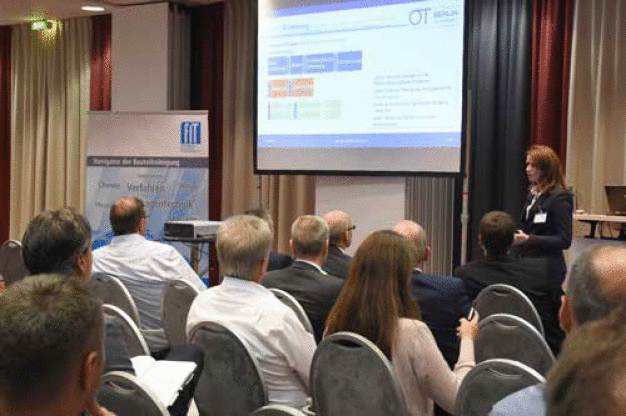
The lecture offerings of the Component Cleaning Forum conveyed a wealth of knowledge on how to produce coating-capable surfaces.
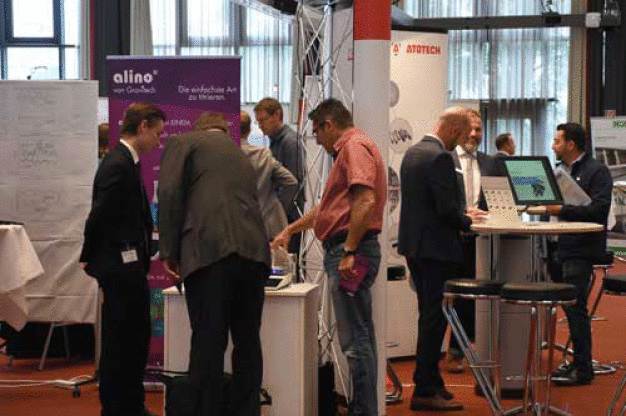
The accompanying exhibition enabled participants to learn about products and services.
Berlin is always worth a trip – and especially when the Surface Days of the Central Association for Surface Technology e.V. (ZVO) take place there. With 665 participants, the event from September 13 to 15, 2017, once again achieved a record participation and offered the most diverse program to date with 87 lectures. The presentations of the integrated Component Cleaning Forum of the Professional Association for Industrial Part Cleaning e.V. (FiT) attracted great interest.
Its leading position as the information and communication platform in the field of galvanic and surface technology was reaffirmed this year at the ZVO Surface Days in Berlin with a new record. 665 participants deepened their knowledge through 87 lectures – also the highest number ever – and informed themselves about trends and new developments in galvanic and surface technology.
Component Cleanliness – Foundation of Coating
With between 35 and 110 participants, the lectures of the two-day Component Cleaning Forum organized by FiT also saw very lively participation. The presentation by Professor Brigitte Haase (University of Bremerhaven) dealt with the contaminants left on a metallic component during manufacturing. It provided an overview of the composition of the contaminants and classified the components of important process media according to their removability. Reiner Grün (Surtec Deutschland GmbH) discussed the chemistry and physics of the cleaning process. He explained the basic structure of aqueous cleaners as full products and 2K systems, the function and synergistic interaction of the components, and the importance of water quality for cleaning quality. Tasks, applications/areas of use, and goals of pretreatment steps such as pickling and decapping formed the topic of Christoph Hoge’s (Coventya GmbH) contribution. The electrochemical degreasing of metals as a mechanical fine cleaning step was presented by Christiane Müller (Dr. Hesse GmbH & Cie KG). She addressed the physical fundamentals, requirements, as well as the advantages and disadvantages of anodic and cathodic degreasing. The recirculation of cleaning and rinsing media as a quality-enhancing and resource-saving measure was presented by Rolf Schreinert (Enviro Falk GmbH). In addition to the fundamentals, examples from various industries illustrated the potential benefits of process water recirculation. Methods for continuous determination of surfactant concentration in galvanic cleaning baths, monitoring bath contamination by oils and fats, and controlling the achieved film cleanliness were introduced by André Lohse (SITA Messtechnik GmbH). Michael Onken (Safechem Europe GmbH) discussed the possibilities of solvent cleaning in pretreatment. He provided information on the application areas of various solvents, the influence of additives contained in processing media on process stability, and economic factors. Professor Peter M. Kunz (Mannheim University of Applied Sciences) addressed what microorganisms can contribute to surface cleaning and degreasing. Using three examples, he demonstrated the economic benefits that can be gained from the use of microorganisms alongside work-improving measures, and what process engineering is required for this. Stefan Nettesheim (Relyon Plasma GmbH) informed about the use of plasma for degreasing and cleaning, for example, to remove an acrylic paint layer from CFRP, a 2K polyurethane paint from an aluminum substrate, or for partial layer removal at adhesive joints. Babette Winkel (Ecoclean) illustrated through various practical examples that aqueous inline washing systems with corresponding media can also be used for surface processes such as iron, zinc, and manganese phosphating as well as for dephosphating. What options exist to optimize an existing cleaning process? This question was answered by Jens Emmerich (BCD Chemie GmbH) using a case study of a hardening plant. The individual work steps along the entire process chain and the measures implemented to achieve the goals – stable follow-up processes, improved process control, and optimized surface quality – were explained. Additively manufactured metallic components are increasingly important in various industries such as medical and energy technology. Subsequent processes, such as cleaning to remove adherences and remelts of powder particles, often still pose a challenge. Johannes Mankiewicz (Fraunhofer Institute for Production Systems and Design Technology IPK) presented the current state of the art, the process strengths, and limitations of methods such as shock wave cleaning, CO2 dry ice and snow blasting, ultrasonic cleaning, and the technical requirements of the systems.
Both the broad range of lectures and the quality of the presentations in the Component Cleaning Forum excited the participants. They were able to take away numerous suggestions. Great satisfaction was also expressed by the 70 companies that presented products and services during the ZVO Surface Days.
The next ZVO Surface Days will take place from September 19 to 21, 2018, in Leipzig. Lecture proposals for the integrated Component Cleaning Forum can be submitted online until January 31, 2018, via https://oberflaechentage.zvo.org/vortragsaufruf.
Fachverband industrielle Teilereinigung (FiT) e.v.
Geschäftsstelle
Hauptstraße 7
72639 Neuffen
Germany
Phone: +49 7025 84340
Fax: +49 7025 843420
email: info@fit-online.org
Internet: http://www.fit-online.org