


- Electronics (wafers, semiconductors, microchips,...)
- Translated with AI
New ultrasonic sensor from SensoTech for semiconductor wet processes
Measure concentrations inline in processes such as SC1, SC2 and BOE
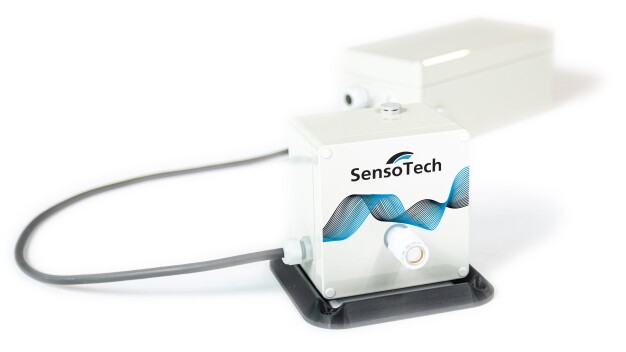
The new SensoTech sensor enables continuous inline monitoring of chemical concentrations in semiconductor wet processes. (Image: SensoTech GmbH)
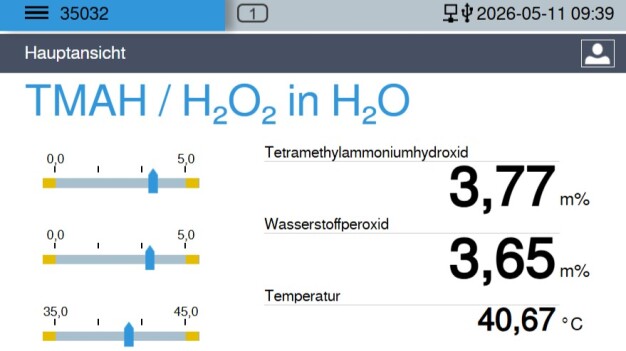
The controller visualizes the inline-measured concentrations of, for example TMAH and H₂O₂ as well as the process temperature, in real time. (Image: SensoTech GmbH)
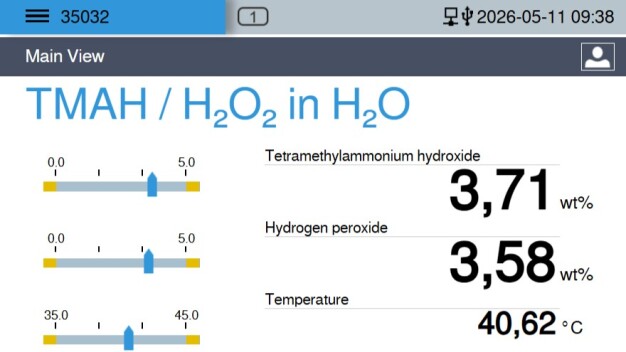
The controller visualizes the inline-measured concentrations of, for example TMAH and H₂O₂ as well as the process temperature, in real time. (Image: SensoTech GmbH)
New sensor technology measures critical chemicals directly in the running process and helps semiconductor manufacturers detect process deviations earlier, reduce (lab) effort and run wet processes more stably.
In semiconductor manufacturing, reliable, controlled wet processes determine yield, quality and reproducibility. Especially in process steps such as SC1, SC2 or BOE (Buffered Oxide Etch), chemical concentrations must be maintained precisely, because even small deviations can negatively affect cleaning and etch results. With a new sensor designed specifically for the semiconductor sector, SensoTech is now bringing an ultrasonic solution to the market that enables these concentrations to be monitored directly inline and in real time.
Inline measurement for critical cleaning and etching processes
The focus is on classic and modified SC1 and SC2 chemistries in wafer manufacturing, specifically NH₄OH / H₂O₂ / H₂O and HCl / H₂O₂ / H₂O, not only in standard mixes, but also in process-specific dilutions, concentration windows and adapted recipes (e.g. with TMAH). The same applies to BOE (BHF) based on HF and NH₄F, where even minor deviations can influence etch rate, selectivity and process stability. The new sensor was designed precisely for these chemically sensitive wet processes.
Everyday challenge: Monitoring process chemistry reliably and cost-effectively
The target audience is primarily semiconductor manufacturers, operators of wet benches and wet-process tools, as well as process, equipment, integration and quality engineers who must ensure chemical process stability in the cleanroom. Their day-to-day work is shaped by tight process windows, high quality pressure, limited cleanroom space and the need to monitor chemical compositions with as little additional sampling or manual handling as possible. Inline analysis solutions already exist for these tasks, but they are often based on more complex measurement methods and are therefore demanding to integrate and operate. This is exactly where the new sensor comes in: Instead of relying on time-delayed lab analyses or complex analytics, concentration information is available immediately within the process.
Ultrasound-based, temperature-compensated and prepared for straightforward integration
The SensoTech solution uses ultrasonic transit time, i.e. the specific speed of sound in the medium, as the central measured variable for determining concentration. Depending on the medium and process, this principle can be combined with additional parameters such as conductivity or other process-relevant variables. The system consolidates the available measurement signals, compensates for temperature effects and calculates the relevant concentration information from them in real time. This creates a flexible measurement architecture for different wet processes without complicating integration. The system is completely maintenance-free, requires no consumables and can be integrated into existing automation environments via standard interfaces.
More control over critical wet processes
The new solution is particularly relevant wherever stable chemical concentrations directly determine process quality and tool availability. In SC1 and SC2 baths, this concerns the reliable adherence to specified recipes, in BOE processes, it additionally involves the precise control of a particularly sensitive etching medium. Continuous concentration monitoring provides a robust data basis for detecting process deviations early, assessing bath lifetime more specifically and aligning maintenance interventions and chemical management more closely with the actual process condition.
Direct benefits for production and process control
For operators of wet-process tools, this primarily means more confidence in day-to-day process control. Concentration trends become transparent, process windows can be maintained more stably and changes in bath condition can be assessed earlier. This supports reproducible tool operation, reduces unnecessarily conservative bath changes and improves the foundation for quality assurance, documentation and ongoing process optimization.
SensoTech GmbH
39179 Magdeburg-Barleben
Germany