- Robot
- Translated with AI
New robotics platform for antibiotic discovery
With the setup at Leibniz-HKI, many experiments can be automated
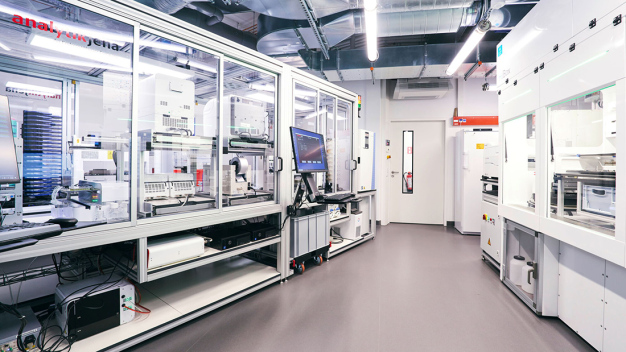
The robotics platform performs laboratory work fully automatically – from preparation to execution to analysis of an experiment. It can carry out a variety of work steps or even multiple experiments simultaneously.
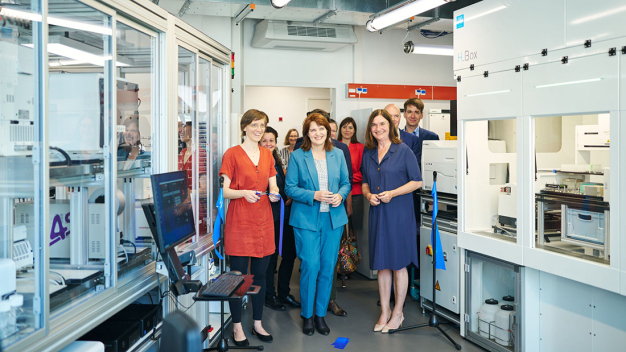
At the inauguration of the robotics platform, Thuringian State Secretary Katja Böhler (center), together with the Administrative Director of Leibniz-HKI Elke Jäcksch (right) and the plant manager Luzia Gyr (left), cuts the symbolic blue ribbon. (Source: Anna Schroll/Leibniz-HKI)
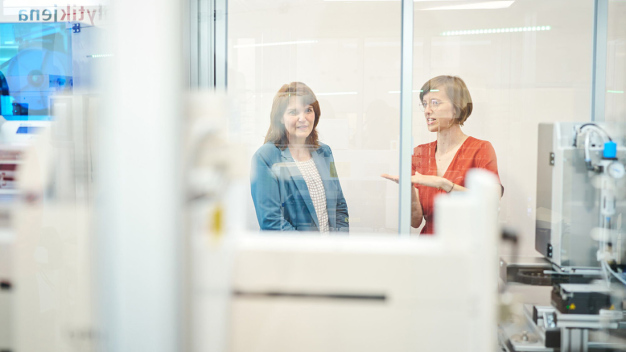
Luzia Gyr (re.), Head of the Robotics Platform, shows State Secretary Katja Böhler the various components of the system and their functionality. (Source: Anna Schroll/Leibniz-HKI)
The new robotics platform at the Leibniz Institute for Natural Product Research and Infection Biology (Leibniz-HKI) is unique nationwide in the academic sector in its combination of size, level of automation, and flexibility. The highly modular system serves the institute to accelerate the discovery of new antibiotics. It was developed in collaboration with the company Analytik Jena GmbH+Co. KG and was officially inaugurated on Thursday, June 15, in the presence of State Secretary Katja Böhler.
The antibiotic crisis is one of the greatest medical challenges of our time. Increasing resistance means that people are dying again from bacterial infections that were long considered easily treatable.
At the same time, the pharmaceutical industry has largely withdrawn from the minimally profitable development of new antibiotics. A main reason for this is the lack of profitability: antibiotics are used sparingly, sold at low prices, and have a short treatment duration.
Publicly funded research is attempting to close this gap. "As a state, we are specifically supporting application-oriented research to bring the results to value creation in Thuringia," says Katja Böhler, State Secretary for Research, Innovation, and Economic Development at the Thuringian Ministry of Economy, Science, and Digital Society. She particularly pointed to the innovation umbrella program "Thüringen MOTIVation," which consolidates all related funding instruments. "Future-oriented cooperation between science and industry makes Jena and Thuringia a high-tech location with many highly qualified jobs. The new robotics system exemplifies how well this interplay between public and private actors works in our region."
"Developing antibiotics with the help of public research funds is a major challenge that our institute is tackling," says Pierre Stallforth, Deputy Director and Project Manager of the new robotics platform at Leibniz-HKI. This was recently achieved with the tuberculosis drug BTZ-043, which was discovered at Leibniz-HKI and further developed in cooperation with academic partners and industry.
The new robotics platform, built within the HKI Biotech Center, is intended to perform experiments faster and more accurately in the future, as repetitive work steps are always carried out exactly the same way. "The combination of automation, data analysis, and innovative research approaches increases the chances of success in identifying new antibiotics," explains Luzia Gyr, head of the system.
The technology platform was designed in close developmental collaboration with the regional bioanalysis specialist Analytik Jena. The most important requirement of future users was maximum flexibility of the system. "Industrial systems are usually characterized by a fixed process sequence. Here, we have a platform that is future-proof and can accommodate the high variability of the institute's and its partners' research topics," explains Matthias Fischer, team leader of automation at Analytik Jena. Lars Böttcher, Vice President for Technology at Analytik Jena, adds: "The project was technically very demanding, but due to the short distances and very intensive coordination among all involved parties directly on site, it was achievable within a relatively short period."
The construction of the modern system was only possible through extensive public funding. It was largely financed by the Federal Ministry of Education and Research within the framework of the Zwanzig20 consortium InfectControl and its follow-up projects. Additional funds were provided by the German Research Foundation within the Excellence Cluster Balance of the Microverse, as well as the state of Thuringia with funds from the European Regional Development Fund (ERDF). The total investment amounts to three million euros. Additionally, the Free State of Thuringia is supporting the jointly applied-for research group RoboThür with one million euros, in cooperation with Friedrich Schiller University Jena, enabling the recruitment of highly qualified personnel for the platform.
The new robotics platform will not only be available to research groups at Leibniz-HKI but also to the University of Jena and other research institutions and industry partners with whom the institute cooperates. Following the recent commissioning of the system, an initial phase of setting up the first test series and validating the results will now take place, which will take several months.
Leibniz-Institut für Naturstoff-Forschung und Infektionsbiologie
07745 Jena
Germany