




- Translated with AI
New applications for micro-lasers in quantum nanophotonics
Your scientists use these lasers to optically excite single-photon sources
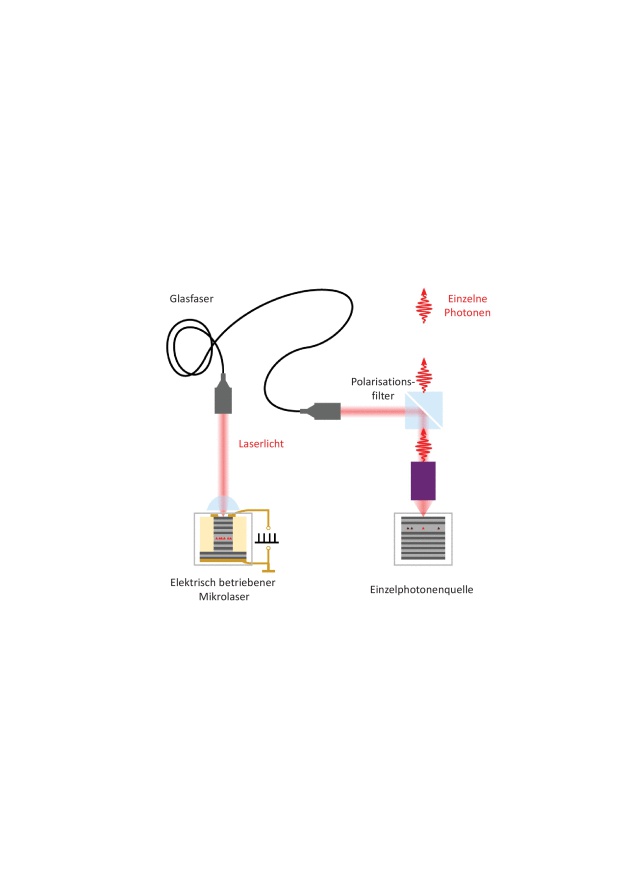
Schematic representation of the experiment: The light from the electrically pulsed micro lasers (left) is guided via a glass fiber to the single-photon source (right). There, it generates individual photons that must be precisely separated from the laser light using a polarization filter. (© Sören Kreinberg/TU Berlin)
The science surrounding micro- and nanolasers is experiencing a worldwide hype. Usually, researchers mainly focus on the fundamental physics of these lasers. What potential benefits these extremely small lasers might have in practical applications remains unclear. "The fact that there are few or no applications for micro lasers is partly because they emit only very low optical power. For example, 1000 micro lasers would be needed to achieve the power of a laser pointer," explains Prof. Dr. Stephan Reitzenstein from the Department of "Optoelectronics and Quantum Devices" at the Institute of Solid State Physics at TU Berlin. "However, applications that require only very little light could be interesting. This is exactly the case when operating a single-photon source." The research group led by Stephan Reitzenstein has, for the first time within the framework of his ERC Consolidator Grant, succeeded in providing a "proof of principle" that a micro laser can be used to excite a single-photon source and emit photons. "Not least, this also allowed us to unite two communities within physics: on the one hand, the science around micro lasers and on the other, the science around single-photon sources."
The overarching goal of this experiment is, among other things, the use of micro lasers in secure quantum communication. In the published work, the micro laser and the single-photon source were located in two different rooms—each in a separate cryostat at a few 10 Kelvin—and were connected via a glass fiber. "After this 'proof of principle,' the next step must be to integrate both components 'on chip.' That is, to place the micro laser and the single-photon source not in separate rooms but on the same, just a few micrometers large chip area," says Stephan Reitzenstein.
The challenge in this experiment was, among other things, to definitively prove that the photons measured at the end of the experiment actually originate from the single-photon source—and not from the micro laser. Typically, a quantum dot (single-photon source) emits at a specific wavelength—say 830 nanometers—and the laser at a different wavelength—say 700 nanometers. In that case, distinguishing the photons is relatively simple. "In our case, however, the quantum dot and the micro laser must emit at exactly the same wavelength. The problem: the micro laser emits approximately a million times more photons than the quantum dot. It is crucial to demonstrate that the photons detected at the end of the experiment actually come from the single-photon source and not from the laser," describes Stephan Reitzenstein. To achieve this, his doctoral student Sören Kreinberg developed a special optical setup that allows the photons to be separated based on their polarization. The laser light, for example, has a horizontal polarization. This excites the quantum dot. In contrast, the quantum dot also emits photons with vertical polarization, among others. "We place this filter, which only allows photons with vertical polarization to pass, behind the quantum dot. This way, we can clearly prove that the detected photons must originate from the quantum dot," he explains.
Another important challenge was to find a micro laser—developed and manufactured in collaboration with Prof. Sven Höfling's group at the University of Würzburg—that has a constant, well-defined wavelength and a matching single-photon source. "Unlike a normal laser, a micro laser does not have a 'knob' to turn to adjust the wavelength. Each micro laser emits light at a specific wavelength, which can vary by up to ten nanometers from one sample to another. We need a laser that always emits at exactly the same wavelength as our single-photon source. To achieve this, my team members Sören Kreinberg and Tomislav Grbešić tested and analyzed hundreds of micro lasers," explains Stephan Reitzenstein. The reason why the micro laser and the single-photon source must harmonize so precisely lies in their potential application in quantum communication: "If the quantum dot is excited by light of different wavelengths, it also emits photons with slightly different properties. These would be unusable for potential quantum communication," he adds.
Quantum-optical spectroscopy of a two-level system using an electrically driven micropillar laser as a resonant excitation source
Sören Kreinberg, Tomislav Grbešić, Max Strauß, Alexander Carmele, Monika Emmerling, Christian Schneider, Sven Höfling, Xavier Porte and Stephan Reitzenstein
Light: Science & Applications (2018) 7, doi: 10.1038/s41377-018-0045-6
Technische Universität Berlin
10587 Berlin
Germany