

- Science
- Translated with AI
More energy-efficient devices thanks to spin technology
Approximately 6.3 million euros in EU funding for two projects
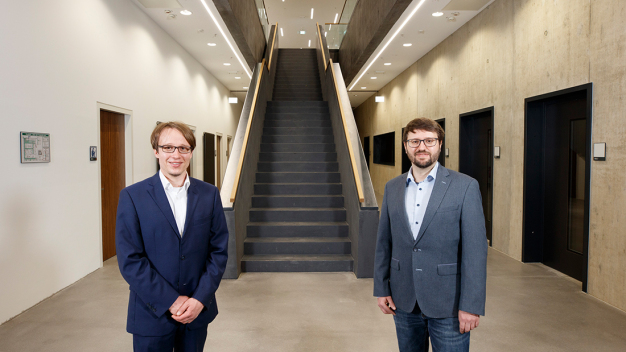
Junior Professor Dr. Philipp Pirro (left) and Professor Dr. Mathias Weiler. (View/Voss TUK)
Smartphones, smartwatches, or a regular computer – electronic devices consume a lot of energy. New technologies enabled by spin research can help reduce consumption, for example by integrating them into common semiconductor and microchips. At the Technical University of Kaiserslautern (TUK), two new research projects funded by the European Union (EU) are addressing this topic. One is coordinated at TUK and funded by the EU with 3.3 million euros, with 525,000 euros going to Kaiserslautern. The other project is led in Belgium. The EU provides around three million euros for this, of which 310,000 euros are allocated for work at TUK.
To make electronic devices more energy-efficient, research is focusing on utilizing spin waves and their quantum particles, magnons. These can carry more information than electrons and consume significantly less energy simultaneously. Spin waves are collective excitations of magnetic moments in a magnetic material. Spin refers to the intrinsic angular momentum of a quantum particle, such as an electron or neutron. It forms the basis of all magnetic phenomena.
The two EU-funded projects aim to translate the findings of spin and magnonics research into practical applications. "Magnonics meets micro-electro-mechanical systems: a new paradigm for communication technology and radio-frequency signal processing" (M&MEMS) aims to make spin technology compatible with existing electronic devices.
The team relies on combining magnonic systems with micromechanical systems, known as MEMS chips. MEMS stands for "micro-electro-mechanical systems". "These include, for example, microscopic motors or acceleration sensors, which are found in smartphones," says junior professor Philipp Pirro, who researches magnetism at TUK. "Magnonic systems can be controlled via magnetic fields. These are usually generated by electromagnets, which currently require electricity." His colleague, Professor Dr. Mathias Weiler, who researches applied spin phenomena at TUK, adds: "This makes the process currently inefficient."
This is where these micromechanical systems come into play. "We want to position small permanent magnets in them to generate a magnetic field," Weiler continues. "Once this is done, no further energy is needed." The magnetic field strength can be controlled by moving the magnet closer to or farther from the magnonic element. This would result in very low energy consumption or demand. "This is especially interesting for mobile devices," Pirro cites as an example.
The project, coordinated by the Technical University of Kaiserslautern (TUK), involves eight partners from five EU countries. These include universities such as TU Munich and Politecnico di Milano, as well as leading technology companies in high-frequency communication like Nokia and Thales. At TUK, Pirro and Weiler are supported by Professor Dr. Burkard Hillebrands, head of the Magnetism research group.
The second funded project, "Computation Systems Based on Hybrid Spin-wave–CMOS Integrated Architectures" (SPIDER), also involves magnonic elements. "We want to build a system where magnonics is connected to a standard computer and integrated into common semiconductor components," explains Pirro. The team focuses on complementary metal-oxide-semiconductor, or CMOS, which are used in all common computers. "If we succeed in making magnonics compatible with existing techniques and chips, we would lower the entry barrier for applying magnonics."
Besides TUK and the Fraunhofer Society, four other European partners are involved in this project. It is coordinated at the Interuniversity Microelectronics Centre (IMEC) in Leuven, Belgium.
The work on both projects will take place in the new research building LASE (Laboratory for Advanced Spin Engineering) on the TUK campus, where researchers from physics, chemistry, and engineering sciences will jointly explore spin phenomena. Recently, Professor Weiler and Junior Professor Pirro each received an ERC Grant from the European Research Council (ERC) to also conduct research in the spin field. ERC Grants are among the most prestigious research funding worldwide.
The teams around the two physicists laid the groundwork for these projects through work at the Center for Optics and Material Sciences, funded by the state, known as OPTIMAS, and in the special research area "Spin + X," funded by the German Research Foundation.
As part of the new projects, there will also be scientific positions available. Interested candidates with appropriate qualifications are encouraged to apply.
Questions answered by:
Junior Professor Dr. Philipp Pirro
Department of Magnetism / TU Kaiserslautern
Tel.: 0631 205 4092
Email: ppirro(at)rhrk.uni-kl.de
Professor Dr. Mathias Weiler
Applied Spin Phenomena / TU Kaiserslautern
Tel.: 0631 205 4099
Email: weiler(at)physik.uni-kl.de
Technische Universität Kaiserslautern
67663 Kaiserslautern
Germany