- Translated with AI
Monitoring of room conditions
Many applications, one solution: New, freely configurable signaling and control unit is universally applicable for cleanrooms and laboratories

In cleanroom and laboratory areas, users must always be informed about the current room conditions. (Source: SAUTER)
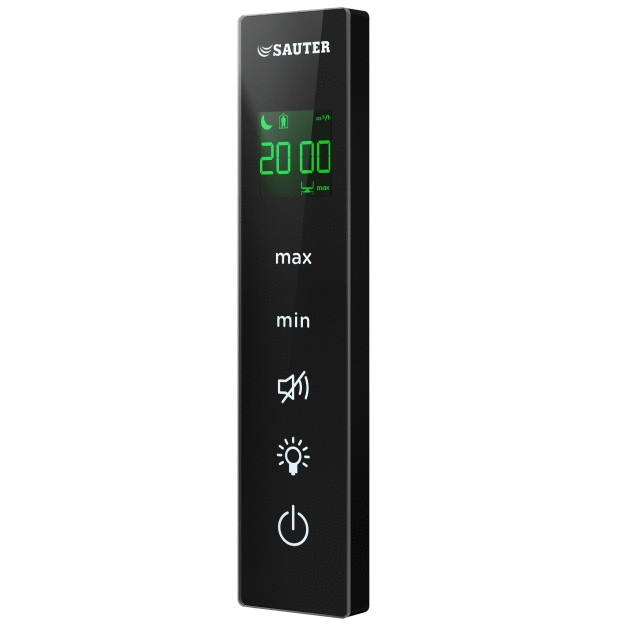
SAUTER has now developed an interface for operation and monitoring with the FCCP 200, which is not only particularly easy to handle but also, unlike previous models, can be used universally in various applications. (Source: SAUTER)
In cleanroom and laboratory areas, users must always be informed about the current room conditions. This is usually ensured by signaling units in the door areas, which provide information about various parameters and their limit violations, and also enable regulation. SAUTER has now developed an interface called the FCCP 200 for operation and monitoring, which is not only particularly easy to handle but also, unlike previous models, can be used universally in different applications. The device, which is especially energy-efficient thanks to the Eco function, is used in combination with a suitable room controller or compact regulator and can be freely configured using SAUTER standard software tools.
"Even the slightest deviation in room conditions can have negative consequences in cleanrooms or laboratories. For example, incorrect room pressure can lead to product contamination," explains Rolf Schulze from SAUTER Life Sciences. To prevent this, signaling and control units are used for regulating and monitoring these rooms—including room pressure, temperature, and relative humidity. While previously a separate device had to be used for each area, the newly developed FCCP 200 interface can now be used for a variety of applications. "In combination with the EY-RC504 room controller or the VAV compact regulator from SAUTER, it is suitable not only for room pressure or laboratory room regulation but also for laboratory exhaust air control," says Schulze. "The necessary functions are programmed and/or parameterized on the side of the associated controller."
Clear indication of operating states through traffic light function
Laboratory exhaust systems must be equipped according to EN 14175 Part 2 with a control and signaling unit that indicates their safe operation in the laboratory. To clearly warn the operating personnel of a faulty exhaust state, the devices must feature acoustic and optical alarms. Each FCCP 200 unit is therefore equipped with an internal buzzer and a dot matrix display with configurable four-color backlighting—options include white, green, yellow, and red. Using a traffic light function, it is immediately recognizable at a glance in which state the exhaust system is and whether limit values have been exceeded. "This display can of course also be used for monitoring entire rooms," explains Schulze.
The control options of the interface for laboratory exhaust regulation include turning the exhaust on and off, switching the lights, priority operation (min/max), and acknowledging the acoustic alarm. Furthermore, through the freely configurable backlit capacitive sensor buttons using SAUTER standard software tools, application-specific or user-specific functions can be implemented, allowing very flexible device use. For example, a "Cleaning Mode" can be activated by pressing two buttons simultaneously, during which all buttons are disabled to clean the FCCP 200. "The individual buttons are activated by setting a parameter," Schulze explains. "Only the buttons needed are visible. Designing a device that can accommodate up to five button functions was therefore more than sufficient."
Energy savings through Eco mode
To ensure maximum safety when using the signaling and control unit, the dot matrix display with touch function also features a chemically resistant, hardened glass surface. Thanks to a very flat housing design, which is particularly suitable for surface mounting, and a simple yet elegant appearance, the interface can be used anywhere. Additionally, the FCCP 200 is equipped with an Eco function that puts the device into standby mode after an adjustable period of time has elapsed: "The backlighting of the display and sensor buttons is reduced," says Schulze. "Power consumption decreases by up to 60 percent."
SAUTER Deutschland
79108 Freiburg
Germany