



- Translated with AI
Modern prerequisites for interdisciplinary research
topping-out ceremony for the new institute building dedicated to the research of neurodegenerative diseases in Göttingen - pbr AG provides the overall planning for the research building
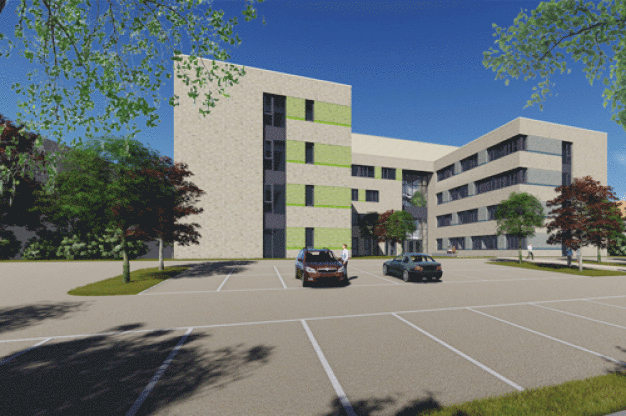
The U-shaped floor plan allows the independence of both institutes to be structurally maintained. (Image rights: Mischa Lötzsch from 4-Motions)
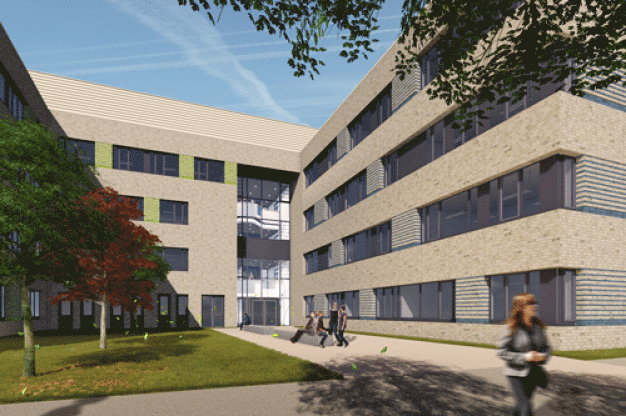
As you approach the building, the simple overall shape dissolves into fine facade details. (Image rights: Mischa Lötzsch from 4-Motions)
Currently, about 1.5 million people in Germany are affected by dementia. A large portion of them are affected by Alzheimer's disease. A clinical picture that presents particular challenges for research. In the new building of the Institute for Biostructural Imaging of Neurodegeneration (BIN) and the German Center for Neurodegenerative Diseases (DZNE), Göttingen location, research on the prevention, diagnosis, and treatment of diseases of the human nervous system will be conducted in the future.
Modern prerequisites for interdisciplinary research
On March 25, 2015, the topping-out ceremony took place for the new research institute at Göttingen University Medical Center (UMG). In the building, the Institute for Biostructural Imaging of Neurodegeneration (BIN) and the German Center for Neurodegenerative Diseases (DZNE), Göttingen location, will jointly research the prevention, diagnosis, and treatment of diseases of the human nervous system.
The institute and research building, with a construction cost of approximately €27.5 million, is planned by pbr Planning Office Rohling AG. The client is Göttingen University Medical Center (UMG) – University of Göttingen. The new building will accommodate functional areas for experimental research, theoretical work, as well as service and communication spaces.
Networked research and interdisciplinary collaboration
The scientific location of Göttingen offers a wide range of research institutions. With the spatial connection of the Institute for Biostructural Imaging of Neurodegeneration (BIN) and the German Center for Neurodegenerative Diseases (DZNE), expertise will be consolidated and resources centralized at this site in the future. Although interdisciplinary collaboration is the main focus, the structural independence of both centers is to be maintained.
The five-story new building with partial basement is being constructed in the eastern part of Göttingen on Von-Siebold-Straße. The urban planning perimeter is characterized by multi-wing buildings with offset building lines facing the street and spacious forecourts. The chosen U-shape integrates the building into the existing development and enhances the outdoor spaces with an attractive courtyard setting. Between the building sections, a glazed building joint designed as a building body inset, along with the windbreak element, signals the main entrance. Here, visitors enter a bright foyer, which is connected to the central staircase.
The building structure is primarily determined by the functional requirements and the extent of the institute areas DZNE, BIN, and cooperation. The new building provides a variety of laboratory, examination, and equipment spaces, as well as office and storage rooms. The floors are organized uniformly. Starting from the main staircase in the left wing, the rooms of BIN are located, with the DZNE rooms on the right side. A shared restroom area is planned to be located centrally next to the staircase on all floors. Within the institute areas, the room distribution is almost identical floor by floor. In the two-wing building sections, laboratories are oriented to the south, and office and service rooms to the north. Separate from public activities, conference rooms are planned on the fourth floor. Equipped with mobile partition walls, these rooms can be flexibly arranged. The ground floor will host public areas such as the foyer and collaboration spaces for both institutes, including a workshop, a cold storage, and service areas for utilities and waste management.
Short routes and a high degree of usage flexibility
The research activities of both users are organized within several teams with changing compositions and sizes. The necessary flexibility in usage is ensured by the floor plan with uniform spatial modules based on a comprehensive building and expansion grid. This way, variability is combined with economical space utilization. The grouping of laboratories and offices in each wing allows for short distances between the two functional areas.
Simplistic large form dissolves into fine detail work
Brick, metal, and glass will shape the appearance of the new institute building. The facade material brick, used in a contemporary manner, references the architectural tradition of the surrounding buildings.
The design by pbr AG includes window sills that organize the facade of the new building in rhythm with the four floors. Running around corners, they merge the facade sides and create a light, floating character. The more you approach the building, the more the simple large form dissolves into fine facade details: The lines of the window sills are continued through profiling in the masonry. Receding brick layers reflect sunlight. Furthermore, the design proposes to rhythm the window sills with pilasters in varying shades. The facade design is inspired by that of the DZNE institute building in Magdeburg, also designed by pbr AG. The goal is to make the unity of the institutes recognizable through a corporate architecture.
pbr Planungsbüro Rohling AG
49076 Osnabrück
Germany