



- 3D printing
- Translated with AI
Melt moon dust with lasers
Flight to the Moon should lay the foundation for future 3D printing of infrastructures
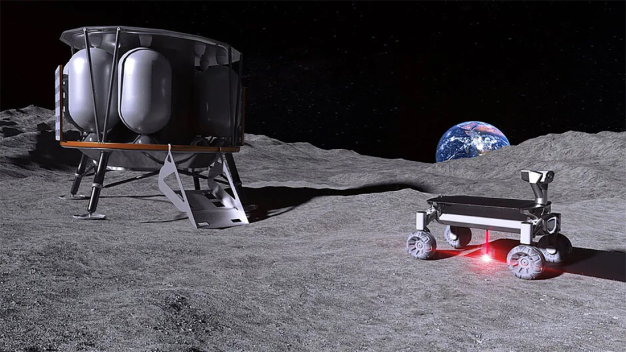
The MOONRISE technology is intended to be used on the Moon, where lunar dust will be melted with a laser. (Image: LZH)
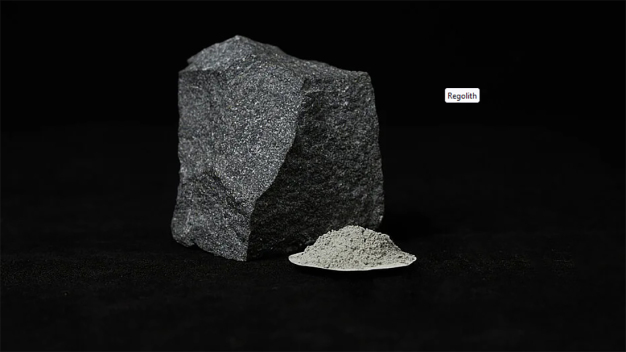
At TU Berlin, a modular system was developed that allows the simulation of the different compositions of regolith at potential landing sites using terrestrial rocks. (Image: Susanne Baumann)
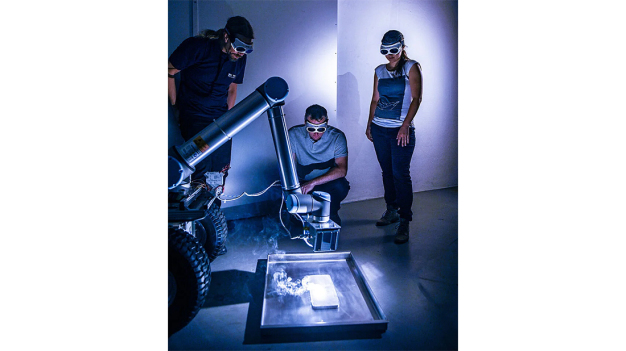
On the robotic arm of the moon rover MRA3D, the MOONRISE laser has already successfully melted entire paths of artificial regolith. (Image: LZH)
3D Printing on the Moon: Scientists from the Laser Center Hannover e.V. (LZH) and the Technical University (TU) Berlin are planning a flight to the Moon to melt lunar dust with laser radiation. In the MOONRISE project, the research team aims to investigate how we can futurely produce landing sites, roads, or buildings from lunar dust using lasers. To do this, the researchers want to bring a laser system to the lunar surface that melts the rock dust present everywhere there. Artificial intelligence will support the laser process. The goal is to demonstrate that laser melting works on the Moon—and that it can potentially be used to manufacture 3D-printed infrastructure for a lunar base.
Both scientifically and economically, our Earth’s satellite is a desirable target. Not only do billionaires want to fly their paying guests around the Moon, but the European Space Agency (ESA) also has plans for a "Moon Village" [1]. The always-dark far side of the Moon would be suitable for powerful space telescopes, and the lower gravity and lack of an atmosphere make the Moon an ideal staging point for missions to more distant targets in space. But how are launch ramps, landing sites, and buildings on the lunar surface supposed to be created? "With costs of up to one million dollars per kilogram, a complete transport of material from Earth to the Moon would be extremely expensive," explains Jörg Neumann, project manager of MOONRISE at LZH.
Houses from Lunar Dust
Powdered lunar rock, also called regolith, is abundantly available on the Moon and could be used as raw material for 3D printing. The use and processing of locally available materials is also known in spaceflight as In-Situ Resource Utilization (ISRU)—and could be a decisive factor in advancing lunar and space exploration.
The Technology Has Already Been Demonstrated on Earth
The groundwork for the project has already been laid. In the predecessor project funded by the Volkswagen Foundation, the research team developed a compact, robust laser and successfully tested it in the laboratory on the robotic arm of a lunar rover. Additionally, the scientists managed to melt regolith in the Einstein Elevator at the Hannover Institute of Technology (HiTEC) of Leibniz University Hannover under lunar gravity conditions. Now, the focus is on making the laser ready for spaceflight. The scientists from LZH and TU Berlin want to develop a flight model of the laser qualified for space use.
Artificial Intelligence for Use on the Moon
The laser will be supported by artificial intelligence (AI). A camera will take photos on the Moon, which will then be analyzed by researchers on Earth using an intelligent image processing system. The system is intended to assist in analyzing the lunar dust melted with the laser and to enable scientists on Earth to perform AI-based process and quality control.
Moon Landscape at TU Berlin
The big challenge: the AI must be trained beforehand for lunar use. At TU Berlin, a laboratory will be established where the regolith will be photographed under lighting conditions similar to those on the Moon. This will create a pool of images for the AI to learn from. "Furthermore, over the past years, a regolith construction kit has been developed that allows precise replication of the properties of different potential landing sites. This will be adapted in the project to the final landing site on the Moon, so that the laser and AI can be aligned for the actual lunar mission," explains Benedict Grefen from the "Exploration and Propulsion" working group in the Department of Aerospace Engineering (RFT) at TU Berlin. The resulting "Surface Analog Model" will also support decision-making during the mission.
Flight to the Moon in 2024
The MOONRISE-FM project has a duration of three years and is funded by the Federal Ministry for Economic Affairs and Climate Action with 4.75 million euros. The project sponsor is the German Aerospace Center (DLR). The mission is planned to launch in 2024.
Sources: [1] https://blogs.esa.int/janwoerner/2016/11/23/moon-village/
Technische Universität Berlin
10587 Berlin
Germany