




- Translated with AI
Light particles in a double pack
© TU Berlin
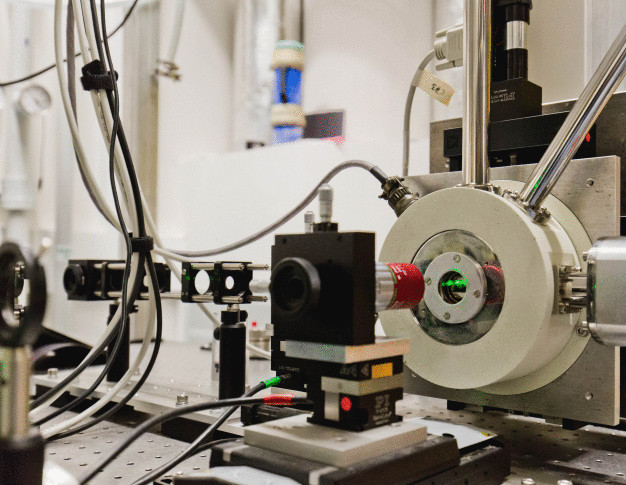
The quantum dot - a type of artificial atom - is cooled in a cryostat to a temperature close to absolute zero. Photon twins are generated using a laser and collected with a microscope objective. (© Oana Popa/PR/TU Berlin)
Physicists from the AG Optoelectronics and Quantum Building Blocks led by Prof. Dr. Stephan Reitzenstein are developing a novel quantum light source for generating photon twins / publication in Nature Communications.
Quantum physics is particularly difficult to understand because the corresponding research often takes place in a microcosm of individual atoms, electrons, and photons – thus not tangible to the human eye. However, it is now known that quantum effects also impact the macroscopic world. Research has shown that frog eye cells, specifically the rod cells, can even detect a single photon. Researchers from Singapore demonstrated that, even at the same brightness of different light types (i.e., the same number of photons per unit time), the rod cells of the eye can distinguish between classical light and quantum light. This enables entirely new interdisciplinary applications for quantum light sources in quantum biology, the intersection of quantum physics and biology, which still sounds like science fiction for now.
While research in the field of quantum optics has so far largely been focused on fundamental research, significant progress has been made in recent years toward generating non-classical states of light and thus toward novel applications. However, developing the corresponding quantum light sources remains an immense challenge: "Even the defined production of a single-photon source – which could be used, among other things, for the development of systems for secure data transmission – is still high-tech today," describes Dr. Tobias Heindel, a member of Prof. Dr. Stephan Reitzenstein's research group in the Department of Optoelectronics and Quantum Building Blocks at TU Berlin, the state of the art.
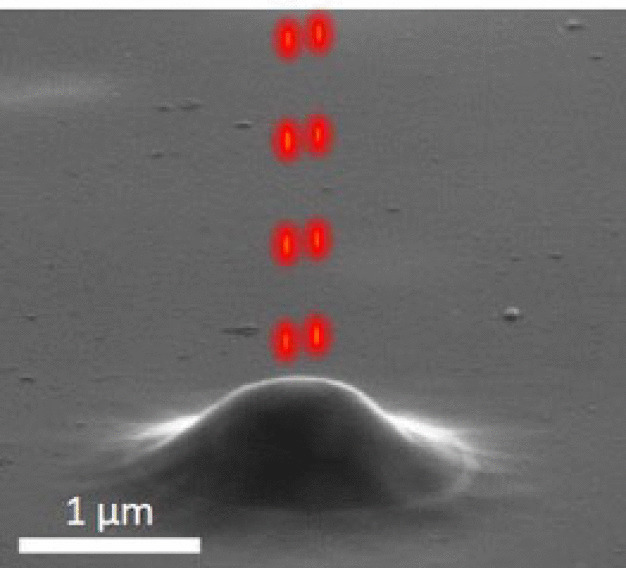
For the first time, this research team has succeeded in intentionally producing a quantum light source based on semiconductor quantum dots that can generate pairs of identical photons – so-called photon twins. Dr. Tobias Heindel, Alexander Thoma, and other team members used a highly optimized quantum building block under the leadership of Professor Reitzenstein. "In recent years, our group has developed a special, globally unique technique called 3D in-situ electron beam lithography, where a micro-lens is precisely positioned over a quantum dot just a few nanometers in size (1 nm equals one millionth of a millimeter). This quantum dot can essentially emit photons at the push of a button, which are directed in a specific direction by the micro-lens and can thus be detected," explains Tobias Heindel. Using specialized measurement techniques, the researchers have now isolated a previously unique quantum dot capable of emitting twin photons. "Our next goal is to develop a method that can turn any quantum dot into a source of photon twins." The production of these quantum building blocks was made possible by the excellent infrastructure of the Center for Nanophotonics at TU Berlin.
"Other research groups have already succeeded in generating twin photons based on natural atoms or nonlinear crystals," says Heindel. However, the major advantage of the Berlin twin-photon source based on quantum dots is that the photon pairs can be emitted almost at the push of a button. When combined with the micro-lens structure, this creates a particularly bright photon source. "Our approach allows us to increase the number of generated photon twins by a factor of five," reports Heindel. To directly detect the emitted photon twins, the physicists collaborated with the Physikalisch-Technische Bundesanstalt Berlin, using a highly sensitive superconducting detector capable of detecting the number of photons in a light pulse.
The work on this novel quantum light source was conducted within the framework of the Collaborative Research Center 787 "Semiconductor Nanophotonics" and the BMBF VIP project "QSOURCE." It has been published in the current issue of the renowned journal Nature Communications. *
* Heindel, T. et al. A bright triggered twin-photon source in the solid state.
Nat. Commun. 8, 14870 doi: 10.1038/ncomms14870 (2017).
Technische Universität Berlin
10587 Berlin
Germany