- Translated with AI
Life on Mars: Where does the methane come from?
Astrobiologists prove that certain microbes can survive under conditions like those on the Red Planet
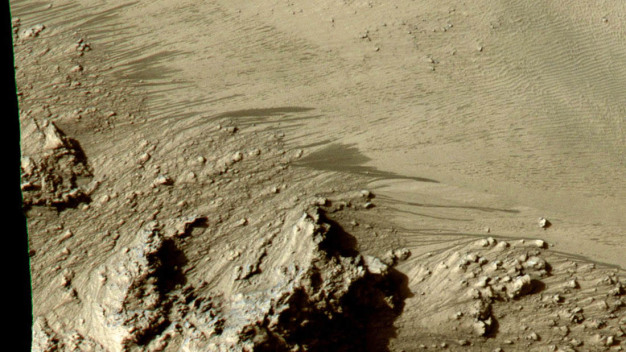
The Mars rover "Curiosity" discovered the flow traces on crater walls on Mars, known as "Recurring Slope Lineae" RSL. (© NASA)
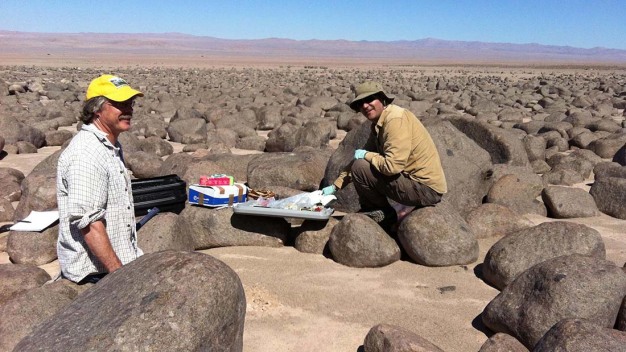
Field research in the Atacama Desert in Chile. Mars-like conditions prevail here. (© TU Berlin_Research Group Astrobiology)
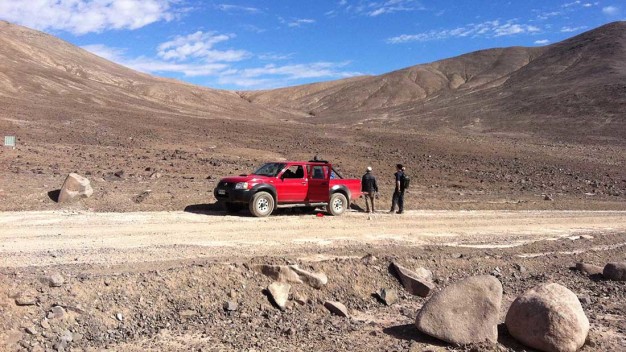
Field research in the Atacama Desert in Chile. Mars-like conditions prevail here. (© TU Berlin_Research Group Astrobiology)
When NASA's Mars rover "Curiosity" found organic molecules on Mars in June 2018, the scientific community was thrilled. It meant that life could have existed on the Red Planet at some point or might still be possible now. Recently, new measurements from "Curiosity" showed that the concentrations of the metabolic product methane fluctuate throughout the year. So, who or what sporadically produces the methane? For the first time, the research team of astrobiologist Prof. Dr. Dirk Schulze-Makuch from the Center for Astronomy and Astrophysics at TU Berlin demonstrated in an experiment that certain microbes (Archaea) can not only survive in Martian-like, salt-rich soils but also metabolize — using only carbon dioxide and hydrogen as energy and fuel sources — and only with the minimal amounts of water that the salty rock extracts from the atmosphere. The methane could therefore originate from them — another important insight in the search for life on Mars. The scientists published their results in the latest issue of Springer Nature Scientific Reports.
"The low average temperature and water activity on the surface of Mars make it difficult for living organisms to survive or even reproduce in this environment," says Dirk Schulze-Makuch. "However, the results of recent Mars missions show that environmental conditions at certain times and places on the Red Planet can indeed exceed the lower limits that make life possible." Under the project name HOME (Habitability of Martian Environments), the research team of the astrobiologist and geoscientist, who is also an Adjunct Professor at Arizona State and Washington State University and President of the German Astrobiological Society e.V., has been investigating the habitability of potential habitats on Mars for several years. As early as 2018, his team demonstrated through extensive studies in the Martian-like Atacama Desert, one of the driest places on Earth, that active microbial communities can survive in this hostile environment until they are reactivated by minimal amounts of water.
Morning frost and flowing traces
Conditions on the Martian surface do not allow the permanent presence of liquid water, but Schulze-Makuch suggests it is possible that hygroscopic salts exist near the surface in some areas, which draw moisture from the environment, such as morning frosts, and that the salt can change from solid to liquid. This has also been proposed by other researchers, for example, for the dark streaks that sporadically appear on the steep walls of some Mars craters and are thought to be flow traces ("Recurring Slope Lineae" RSL). It is also suspected that underground, near-surface organisms could meet their water needs from these salts.
In a closed Mars analogue system, microbes metabolize
To test such hypotheses, researchers repeatedly conduct studies in very remote regions with environmental conditions similar to those on Mars, such as the Atacama Desert in Chile, the McMurdo Dry Valleys in Antarctica, or the Larsemann Hills in East Antarctica. "Studying these Mars analogue environments and the microbiota present there helps evaluate the habitability of Martian environments," says Dirk Schulze-Makuch. These areas are extremely dry (arid) but also salty. They are inhabited by microbial communities that have adapted to their environment to such an extent that they begin to metabolize as soon as they are wetted by deliquescence. Deliquescence is the specific ability of certain substances, mostly salts, to influence the relative humidity of their surroundings. To test whether the fluctuating methane concentrations measured by "Curiosity" could originate from microbes living near the surface, the researchers developed a closed deliquescence system with dried Martian analogue substrates (Mars Regolith Analogues – MRA), hygroscopic salts, and three methanogenic archaea (the microbial strains Methanosarcina mazei, M. barkeri, and M. soligelidi). They then measured under which conditions the different microbes were stimulated to metabolic activity. The result: two of the three bacteria-like organisms responded, each in different substrates and at different temperatures. This caught the scientific community's attention because, until now, the model organisms (including methane-producing microbes) had primarily been exposed to stress factors such as desiccation, drought, hunger, freeze-thaw cycles, high salt content, low atmospheric pressure, and increased radiation doses to assess Mars's habitability. "To our knowledge, there is no study demonstrating that methanogenic archaea can exist in a near-surface environment where water is only made available through deliquescence," says Schulze-Makuch. "We were able to show for the first time that the water provided solely by deliquescence is sufficient to rehydrate methanogenic archaea under these extreme conditions, essentially bringing them back to life, and to reactivate their metabolism in an environment similar to what exists just below the surface of Mars."
Deborah Maus, Jacob Heinz, Janosch Schirmack, Alessandro Airo, Samuel P. Kounaves, Dirk Wagner, Dirk Schulze-Makuch: "Methanogenic Archaea Can Produce Methane in Deliquescence-Driven Mars Analog Environments"
The original publication can be found at the following link: https://www.nature.com/articles/s41598-019-56267-4
Further information provided by:
Prof. Dr. Dirk Schulze-Makuch
Technical University of Berlin
Center for Astronomy and Astrophysics at TU Berlin
Planetary Habitability and Astrobiology
Tel.: 300/314-23736
Email: schulze-makuch@tu-berlin.de
Technische Universität Berlin
10587 Berlin
Germany