- Translated with AI
Knowledge gap in chemistry closed
Interdisciplinarity brought the breakthrough
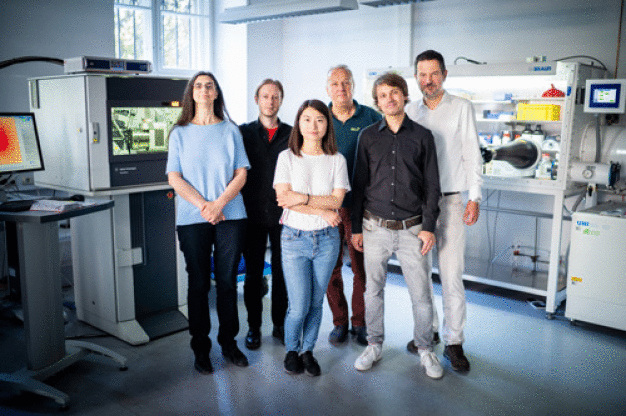
V.L.n.R. Mrs. Dr. Elisabeth Irran (X-ray structure analysis), Dr. Robert Müller (Department of Theoretical Chemistry - Quantum Chemistry), Dr. Qian Wu, Prof. Dr. Martin Kaupp, Dr. Hendrik F. T. Klare, Prof. Dr. Martin Oestreich. (© TU Berlin/PR/Dominic Simon)
According to some findings, one searches forever and when they are finally found, everything seems quite simple. Similar to this, the research team led by Dr. Martin Oestreich, Professor of Organic Chemistry – Synthesis and Catalysis at TU Berlin, and his colleagues Dr. Hendrik Klare and Dr. Qian Wu, experienced a similar journey. Their research project "The Characterization of Water-Substituted Silylium Ions in Condensed Phase" has now been published in the renowned scientific magazine Science. These silylium ions are elusive substances that were previously only detectable in the gas phase, if at all. "We are especially pleased that this publication is a pure TU Berlin publication," says Martin Oestreich. "The actual laboratory work was carried out by Humboldt Fellow Dr. Qian Wu from my research group." In the field of Dr. Martin Kaupp, Professor of Theoretical Chemistry – Quantum Chemistry, the theory was calculated, and Dr. Elisabeth Irran, head of the Center for Crystal Structure Determination at TU Berlin, measured the molecular structures.
For well over 100 years, it has been known that there are so-called carbocation ions. These are highly reactive, cationic (positively charged) intermediates from carbon chemistry. After their discovery, it took decades to produce and characterize them, as their very reactive nature repeatedly prevented this. George Olah was awarded the Nobel Prize in 1994 solely for the characterization of these carbocation ions.
In the periodic table of elements, silicon sits in the sixth main group below carbon — just like carbon, it is an extremely important element both economically and scientifically. Curiously, until a few years ago, the corresponding cations of silicon related to carbocation ions were not known at all. Their existence could be theoretically predicted, and they could be kept in the gas phase, but stabilizing or even isolating them in the laboratory was not possible because they are also extremely reactive molecules.
About 25 years ago, it was first possible to detect so-called tertiary silylium ions — that is, a silicon cation with three carbon substituents. Dr. Qian Wu has now succeeded in producing all three other derivatives in solution and in solid form. That is, silylium ions that carry either two, one, or even only hydrogen atoms as substituents. "With this, she has taken the same step for silicon as George Olah did decades ago for carbocation ions, thereby closing a significant gap in main group chemistry and chemistry in general," describes Martin Oestreich the importance of the work.
Although this discovery may sound rather abstract to laypeople, for chemists it concerns fundamental questions of chemistry: "The reactivity of these intermediates is so high that they react with any substance in the environment. Their isolation is therefore anything but trivial," explains Hendrik Klare. Therefore, initially, the scientists are less concerned with practical applications. They simply generated textbook knowledge. "Applications were not the focus of our work, but of course, now for the first time, there is the possibility to systematically investigate these new molecules. This is an important step toward application, especially in homogeneous catalysis," says Hendrik Klare. "A conceivable option: activating very inert substances, for example, chlorofluorocarbons (CFCs). It is quite conceivable to exchange the fluorine in these substances, which are very difficult to break down, with hydrogen using these silylium ions," concludes Martin Oestreich.
Technische Universität Berlin
10587 Berlin
Germany