




- Automation
- Translated with AI
Innovation boost for NRW biotechnology
Robust automated production of stem cells for new therapeutics
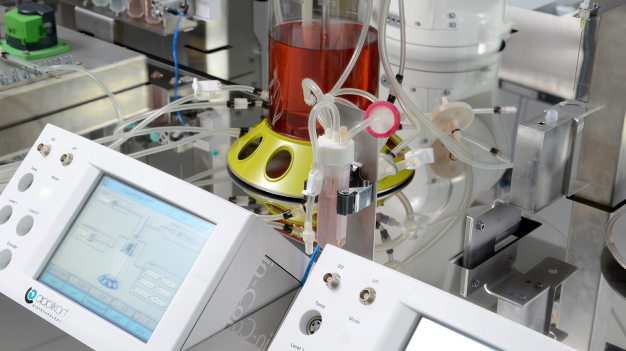
The Fraunhofer IPT integrates the entire process of producing extracellular vesicles into its fully automated AUTOSTEM laboratory platform. © Fraunhofer IPT
Stem cell therapies offer enormous potential for personalized treatment of degenerative and tumor-related diseases. With the recently launched research project »RauPE« (Robust Automated Production of Therapeutically Applicable Extracellular Vesicles), the goal is to automate the production of these groundbreaking medical therapies and make them accessible to a large number of patients. Together with BioThrust GmbH, a spin-off of RWTH Aachen, and the University Hospital Essen, the Fraunhofer Institute for Production Technology IPT is developing an expansion platform that enables large-scale production of stem cell-based therapies, thereby reducing manufacturing costs.
One of the biggest challenges in stem cell-based therapies is the scalable production of the required cell quantities. Extracellular vesicles (EV) are used as therapeutics for degenerative and tumor-related diseases due to their established treatment successes. EV are delicate membrane-bound particles that have detached from their original cells. These vesicles must be produced from specialized stem cells and extracted from the cell culture medium for therapeutic manufacturing. The challenge of efficient large-scale production lies in the fragility of EV. Therefore, today, cell expansion in bioreactors is only possible in small volumes and with specialized equipment. However, this drives up manufacturing costs. The partners in the »RauPE« project are now developing a robust and automated expansion platform based on the membrane perfusion bioreactor of the Aachen spin-off BioThrust. This platform will enable the automated production of high-quality EV in the future.
New bioreactor technology enables more efficient cell proliferation
Typically, EV-producing stem cells are cultured in petri dish-like vessels. However, this approach is too inefficient and labor-intensive for large-scale production. Traditional bioreactors, where cells grow on carrier particles, are also unsuitable because the mechanical forces in the reactor can damage the cells. To ensure continuous oxygen supply and fresh medium for cell growth, BioThrust GmbH has developed membrane reactor cartridges that incorporate bubble-free oxygen sparging, enabling more efficient and scalable proliferation of sensitive stem cells. These cartridges are used in the project for the production of immortalized mesenchymal stem cells (ciMSC), developed at the University Hospital Essen. During cultivation, these cells release extracellular vesicles that can be used therapeutically, for example, against certain types of cancer, inflammation in osteoarthritis, or after strokes.
Automated processes for safe EV production
Another main goal of the project is to create a scalable process for manufacturing ciMSC EV preparations that meets the requirements for medical product certification. Fraunhofer IPT integrates the entire EV production process into its fully automated AUTOSTEM laboratory platform. This allows for efficient, precise, and safe execution of all process steps for producing new therapeutics with minimal manual effort – from cell cultivation to harvest and purification of EV.
Funded research project for the development of cost-effective and efficient cell therapies
The »RauPE« project combines expertise from medical biotechnology, bioprocess engineering, and process automation through its three project partners. The aim is to develop scalable manufacturing of cell therapeutics to enable cost-effective and efficient cell therapies. The project will be supported over the next three years, starting in July 2024, through the EFRE.NRW funding program with funds from North Rhine-Westphalia and the EU.
Project consortium
– BioThrust GmbH, Aachen (Project Coordinator)
– Fraunhofer Institute for Production Technology IPT, Aachen
– University Hospital Essen
Fraunhofer-Institut für Produktionstechnologie IPT
52074 Aachen
Germany