

- Translated with AI
Important for implants and mobile diagnostics
Irregular professorship in the field of bioelectronics awarded to Dr. Mario Birkholz
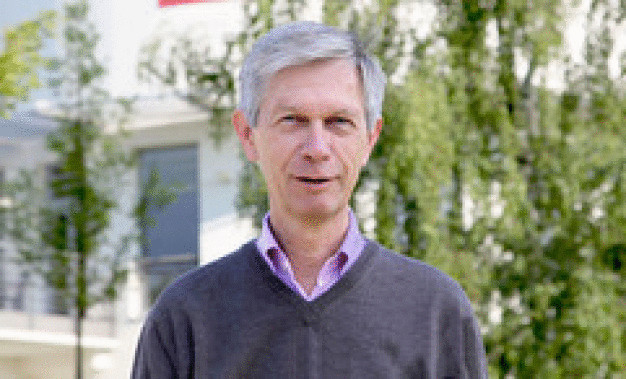
Prof. Dr. Mario Birkholz (© IHP 2017)
Due to his exceptional contributions to research and teaching, TU Berlin has awarded the physicist Dr. Mario Birkholz from IHP – Leibniz Institute for Innovative Microelectronics an extraordinary professorship for Bioelectronics. With this extraordinary professorship for Dr. Mario Birkholz, TU Berlin recognizes the future significance of bioelectronics, which is expected to make important contributions to the digitalization of life sciences.
Prof. Dr. Mario Birkholz, who has initiated and led various projects on interdisciplinary cooperation with life scientists at IHP in Frankfurt (Oder), has been sharing his knowledge with master's students at TU Berlin for five years, supervising their theses and teaching a course.
The young discipline of bioelectronics is dedicated to the use of microelectronics in medicine and biotechnology. Following Moore's Law, microelectronics continues to miniaturize, so that the area of microchips can be halved every one and a half to two years — without any loss of performance. The continuous shrinking of sensors, data storage devices, and computers has made microelectronics an important component in implants, DNA sequencers, mobile diagnostics, lab-on-chip systems, and other innovative biomedical products. Silicon semiconductor components, produced in IHP's cleanroom, increasingly come into contact with biological environments, raising new questions about their biostability and functionality in such settings.
Bioelectronics plays an important role in novel sensors that monitor biological processes, as investigated by the Department of BioProcess Engineering at TU Berlin. The joint Bioelectronics laboratory was established in 2012 by the head of the department, Prof. Dr. Peter Neubauer, and the now appointed professor, Dr. Mario Birkholz. A recently approved funding project by the Federal Ministry of Education and Research is developing the control of flows of biological cells using electric fields.
Technische Universität Berlin
10587 Berlin
Germany