



- EDP, Hardware, Software
- Translated with AI
Imec, KU Leuven, and PragmatIC Semiconductor demonstrate the fastest flexible 8-bit microprocessor for energy-efficient applications

The flexible 8-bit microprocessor from Imec next to a 2-euro coin.

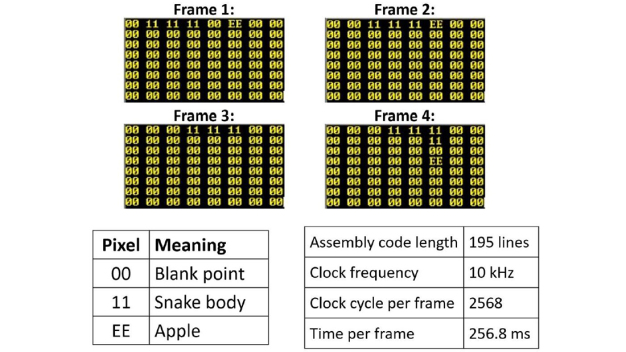
Screenshot of the Snake game in action and timestamps.
This week, imec, a globally leading research and innovation center for nanoelectronics and digital technologies, together with KU Leuven and PragmatIC Semiconductor, a worldwide leading company for flexible electronics, will present at the 2022 International Solid-State Circuits Conference (2022 ISSCC) the fastest 8-bit microprocessor in flexible 0.8-µm metal-oxide technology, capable of executing complex assembly code in real time. The microprocessor was implemented using a unique digital design flow that enabled the creation of a new standard cell library for metal-oxide thin-film technologies, relevant for the development of a wide range of IoT applications. PragmatIC Semiconductor's robust thin-film technology, the foundry partner of imec, was key to integrating approximately 16,000 metal-oxide thin-film transistors on a 24.9 mm² flexible chip.
Flexible electronics based on thin-film transistors are preferred over Si-CMOS-based electronics for applications requiring low-cost, thin, flexible, and/or bendable devices. The technology has already proven successful, for example, in sensors for health patches and RFID tags, as well as driving displays. What is still missing is a flexible microprocessor capable of performing more complex signal processing calculations, thereby expanding the range of IoT applications with computational functions.
Imec has developed a flexible 8-bit microprocessor in 0.8-µm indium-gallium-zinc-oxide (IGZO) transistor technology that can perform such complex calculations. Kris Myny, senior scientist at imec, states: "Our flexible microprocessor exhibits excellent properties for IoT applications, including high speed (71.4 kHz maximum clock frequency), low power consumption (11.6 mW at 10 kHz, 134.9 mW at maximum clock frequency), and high transistor integration density (~16,000 transistors with 0.8 µm gate length on a 24.9 mm² chip). Additionally, at ISSCC 2022, we will demonstrate the flawless operation of our circuit in real time by executing the complex assembly code of the popular game Snake."
With the new microprocessor, imec has addressed key challenges related to the design of unipolar systems. Kris Myny explains: "Metal-oxide thin-film transistors based on IGZO are inherently n-type. This leads to circuits with higher (static) power consumption compared to complementary technologies. To solve this problem, we developed our own design flow, starting from an open-source file of the MOS6502 microprocessor — one of the most widely used microprocessors ever developed. We designed the number of cells and logic gates to achieve the optimal design for our flexible 6502 microprocessor in terms of area, performance, and speed — using pseudo-CMOS for our logic family. With this unique design process, we were able to create a new standard cell library for metal-oxide thin-film technology that can be used for innovative applications based on this technology. This work is a wonderful culmination of my ERC Starting Grant, which aimed to open new perspectives in the field of thin-film transistor technology."
For the production of the flexible microprocessor, imec partnered with foundry partner PragmatIC, whose unique FlexIC-Foundry® enables rapid prototyping and profitable series production of flexible integrated circuits. Brian Cobb, VP of Product Development at PragmatIC, states: "Until recently, there was no mature and robust technology to integrate such a large number of thin-film transistors with sufficient yield. Our groundbreaking FlexLogIC® manufacturing now allows the rapid realization of such complex new designs at extremely low costs, delivering ICs on thin and flexible wafers. Our FlexIC-Foundry service helps design teams like imec's to expand the spectrum of designs and applications for flexible electronics."
This research was conducted under the ERC Starting Grant FLICs, funded by grant agreement No. 716426, as part of the European Union's Horizon 2020 research and innovation program.
IMEC Belgium
3001 Leuven
Belgium



