




- Translated with AI
Imec demonstrates an ultra-sensitive, compact optomechanical ultrasound sensor based on silicon photonics
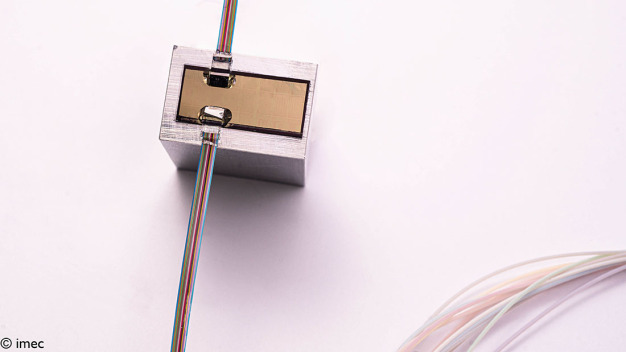
Opto-mechanical ultrasound sensor array chip with fiber optic array access.

Close-up of the opto-mechanical ultrasound sensor wafers.
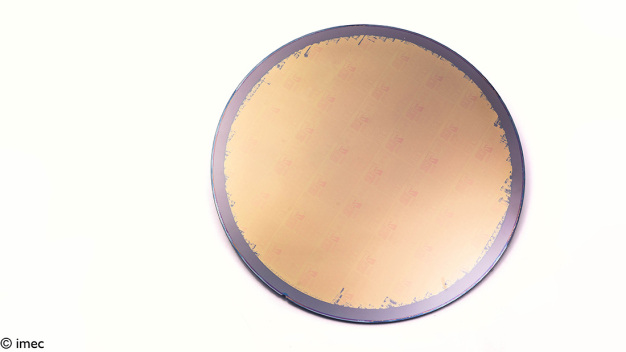
Opto-mechanical ultrasound sensor wafer.
Imec, a globally leading research and innovation center for nanoelectronics and digital technologies, presents an optomechanical ultrasound sensor on a silicon photonics chip, which exhibits unprecedented sensitivity thanks to an innovative optomechanical waveguide. Due to this highly sensitive waveguide, the 20 µm small sensor has a detection limit that is two orders of magnitude better than piezoelectric elements of the same size. The low detection limit of the sensor enables new clinical and biomedical applications of ultrasound and photoacoustic imaging, such as mammography in deeper tissue layers and the examination of vascularization or innervation of potential tumor tissue. This sensor was introduced in a paper published earlier this month in Nature Photonics.
Tomographic ultrasound and photoacoustic imaging enable the creation of two- or three-dimensional images using an array of ultrasound sensors. However, piezoelectric ultrasound sensors that are state-of-the-art have their limitations. Firstly, the detection limit inversely depends on the size of the sensors, which poses a problem for high-resolution images with small acoustic wavelengths. High-resolution images require small piezoelectric sensors, which inherently have a higher sensitivity threshold, leading to noisy images. Secondly, piezoelectric sensors rely on their mechanical resonance to increase signal amplitude. This means they operate within a small range around the resonance frequency to avoid high detection thresholds. Additionally, arrays of piezoelectric sensors require a wire for each sensor element, which complicates applications such as catheter-based procedures.
"The sensor we have introduced will significantly change deep tissue imaging in otherwise opaque tissues like skin or brain. For applications such as subcutaneous melanoma imaging or mammography, it allows a more detailed view of the tumor and the surrounding vasculature, contributing to more accurate diagnoses," says Xavier Rottenberg, Fellow of wave-based sensors and actuators at imec.
Imec's solution is based on a highly sensitive optomechanical waveguide with shared ribs, manufactured using a new CMOS-compatible process. The sensitivity is two orders of magnitude higher than that of a conventional sensor. A low detection limit can improve the trade-off between imaging resolution and depth for ultrasound applications and is crucial for photoacoustic imaging, where pressures are up to three orders of magnitude lower than in conventional ultrasound imaging methods. Furthermore, it can enable low-pressure applications such as functional brain imaging through the skull, which suffers from strong ultrasound attenuation caused by bone.
Finally, a finely resolved (30 µm) matrix of these tiny (20 µm) sensors can be easily integrated on the chip with photonic multiplexers. This opens up new application possibilities, such as miniaturized catheters, since the sensor matrices require only a few optical fibers to connect, instead of one electrical connection per element as in piezoelectric sensors.
"This technology forms the backbone of imec's internal photoacoustic roadmap and will continue to be tested with selected partners," adds Xavier Rottenberg.
IMEC Belgium
3001 Leuven
Belgium