

- Building technology
- Translated with AI
Hygienic food production thanks to efficient air filters
The comparison of lifecycle costs and filter performance is worthwhile
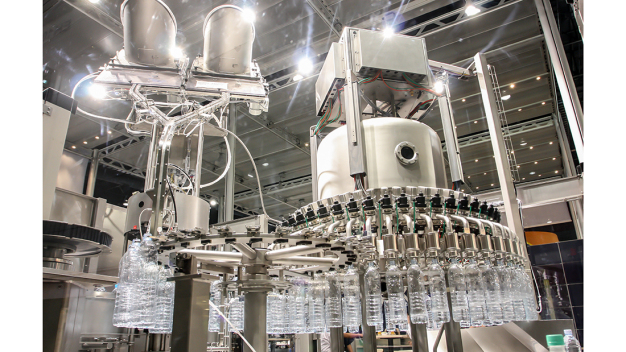
On average, only 15% of the operating costs of an air filter are related to its purchase, while typically 70% are spent solely on its energy consumption. Therefore, when selecting suitable air filters, it is worthwhile to consider the life cycle costs in order to utilize potential energy savings. (Image: Camfil)
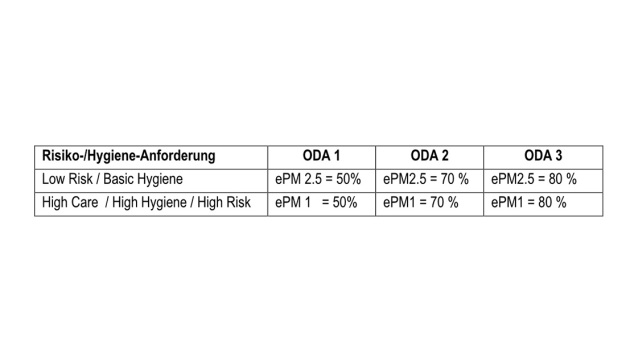
Table 1
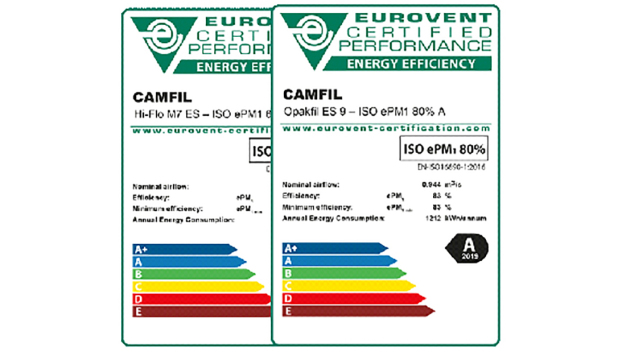
EUROVENT label for simplified filter selection: Low energy consumption combined with good indoor air quality. (Image: Camfil)
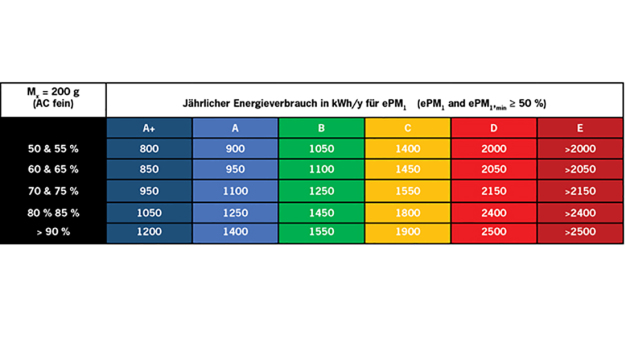
Energy classes of the filter class ePM1 (Table: EUROVENT Rating Standard REC 4/21-2018)
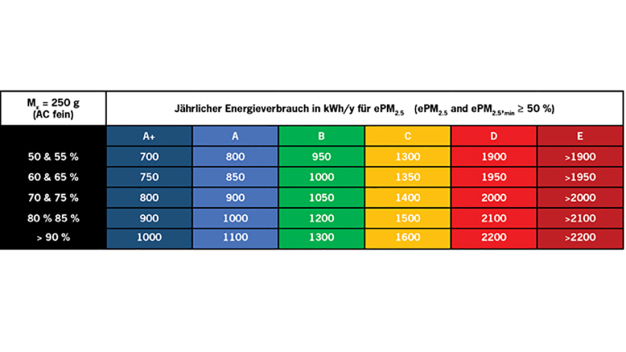
Energy classes of the filter class ePM2.5 (Table: EUROVENT Rating Standard REC 4/21-2018)
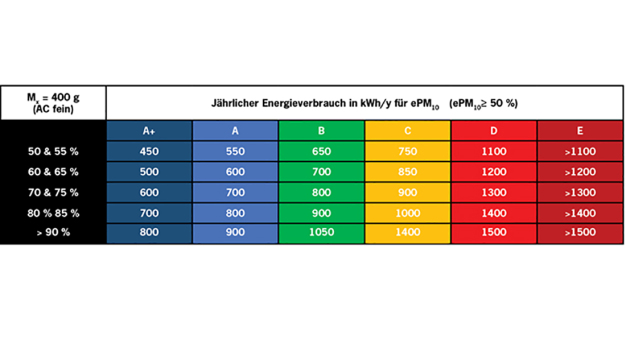
Energy classes of the filter class ePM10 (Table: EUROVENT Rating Standard REC 4/21-2018)
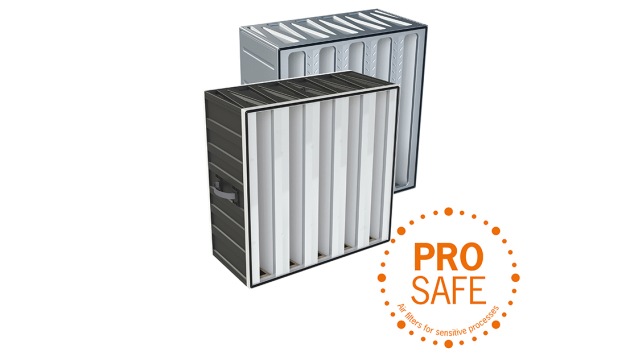
The Absolute V HEPA Filter Series – also known as ProSafe air filters for sensitive processes. (Image: Camfil)
To prevent biological contamination of the products to be manufactured and to ensure stable production processes, high indoor air quality is especially essential in the food industry. This protects not only the production processes and products but also the employees. Therefore, the Technical Buyer, Production Manager, or Facility Manager is repeatedly faced with choosing an optimal filter solution. To make "the agony of choosing air filters" easier, Camfil answers six questions that provide orientation and clarity for the target group on the (air) path to more hygienic food production.
Although fresh air is a fundamental requirement for vitality and health in people's private daily life, it can become a serious trap in the food industry: because the "enemy" of every beverage producer or meat, bakery, and confectionery manufacturer is "biological contamination" via fresh air supply. During a manufacturing process, microorganisms can enter the ambient air of production and cause contamination. To prevent sources of viruses and bacteria, hygienic air quality plays an important role alongside a careful selection of the necessary equipment, systems, and components for manufacturing. Bacteria, mold spores, yeasts, or viruses present in the air are potential causes of premature spoilage of goods and can also impair the health of employees.
If no efficient air filtration systems are installed, these microorganisms generally have access through the outside air and supply air to every production hall. Because the average outdoor air contains 200 to 1,500 bacteria per m³ of air. When these encounter heat, humidity, or accumulated organic substances in HVAC systems, their very rapid and multiple reproduction is inevitable. Possible consequences could include production outages, product recalls, additional costs for defect rectification and inspections, revenue losses, removal from shelves, and of course, damage to reputation. What is acceptable hygiene-wise for pharmaceutical or medical production areas should only be cheaper for the food industry. Only in this way can the high consumer demands for quality and shelf life of food be rightfully met. Therefore, food manufacturing companies place great importance on safe production.
Six Questions & Answers Against "the agony of choosing air filters"
To create adequate air quality for specific production processes under economically justifiable conditions, various aspects must be considered when selecting suitable filter classes and/or filter types, which are formulated in the following questions and answers:
1. What quality should/must the filtered air have?
To define the required air quality within a production process, standards can or must be used depending on the product group or industry. Examples include DIN EN ISO 14644 "Cleanrooms and associated controlled environments" and DIN EN ISO 14698 "Biocontamination control for cleanroom technology" or DIN EN 16798 for classifying the quality of room, supply, exhaust, and outdoor air in non-residential buildings (ventilation of non-residential buildings - performance requirements for ventilation and air conditioning systems and room cooling systems).
2. Which areas in my company require a filter system?
Not only the products themselves should be produced under defined hygienic standards with clean hall air, but also the personnel and equipment involved in production. While for employees, health and well-being aspects are paramount, in the machinery sector, uninterrupted operation times and low maintenance and cleaning effort are the focus. Camfil's experienced consultants also know the less obvious areas where filtered room air can significantly contribute to smoother and more efficient processes. For example, to effectively utilize the thermal energy of exhaust air from heated air outdoors, heat exchange concepts are used. The cleaner the outdoor and supply air as well as exhaust air, the less contamination of the heating and cooling coils inside, and the more effectively energy can be transferred.
3. What air quality for which location?
Answering this question is best done with the advice of a specialist. They know the optimal assignment of coarse dust, fine dust, suspended particles, or molecular filters based on the local requirements. Here are some guidelines from Camfil:
- The standard DIN EN ISO 16798-3 generally recommends a two-stage particle filtration, where the first stage uses filters of class ePM10 ≥ 50% to ePM1 or ePM2.5 ≥ 65%, and the second stage uses media of filter class ePM1 ≥ 50% to ePM1 ≥ 80%.
- In cities or areas with outdoor air quality ODA 2 or ODA 3 (ODA = Outdoor Air Quality) and an indoor air quality requirement between IDA 1 and IDA 2* (IDA = Indoor Air Quality), a molecular filter is used before at least a particle filter of classes ePM1 ≥ 70% to ≥ 80% to protect the molecular filter.
* IDA 1-4 = quality categories of indoor air according to DIN EN ISO 16789 from high (1) to low (4).
Planning an HVAC system also involves determining the ODA value. The ODA value considers outdoor air quality at the location in three categories from ODA 1 (good) to ODA 3 (poor) and has a direct influence on the air filters used in the HVAC system. The poorer the outdoor air quality and the higher the indoor air quality (IDA) should be, the more intensive the outdoor air must be filtered. Thus, the ODA value is an important factor in designing an HVAC system, as the filter quality used also affects the energy efficiency of the system. (see Table 1)
- To protect outdoor air, supply air, exhaust air, recirculated air, or exhaust air systems, at least filters of class ePM10 ≥ 50% should be used. However, Camfil recommends products of filter class ePM1 with at least ≥ 60% removal efficiency.
- The timing of filter replacement should be determined by the first reached limit value regarding actual operating hours, recommended installation period, or the final pressure difference, with VDI 6022 prescribing a time-based filter change: outdoor air filters after 12 months of use, supply air filters after 24 months, if the specified limits are not reached earlier.
- To prevent microbial growth, the relative humidity in all system parts, including the filters, should be kept as low as possible, ideally below 70%. Falling temperatures and humidity reduce the possibility of a habitable environment for microorganisms.
4. Why does comparing lifecycle costs of air filters make sense?
A product and type comparison with a critical look at the lifecycle costs (LCC) of an air treatment system generally offers significant savings potential. It is not uncommon to save more than 10,000 euros per system per year through this comparison. Each additional Pascal pressure difference across a filter stage in an HVAC system causes an additional €1.80 in energy costs, based on an energy cost of €0.18/kWh.
Because typically, only 15% of the operating costs of an air filter concern its purchase price, while 70% are spent solely on its energy consumption. The remaining 15% are costs for labor and disposal. Therefore, it is important to consider not only the purchase price but also the final differential pressure / initial differential pressure, as well as the service life and energy efficiency of an air filter when choosing.
- > What is the cost of the air filter upon purchase?
- > What filtration efficiency according to DIN EN ISO 16890 does the air filter achieve? (Fine dust classes PM1, PM2.5, and PM10)
- > How long is its regular operating time (service life) designed for? (According to VDI 6022: 12 months or 24 months)
- > How much energy does the air filter need to perform its filtration over the designed operating period?
5. Where can I get all this information to compare?
Until 2012, air filters were not always tested accordingly, making it impossible to compare different brands/types. With the introduction of EUROVENT, for objective classification of energy efficiency, it has become easier to find the right air filter with the lowest energy consumption while maintaining the best room air quality. All air filters are rated on a scale from A+ to E, where energy class A+ indicates the lowest and class E the highest energy consumption. The classification based on the EUROVENT Rating Standard REC 4/21-2018 allows a better understanding of annual energy consumption, defined across energy classes A+ to E.
6. What does Camfil specifically offer to the food industry?
Generally, the following industry-specific product standards are available from Camfil:
- Reduction of microbiological contamination through optimal filtration
- Food certification for process-related particle filters
- Compliance with EU Regulation (EC) No. 1935/2004 for all particle filters relevant to the food industry
- Air filters and filter housings meet HACCP risk level (Hazard Analysis and Critical Control Points)
- Traceability, identification, and labeling of filters
- Classification according to European standard DIN EN ISO 16890, modular and flexible filter solutions
- Easy and safe handling
- Fast and efficient maintenance
- Customized accessibility, for example for in-situ testing
- Corrosion resistance (stainless steel, plastics, polyester resin)
Especially with the Camfil ProSafe series, the name is program: it meets the highest requirements regarding safety, traceability, and control. "ProSafe" filters, specifically developed to guarantee process safety, are made from materials that also protect the most sensitive manufacturing processes optimally. While it is essential for users in the life sciences industry that filters are resistant to decontamination agents, the food industry requires components certified for contact with food according to European Regulation EC 1935/2004. Materials must be inert against microbiological growth according to DIN EN ISO 846 and VDI 6022, but also free from harmful chemical components such as Bisphenol A, formaldehyde, or phthalates.

Camfil GmbH
Feldstr. 26 - 32
23858 Reinfeld
Germany
Phone: +49 4533 2020
Fax: +49 4533 202202
email: info.de@camfil.com
Internet: http://www.camfil.com