

- Translated with AI
Jörg-Dieter Walz
Hans-Jürgen Warnecke Innovation Award 2012
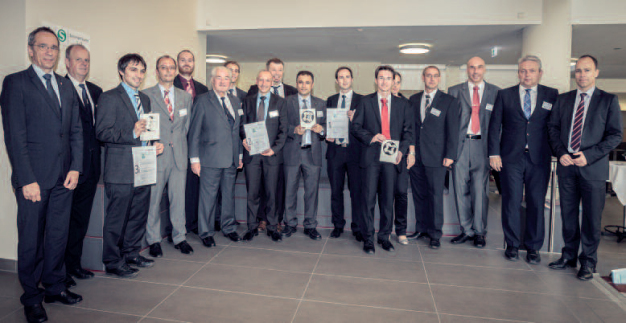
L to R: Dr. Wolfgang Rauh, Dr. Norbert Leopold, Jonathan Schächtele, Dr. Jochen Schließer, Armin Schäfer, Prof. Hans-Jürgen Warnecke, Dominik Kaltenbacher, Dr. Udo Gommel, Ivica Kolaric, Serhat Sahakalkan, Thomas Ackermann, Guido Kreck, Yvonne Holzapfel, Markus Rochowicz, Christoph Schaeffer, Prof. Alexander Verl, Prof. Thomas Bauernhansl.
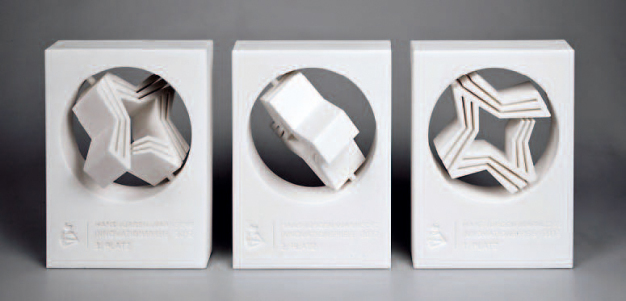
Hans-Jürgen Warnecke Innovation Award 2012
For the 20th time, the IPA Innovation Award 2012 was presented at the Innovation and Startup Day of the Fraunhofer IPA. The internal IPA award has been named this year after the former Fraunhofer President and IPA Institute Director Prof. Dr. mult. Hans-Jürgen Warnecke.
Only those who are innovative, who develop and implement new processes, products, and organizational forms, can succeed in the market. Innovations with groundbreaking potential secure the competitiveness and performance of companies and technological progress, and are important drivers for further development in research.
The Fraunhofer IPA plays a significant role in innovation activities. Establishing innovations through research and development projects and successfully positioning them with and for its customers is the core task of Fraunhofer IPA. To promote the process from idea generation to implementation and enforcement and to provide incentives, the IPA has been awarding three internal innovation prizes every year since 1993. Since this year, the Innovation Award is presented under the name and patronage of the former Fraunhofer President and IPA Institute Director, Prof. Dr. mult. Hans-Jürgen Warnecke, who personally awards the winners. The awards were presented on October 19, 2012, during the Innovation and Startup Day. Current highlights of research at Fraunhofer IPA were on the agenda, as well as best-practice examples for economic utilization, complemented by short presentations from the IPA specialist departments on new topics and innovation ideas.
The jury had six nominated and presented developments to choose from among the submitted applications. The institute directors, Prof. Dr.-Ing. Dr. h.c. Alexander Verl and Prof. Dr.-Ing. Thomas Bauernhansl, as well as external jurors Dr. Jochen Schließer, Festo AG & Co. KG, Dr. Wolfgang Rauh, VITA Zahnfabrik H. Rauter GmbH, and Dr. Norbert Leopold, HWP Planungsgesellschaft mbH, based their decision on criteria including "Customer Benefit," "Creativity," and "Methodological-Scientific Approach."
1st Prize: ECO Touch – Transparent Electrodes Based on Carbon
by Thomas Ackermann, Serhat Sahakalkan, Ivica Kolaric
Touch displays are now indispensable in everyday life, and their ease of use owes itself to the top layer of the display. One of these transparent conductive layers (TCF) is indium tin oxide (ITO). It is frequently used because it best fulfills the required properties of electrical conductivity and high optical transparency. Disadvantages of this material include its difficult procurement, material cost, and brittleness. Alternative materials are being developed by Fraunhofer IPA. They produce inks from graphene and carbon nanotubes (CNTs), which impress with high electrical conductivity and flexibility, making them ideal for innovative displays.
2nd Prize - Clean Room Technology for "Planetary Protection" for the European Space Agency ESA
by Udo Gommel, Yvonne Holzapfel, Markus Keller, Guido Kreck, Markus Rochowicz
Anyone who wants to take samples on a distant planet must implement space-specific purity measures. Otherwise, they risk bringing back what they believe to have discovered, from Earth. To protect against such planetary contamination and to prevent earth contamination after return, researchers at Fraunhofer IPA developed an innovative assessment system for purity technology. This system selected suitable purity measures, including an appropriate cleaning and logistics concept, which required the realization of an adequate, clean manufacturing environment. Initiated by ESA, the insights developed in the project are being incorporated into a universal standard for product and quality assurance of the "European Cooperation for Space Standardization" (ECSS).
3rd Prize - Round Window Implant – Sound Transducer for Implantable Hearing Devices
by Armin Schäfer, Jonathan Schächele, Dominik Kaltenbacher
Fraunhofer IPA developed a sound transducer for an implantable hearing device that does not require the usual multi-hour, non-risky operation for implantation. Instead, only a short outpatient procedure is needed to insert the piezoelectric microactuator. The microactuator, with a diameter of only 1.7 mm, operates on the principle of a bending actuator. A layered composite of piezoceramic and silicon causes a bending movement when an electric voltage is applied. The microactuator serves as a speaker for a novel round window implant, providing higher audiological amplification and improved sound quality.
The three other equally exciting projects nominated and presented for the Hans-Jürgen Warnecke Innovation Award 2012 came from the fields of bioproduction, robotics, and coating technology:
"Autranomics – Automated Transgenomics"
Deciphering Gene Functions – Fully Automated Cultivation, Analysis, and Sorting of Cells
by Alexej Domnich, Roland Huchler/Innocyte, Michael Fritsche/Innocyte, Sebastian Schöning, Klaus Fischer, Sandra Knoch, Timo Cuntz, Rolf Wössner
In a cooperative project between Fraunhofer and the Max Planck Society, an "Autranomics" system was developed for automated cultivation and handling of cells. This enhances the research of protein functions in the human body. The fully automated system can deliver reproducible, standardized, and high-quality results in a short time. This enables a better understanding of complex genetic diseases such as cancer or Parkinson's and facilitates the development of new therapies.
"Thinking Wheels" – Intelligent Wheel Modules for Omnidirectional Drive Systems
by Theo Jacobs, Christian Connette
Researchers at Fraunhofer IPA have developed a novel, modular wheel and steering system for mobile robots. The result is intelligent and autonomous wheel modules. This allows for more flexible, human- and environment-adapted movements with conventional wheels. The combination of wheel modules and decentralized control enables mobile service robots or driverless transport systems to freely combine movements such as spinning in place and forward or sideways driving. Additionally, modularization increases the share of identical parts, significantly reducing costs compared to current robot solutions.
Model-Based Paint Film Control
by Christian Hager, Matthias Schneider, Ulrich Strohbeck, Oliver Tiedje
Scientists from Fraunhofer IPA and the Graduate School of Excellence in Advanced Manufacturing Engineering (GSaME) at the University of Stuttgart developed a novel computational model to simulate and control the formation of paint film structures on a computer. With this model, high-quality and uniformly defined painted products can be achieved by utilizing various process influences such as spraying process, environmental conditions, and material properties through calculations.
Fraunhofer-Institut für Produktionstechnik und Automatisierung IPA
70569 Stuttgart
Germany