



- R+D & Community of Interest
- Translated with AI
German-Dutch Field Lab launched
Optimize production with AI and digital twins
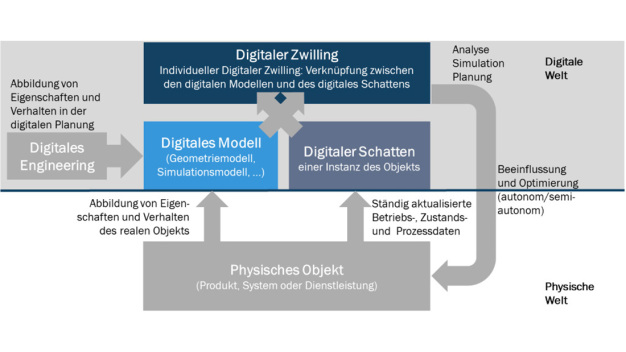
Digital Model, Digital Shadow, Digital Twin. © ESB Business School, Reutlingen University
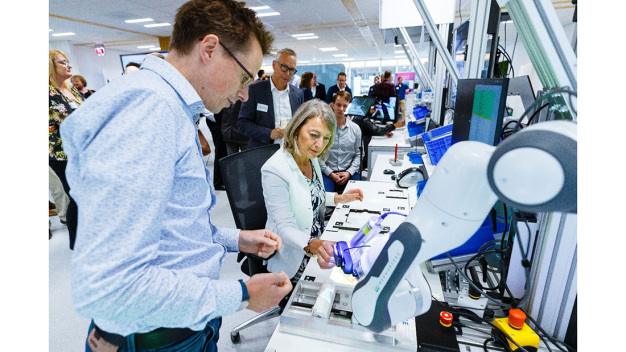
Brainport Industries Campus – Flexible Manufacturing. © Brainport Industries
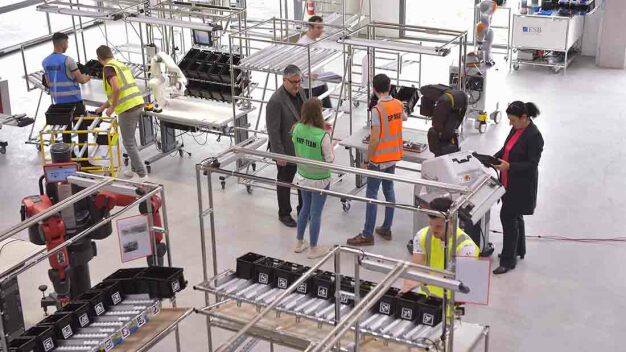
Werk150 – the factory at the campus of Reutlingen University. © ESB Business School, Reutlingen University
The start button for the Germany-Netherlands Fieldlab "Artificial Intelligence for Digital Twins" (AI4DT) was jointly pressed by State Secretary Katrin Schütz, Ministry of Economic Affairs, and Martijn van Gruijthuijsen, Minister of Economic Affairs of the Dutch province of North Brabant. The networking of two strong European regions aims to promote the exchange and application of artificial intelligence (AI), especially among SMEs.
Information technology optimizes production. To realize more flexible and efficient manufacturing processes, it is not enough to digitally record production and communicate its states digitally. For this, "artificial intelligence" (AI) is needed, which draws conclusions from data, derives action recommendations or generates instructions, and can even implement them autonomously. For their application in the context of Industry 4.0, data models are being developed through which the necessary information can be mapped and provided, for example as a "digital twin".
"A digital twin represents the connection between the real and digital worlds. It is a digital replica of real machines, products, or systems such as factories or organizations, with their properties, state, and behavior. A digital twin can be used for faster detection of system states, forecasting future behavior, and more efficient planning. Machine learning and artificial intelligence play a major role in planning, helping to make the right decisions," explains Professor Daniel Palm, project leader of the first Germany-Netherlands Fieldlab and head of the Reutlingen Center for Industry 4.0. "Digital twins are the key technology of the future for unlocking the potentials of digitalization in companies," emphasizes Peter van Harten, special envoy of the Dutch Smart Industry Program and one of the initiators of the project.
Opportunities and Challenges for SMEs
The potentials within companies and in the value chains are enormous. However, especially small and medium-sized enterprises (SMEs) face significant challenges in the conception, application, and use of digital twins and artificial intelligence. The questions and uncertainties concern business models, technologies, security aspects, software, integration, employee skills, and access to objective information or benefit assessments. These aspects complicate the implementation of important information technology procedures in operations.
Developing Industrial Solutions Together in Fieldlabs
With the establishment of a joint Dutch-German Fieldlab "Artificial Intelligence for Digital Twins (AI4DT)", an initial step is to be taken to address these challenges. Fieldlabs are environments where companies and research institutions can develop, test, and implement intelligent industrial solutions. They are real and virtual locations where experts and learners come together to work on practical applications of solutions. They connect research and education with public institutions and businesses.
Events on the Cooperation Platform – Demonstrators in Eindhoven and Reutlingen
The AI4DT network consists of companies, experts, and technology providers who meet regularly at joint events, share information, and exchange experiences. A permanent B2B cooperation platform at www.ai4dt.com supports B2B matchmaking activities and virtual events. Additionally, solutions can be demonstrated and visually conveyed at the physical locations within the project, the Brainport Industry Campus Eindhoven and Werk150 – the factory at the Reutlingen University campus.
Alliance of Politics, Research, and Industry
The establishment and operation of the AI4DT network are supported by the Ministry of Economic Affairs, Labor, and Housing of the state of Baden-Württemberg and the Dutch province of North Brabant, as well as the Fraunhofer Institute for Production Technology and Automation IPA, the Steinbeis Innovation Center, regional networks such as Dutch Smart Industries, the Industry 4.0 Alliance from Baden-Württemberg, and consulting firms like the Steinbeis Europe Center. The focus of the initiative is on cross-border networking of companies and research institutions from both regions, supporting the economy in market development and transferring knowledge into practical application.
"Connecting two of Europe's most innovative regions allows us to better harness the potentials of digital twins and artificial intelligence through joint efforts. Networking companies and innovation partners from Baden-Württemberg and Brabant opens up numerous opportunities for our economy," explains Katrin Schütz, State Secretary in the Ministry of Economic Affairs, Labor, and Housing of Baden-Württemberg, regarding cross-border activities. Martijn van Gruijthuijsen, Regional Minister for Economic Affairs, Education, and Skills Development of the Dutch province of North Brabant, adds: "There are many highly successful value creation partnerships between the two regions. The successful partnership in manufacturing equipment in the extreme ultraviolet (EUV) range between ASML – the Dutch provider of lithography systems, Trumpf, and Zeiss is just the most well-known. Trumpf supplies the lasers, Zeiss the optics for ASML's EUV systems. We need more such success stories – especially in the SME sector."

Fraunhofer-Institut für Produktionstechnik und Automatisierung IPA
Nobelstraße 12
70569 Stuttgart
Germany
Phone: +49 711 970 1667
email: joerg-dieter.walz@ipa.fraunhofer.de
Internet: http://www.ipa.fraunhofer.de