- Knowledge & Events
- Translated with AI
Anneke Bosch, Ines Heudorfer, Stephanie Saier
German cleanroom – industries, data, facts
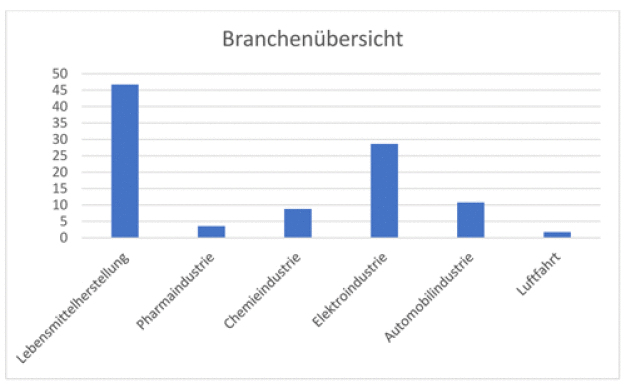
Figure 1
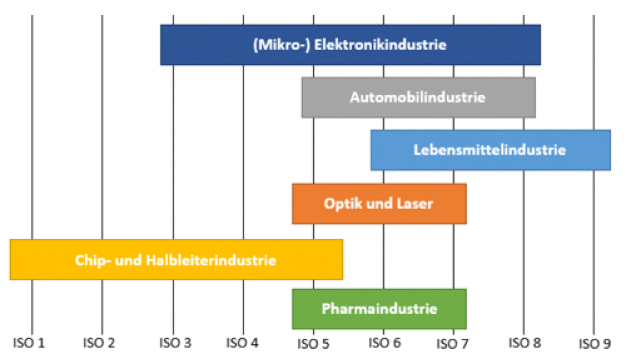
Figure 2
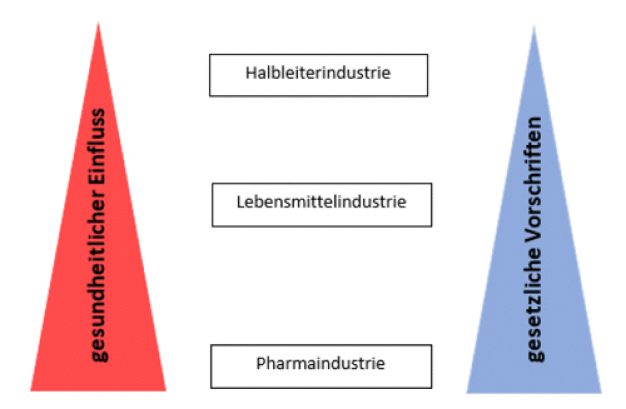
Figure 3
The Project Work
Three female students from Albstadt-Sigmaringen University worked on the topic “German Cleanroom – Industries, Data, Facts” as part of a project. Primarily, the goal was to present the current situation on the German cleanroom market. The topic was proposed by the German Cleanroom Institute e.V.
The students gathered all necessary information through questionnaires and interviews with companies in the cleanroom industry and presented their findings at Cleanzone 2017.
The companies surveyed by the students included cleanroom manufacturers, machinery producers, laundries, manufacturers of cleanroom equipment and clothing, and service providers, including cleaning companies. There were some difficulties, as they did not receive the expected results because many companies, for various reasons, could not or did not want to disclose their data.
The Results
Industries
The following diagram (Figure 1) provides an overview of which industries rely on cleanrooms. It also shows the distribution of potential cleanroom users. The food and electronics industries offer significant potential here.
This diagram (Figure 2) illustrates which industries use which cleanroom classes. The most commonly used classes are primarily ISO 5 to ISO 7. These are used across almost all industries.
Current State
Today, you mainly find cleanrooms of ISO classes 3-8. Classes 1 and 2 are almost exclusively small glove boxes, as the operating costs are very high and human influence is difficult to compensate for. Many factors influence the price of a cleanroom, including class, size, and equipment. The construction costs for 1 cubic meter of an ISO class 7 cleanroom can be around €5,000. Besides these costs, operating a cleanroom is also expensive because consumables of appropriate quality are needed continuously. On average, a cleanroom is operated for about 25 years before being replaced by a new one. Renovation of old cleanrooms is relatively rare, as it often incurs higher costs.
Looking at the legal situation in Germany, clear differences become apparent. While the pharmaceutical industry precisely specifies the environmental conditions under which production should take place, the food industry almost exclusively has requirements regarding the quality of the final product. In contrast, the chip and semiconductor industries do not have legal requirements. One reason for this is certainly the varying impact on human health. As shown in the diagram (Figure 3), legal requirements increase the greater the health impact on humans. If there are no regulations, manufacturers must rely on experiential values.
Development
The trend is moving towards Industry 4.0, meaning the cleanroom of tomorrow will be digital and smart. This includes automation and robotics as well as the networking of measuring devices and the data collected. Automation minimizes human contamination of the cleanroom. Furthermore, it will become increasingly important to adapt the cleanroom flexibly to new productions, quickly integrate new machines, and design production facilities according to current needs. Due to rising cost pressures, increasing energy efficiency is being prioritized. The focus is on energy-saving technology and energy recovery to keep operating costs low. Although cleanrooms are highly efficient, the costs are relatively high, especially for large cleanroom areas. Therefore, the trend is to keep cleanrooms as small as possible to reduce technical effort and save costs. The smaller the cleanroom, the lower the contamination risk and the investment and operating costs. So-called “Mini-Environments” or “FlowBoxes”—small, enclosed, sometimes modular or even mobile cleanroom units—are designed to meet this trend.
The importance of cleanrooms in the food, automotive, optics, and microelectronics sectors is increasing. In the food sector, higher quality requirements are emerging, along with a desire for gentle manufacturing processes and minimal or no use of preservatives. Cleanroom technology allows manufacturers to omit preservatives while still achieving shelf life. In the automotive, optics, and microelectronics sectors, cleanroom technology can significantly reduce rejection rates caused by contamination such as particle deposits, thereby saving costs. In the pharmaceutical and medical sectors, the importance of cleanrooms remains unchanged, as they are still widely used.
Outlook
Overall, it becomes clear that the role of the cleanroom continues to grow in importance. However, many new technical requirements are being placed on cleanrooms. Germany must and can become a pioneer in developing new and more efficient technologies. There is also significant potential in the sector of cleanroom cleaning. In the near future, many changes and requirements will face the cleanroom industry, which will need to be managed.

Hochschule Albstadt-Sigmaringen
Fakultät Life Sciences
Anton-Günther-Str. 51
72488 Sigmaringen
Germany
Phone: +49 7571 7328242
Fax: +49 7571 7328235
email: schmida@hs-albsig.de
Internet: http://www.hs-albsig.de/Seiten/homepage.aspx