


- Translated with AI
From the Microcosm to the Atomic World
At TU Berlin, there is one of the largest centers for electron microscopy in Germany. The ZELMI has been in operation for 40 years – Commemorative colloquium on November 21, 2018
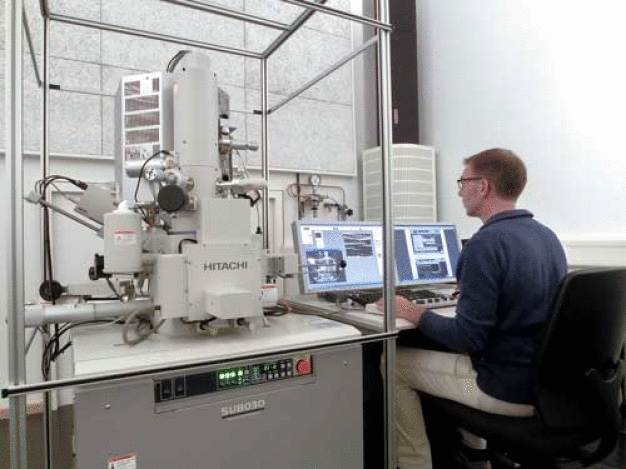
High-resolution scanning electron microscope (© TU Berlin/ZELMI)
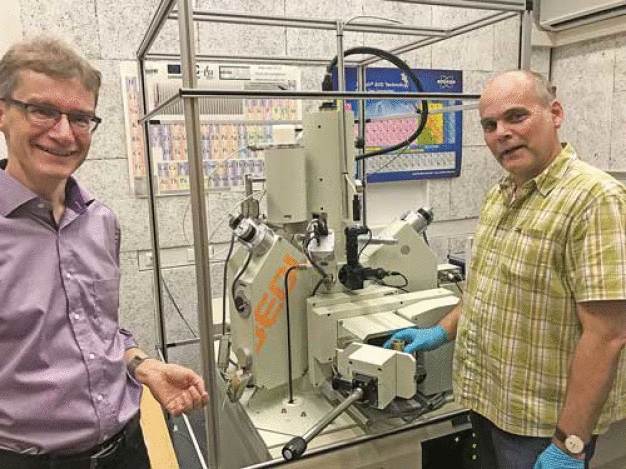
ZELMI Director Dr.-Ing. Dirk Berger (l.) and Dipl.-Ing. Jörg Nissen prepare a measurement on the field emission electron microprobe. The surrounding magnetic field frame prevents disturbances that could deflect the electron beam and distort the results. (© TU Berlin/PR/Patricia Pätzold)
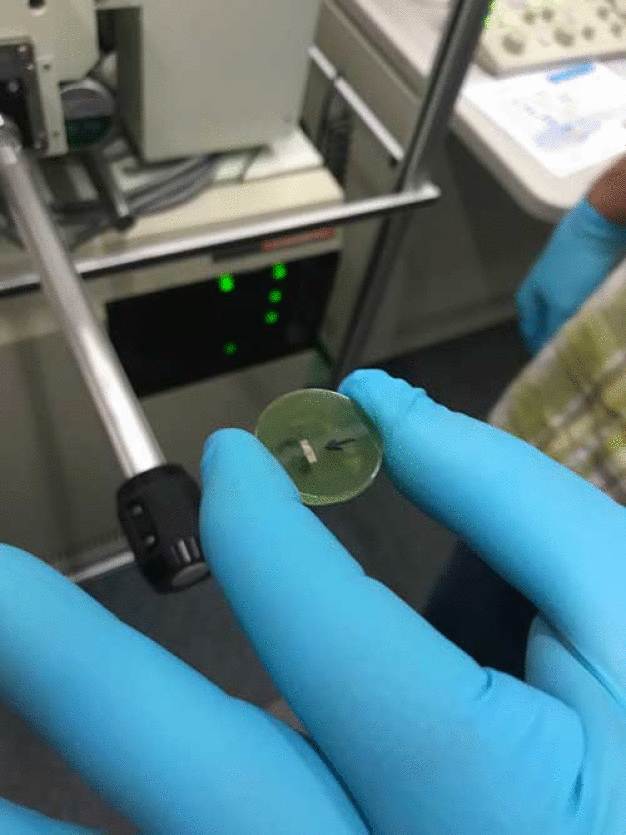
Probe for the Electron Beam Microprobe 2 (© TU Berlin/PR/Patricia Pätzold)
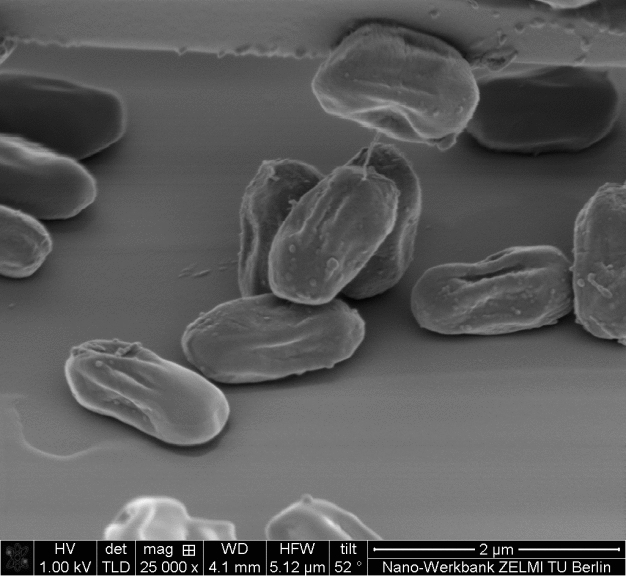
Synaptic cells under the raster electron microscope (© TU Berlin/ZELMI)
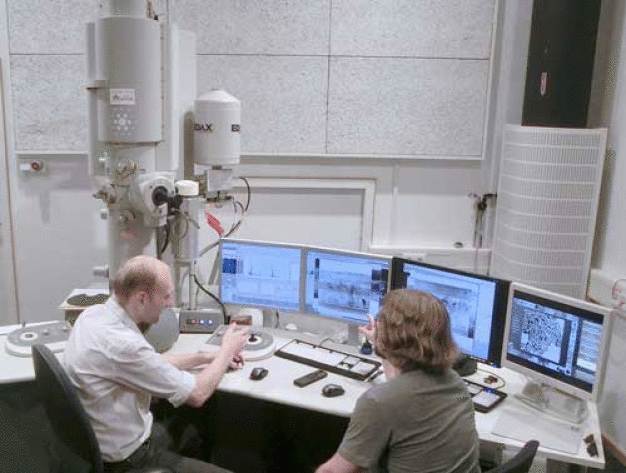
Transmission Electron Microscope (© TU Berlin/ZELMI)
In the summer of 2018, the collapse of a four-lane highway bridge in Genoa claimed the lives of dozens of people. Water, it was suspected, could have penetrated the concrete coating of the reinforcement and led to corrosion. A material problem. But how do experienced construction material researchers, who want to prevent such disasters in the future, learn details about the properties of building materials and their damage behavior? To chemically and mineralogically characterize materials, researchers at TU Berlin use, for example, one of the ten million-euro electron microscopes in ZELMI, the Central Facility for Electron Microscopy of the university, which celebrated its 40th anniversary.
Ernst Ruska built the first electron microscope in 1931 at the TH Berlin, the predecessor institution of TU Berlin, and received the Nobel Prize for it in 1986. Today, internal and external research areas—from chemistry and materials science to tool and semiconductor technology at the nanometer scale—use the modern equipment of ZELMI. It is one of the largest centers for electron microscopy in Germany, with equipment averaging only five years of age. Its offerings range from scanning electron microscopy, electron beam microanalysis, transmission electron microscopy, light microscopy, to extensive preparation procedures from metallography to processing with focused ion beams. The permanent staff at ZELMI ensures the optimal use of the equipment and the transfer of know-how. One of the decisive turning points in the development of ZELMI toward its current significance was the acquisition of the TEM (transmission electron microscope), which allows resolution at the level of atomic lattice planes. It was financed through funds from the TU Excellence Cluster “UniCat,” which is engaged in catalysis research. Many other research areas that utilize ZELMI’s services have now invested their own funds. ZELMI also offers its services to other universities or external institutions. This results in between 5,000 and 8,000 user hours annually.
Technische Universität Berlin
10587 Berlin
Germany