

- Translated with AI
From light doping for vegetables to water treatment
The UV LEDs developed at TU Berlin are "multi-tasking"
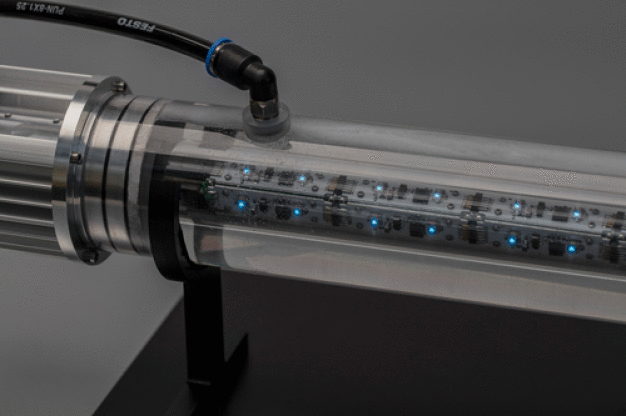
UV LEDs are robust – they are therefore ideally suited for mobile water purification. (© FBH/schurian.com)
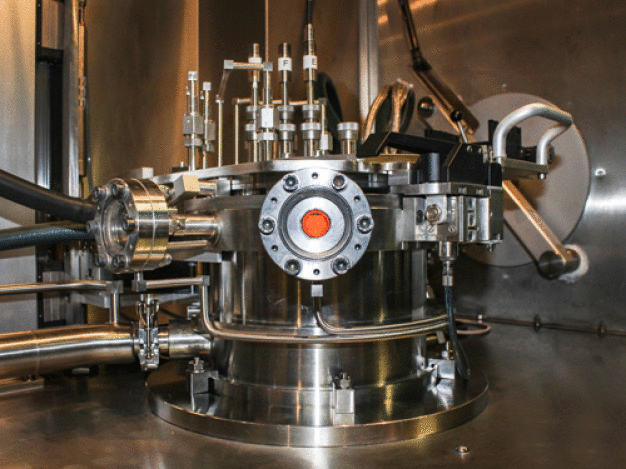
Approximately 1.8 million euros costs a modern gas-phase epitaxy system used for the production of UV LEDs. (© TU Berlin/P. Gupta)
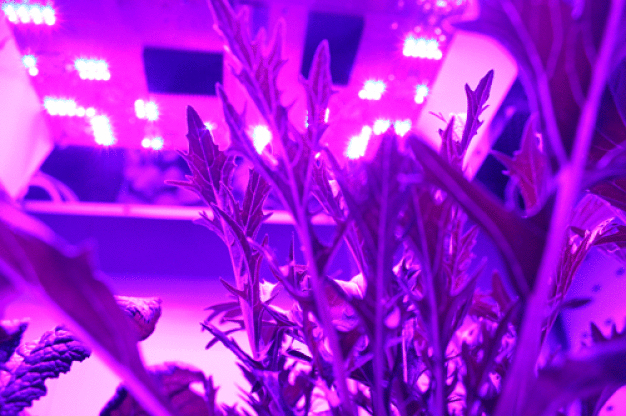
Special UV-LEDs are used in vegetable cultivation. They stimulate the plants to produce especially many valuable secondary plant compounds. (© Melanie Wiesner-Reinhold, IGZ)
Multiresistant hospital germs worry the medical world: they seem to be spreading almost everywhere. Especially in hospitals, the control of disinfection is becoming increasingly important. To do this, swabs are regularly taken from disinfected objects. Potentially attached germs are then detached and cultivated on a nutrient medium. If something grows on the medium, germs were present despite cleaning; if nothing grows, disinfection was successful. Problem: this method takes several hours or even days.
"Four-fifths of these samples are germ-free – but which ones, that is the question," says Prof. Dr. Michael Kneissl, head of the Department of Experimental Nanophysics and Photonics at TU Berlin.
“When the surface of such samples is irradiated with UV-LEDs of different wavelengths, certain biomolecules in the germs are stimulated to fluoresce. This allows a potential germ load to be detected. And not only that: many multiresistant germs have characteristic fluorescence spectra, so in the future, these could be recognized directly as such,” explains Michael Kneissl, who is also deputy spokesperson of the “Advanced UV for Life” consortium. The consortium, equipped with around 45 million euros from the Federal Ministry of Education and Research (BMBF), now with 49 partners, is testing innovative applications for UV-LEDs in 26 ongoing projects. And there are many. The UV-LEDs used are mostly sourced from the laboratories of TU Berlin and the Ferdinand-Braun-Institute, which have been collaborating in their joint lab “GaN Optoelectronics” for over a decade. Depending on the wavelength, the application possibilities of UV-LEDs are extremely diverse and economically highly interesting: besides disinfection, potential fields include medicine, water treatment, gas sensing, lithography, and light applications in plant cultivation.
UV-LEDs for water disinfection
LEDs, or light-emitting diodes, are known as successors to the incandescent bulb. Ultimately, LEDs are light-emitting semiconductor components that generate light from electrical current. Depending on the semiconductor material used, these LEDs can also emit light in the non-visible range, such as UV light. The semiconductor material used is an alloy of aluminum, gallium, and nitrogen. These semiconductors can cover almost the entire ultraviolet spectrum (210 nm – 400 nm), depending on the manufacturing process.
“A particularly interesting application of UV-LEDs is water treatment,” says Michael Kneissl. UV light with wavelengths of 250 nm – 280 nm has the property of cross-linking neighboring nucleobases in DNA. When water is irradiated with this UV light at high intensity, the germs present in it can no longer reproduce and die off. “Basically, this method is ideal for areas without a functioning water supply or, for example, in disaster zones,” explains Michael Kneissl. Traditionally, the UV light required for this is produced by mercury vapor lamps – with the well-known disadvantages of these lamps: manufacturing and disposal are complex, mercury is toxic, they are sensitive, and have a short lifespan. For use at the so-called “point of use” – that is, applications immediately before consumption, such as in developing countries or disaster areas – these lamps are hardly suitable. “UV-LEDs, on the other hand, are very robust, non-toxic, switchable, and can be operated with solar power or batteries as semiconductor devices – making them ideal for mobile applications,” says Michael Kneissl.
1.8 million euros for new gas-phase epitaxy system
In the research and development of short-wavelength UV-LEDs with sufficient efficiency and performance, Michael Kneissl and his team are considered leaders in Europe. “To further advance this research, the Federal Ministry of Education and Research is now funding an additional, approximately 1.8 million euro device for metal-organic vapor phase epitaxy (MOVPE) at TU Berlin,” the scientist is pleased to report. “Epitaxy processes are used to produce extremely thin, crystalline layers, as required in semiconductor manufacturing. To produce these special LEDs, thousands of defined, atomically thin layers must be deposited onto the substrate. The structure of these layers ultimately determines how effectively the input electrical current is converted into UV light by the semiconductor. Depending on the desired wavelength, different layers are built up. The new system allows for much faster and more efficient production and testing of components for UV-LEDs,” describes Michael Kneissl the highly complex manufacturing process of the LEDs. “In our latest publication in Nature Photonics, we show that the overall efficiency of UV-LEDs is a product of various partial efficiencies. We know the individual parameters and are working to optimize them. In the lab, we already achieve efficiencies comparable to conventional UV lamps,” says the physicist.
Light doping in vegetable cultivation
The diverse potential applications of UV-LEDs have also led the team at the Leibniz Institute for Vegetable and Ornamental Crops to focus intensively on healthy nutrition in the form of so-called functional foods (foods with specific health-promoting ingredients). Using a process that can be described as light doping, leafy vegetables are irradiated with low-dose UV light between 290 nm and 350 nm. This regulatory UVB irradiation specifically stimulates the secondary metabolism of the plants. In response, they synthesize increased amounts of certain secondary plant compounds, which are also considered very healthy for humans. “The Leibniz Institute for Vegetable and Ornamental Crops and the Ferdinand-Braun-Institute are working together to develop UV-LED modules that deliver the optimal UV spectrum for this purpose. The goal is a surface emitter that can be used in a greenhouse to precisely dose plants with a defined wavelength,” explains Michael Kneissl.
Technische Universität Berlin
10587 Berlin
Germany