



- Science
- Translated with AI
Fraunhofer IPA develops sterile connection element for cancer therapy
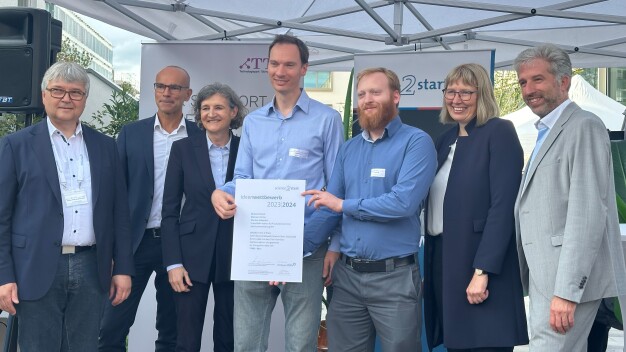
V. l. n. r.: Dr. Klaus Eichenberg, Dr. Christian Lindemann, Dr. Viola Bronsema, Michael Pfeifer, Richard Rösch, Dr. Ulrike Brucklacher, Mayor Boris Palmer. © BioRegio STERN Management GmbH/Photo: KD Busch
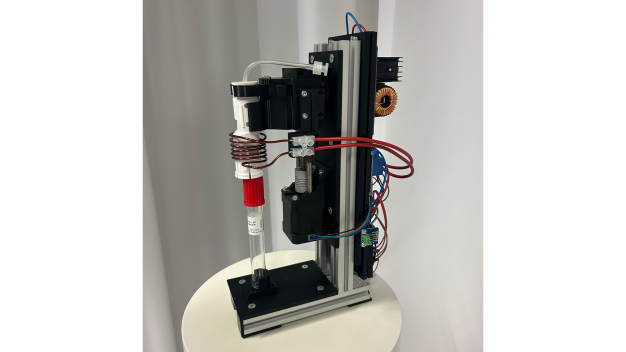
Prototype of the sterile single connector © Fraunhofer IPA
Current approaches to cancer therapy rely on modifying the body's own cells to trigger selective immune responses against cancer cells after reintroduction into the patient. Researchers at Fraunhofer IPA have developed a sterile connection element that could simplify the manufacturing process of modern medical therapeutics.
CAR-T cell therapy is a form of cancer treatment in which cells are taken from the patient and genetically modified so that they can recognize and specifically attack proteins on the surface of cancer cells. The most important step in producing active ingredients for this procedure is called liquid handling. During this complex process, various consumables and stimulation reagents are added to the body's own cells for modification. Protection against contamination is of the highest priority, which is why production has so far had to take place under elaborate cleanroom conditions. Building and maintaining such cleanrooms, however, involves enormous costs. Liquid handling between closed systems would significantly reduce the requirements for the production environment and thus costs.
Automated liquid handling with sterilization connector
But what is the difference between an open and a closed system? The consumables and stimulation reagents needed for cell modification are filled in large quantities into so-called vials. These are small containers for safe storage, sealed with a septum. The septum is pierced with a cannula to extract the liquid. Because germs from the environment, such as from the air or the septum surface, can be introduced into the vial via the cannula, this process is considered open. In a closed system, there is no contact with the environment or potential pathogens during the piercing and sampling process, so sampling can be performed under sterile conditions even outside a cleanroom. Currently, no automation-ready solution exists for sterile piercing under non-cleanroom conditions.
At Fraunhofer IPA, the three scientists Michael Pfeifer, Markus Schandar, and Richard Röschen have developed a sterile connection element that enables automated liquid handling within a closed system. The approach consists of a connection device and a needle-shaped consumable element, which is sterilized by heat and then pierced into the septum of the vial. The connection device supplies the necessary energy via an induction coil to heat a sterile, partially sheathed, conductive needle, whose opening is released toward the vial at the moment of piercing. With this idea of a sterile single connector, one of the most critical questions in the production of modern medical therapeutics could be addressed. As part of research projects, the basic type of the sterilization connector was built as a functional demonstrator and its function demonstrated. This proved fundamental feasibility. Biological validation is still pending.
Awarded at the Science2Start Ideas Competition 2024
The three IPA scientists secured third place in this year's Science2Start Ideas Competition with their concept. BioRegio STERN invites young scientists and entrepreneurs from the life sciences annually to submit their ideas. This year, four prizes were awarded in a ceremony.

Fraunhofer-Institut für Produktionstechnik und Automatisierung IPA
Nobelstraße 12
70569 Stuttgart
Germany
Phone: +49 711 970 1667
email: joerg-dieter.walz@ipa.fraunhofer.de
Internet: http://www.ipa.fraunhofer.de